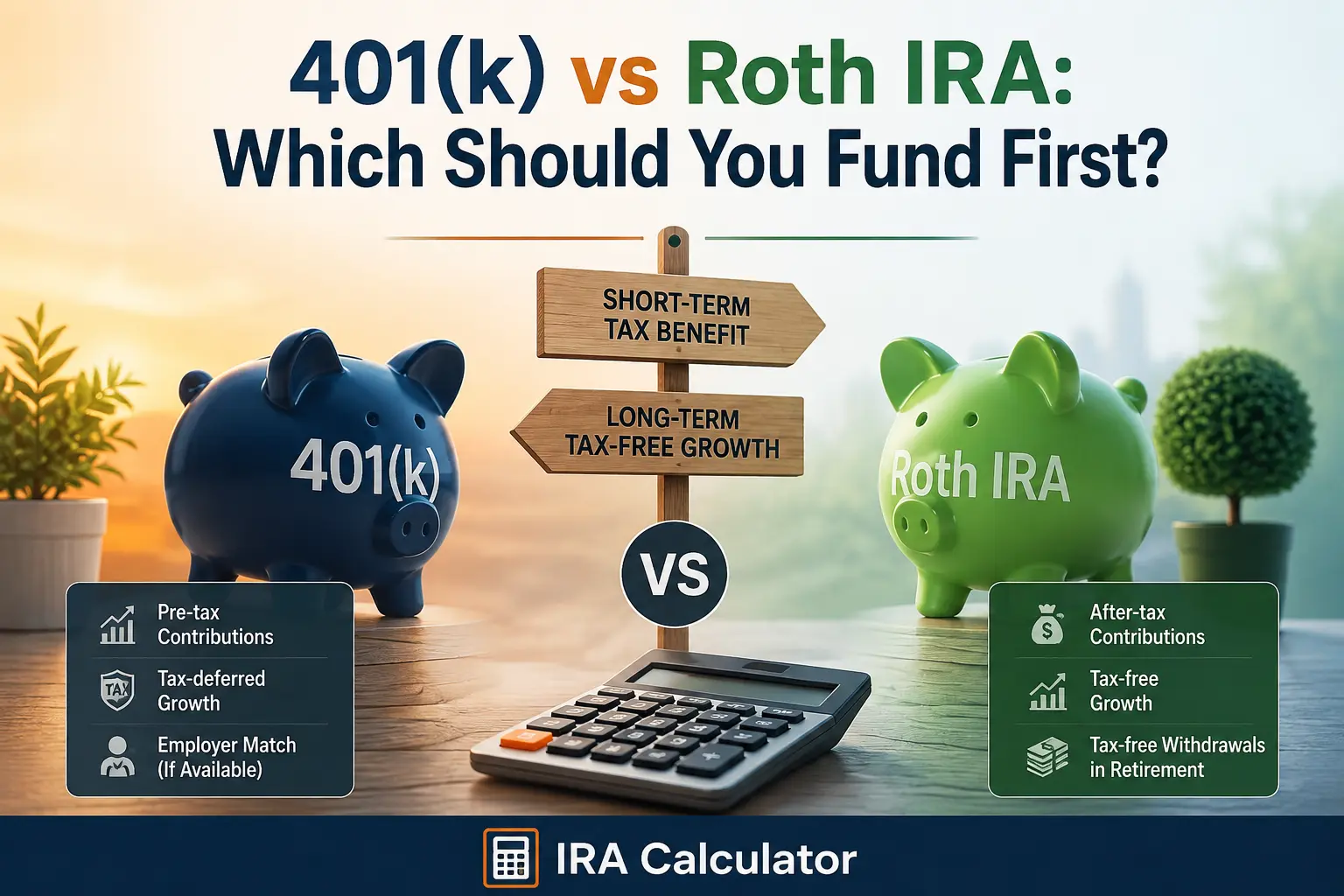
The 401(k) and Roth IRA are the two most important retirement accounts available to US workers. Both offer tax advantages — but the timing of the tax benefit is reversed. Understanding which to prioritize, and why, can add hundreds of thousands of dollars to your final retirement balance.
The one thing that matters: when you pay tax
| 401(k) (traditional) | Roth IRA | |
|---|---|---|
| Tax on contribution | No (pre-tax deduction now) | Yes (after-tax dollars) |
| Tax on growth | No (deferred) | No |
| Tax on withdrawal | Yes (ordinary income tax) | No (tax-free after age 59½) |
| Employer match | Yes (3–6% typical) | No |
| 2026 contribution limit | $23,500 | $7,000 (under 50) |
| Total limit including match | $69,000 | $7,000 |
The expert-recommended order of operations
- 401(k) up to the employer match — this is free money. If your employer matches 50 cents on every dollar up to 6%, that's an immediate 50% return on your contribution. Never leave it unclaimed.
- Max your Roth IRA ($7,000 in 2026) — after-tax contributions grow and are withdrawn completely tax-free. No RMDs. More investment flexibility than most 401(k) plans.
- Back to the 401(k) — if you still have room above the Roth IRA max, return to the 401(k) for the additional pre-tax deduction and the higher contribution limit.
- HSA (if eligible) — triple tax advantage: pre-tax in, tax-free growth, tax-free out for medical expenses. Often overlooked but extremely powerful.
- Taxable brokerage — after all tax-advantaged space is exhausted, a regular investment account with no contribution limit or tax benefit.
Worked example: $65,000 salary, employer 4% match
| Step | Action | Annual amount | Tax impact |
|---|---|---|---|
| 1 | 401(k) to match (4%) | $2,600 | Pre-tax, plus $2,600 employer match = $5,200 total saved |
| 2 | Roth IRA max | $7,000 | After-tax, but grows and withdraws tax-free |
| 3 | Additional 401(k) | $8,000 | Pre-tax — reduces taxable income |
| Total saved | $17,600 + $2,600 match = $20,200 |
When traditional 401(k) wins
- You're in the 24%+ federal tax bracket now — reducing current taxable income is immediately valuable.
- You expect lower income in retirement (moving to a no-income-tax state, for example).
- You want the higher contribution limit ($23,500 vs $7,000 for a Roth IRA).
When Roth IRA wins
- You're 22–35 years old in a 12–22% federal bracket — decadelong tax-free growth dominates the later deduction.
- You want no required minimum distributions in retirement.
- You want flexibility: Roth contributions (not earnings) can be withdrawn penalty-free before age 59½ if needed.
- You expect Social Security plus other income sources to keep you in a moderate bracket even in retirement.
The income limit problem for high earners
Roth IRA eligibility phases out at higher incomes. In 2026:
- Single filers: full Roth IRA allowed below ~$146,000 MAGI; phased out between $146,000–$161,000; not allowed above ~$161,000.
- Married filing jointly: full Roth below ~$230,000; phased out to ~$240,000.
If your income exceeds the limit, the workaround is a backdoor Roth IRA: contribute to a traditional (non-deductible) IRA, then convert it to a Roth. Consult a tax professional before doing this — the pro-rata rule applies if you have existing traditional IRA balances.
Frequently asked questions
What's the main difference between a 401(k) and Roth IRA?
A 401(k) uses pre-tax dollars (tax deduction now, taxed when you withdraw in retirement). A Roth IRA uses after-tax dollars (no deduction now, completely tax-free withdrawal in retirement). The 401(k) also has an employer match; the Roth IRA has no match but more investment choice.
Should I do 401(k) or Roth IRA first?
Contribute to your 401(k) up to the employer match first — that's free money (an immediate 50–100% return). Then max your Roth IRA ($7,000/year) for tax-free growth and no RMDs. After that, return to additional 401(k) contributions if you have more to save.
What are the 2026 contribution limits?
401(k): $23,500 employee elective deferral; $69,000 total including employer match. Roth IRA: $7,000 under 50; $8,000 if 50 or older. Roth eligibility phases out for single filers between ~$146,000–$161,000 MAGI.
What if my employer offers a Roth 401(k)?
A Roth 401(k) combines the higher contribution limit with Roth tax treatment (post-tax now, tax-free later). If you expect a similar or higher tax bracket in retirement, prefer Roth 401(k) over traditional. If you expect a lower bracket, prefer traditional and take the deduction now.
Disclaimer: This article is for educational purposes only and does not constitute tax or financial advice. Contribution limits and income thresholds change annually. Consult a qualified tax professional or financial advisor before making retirement account decisions.