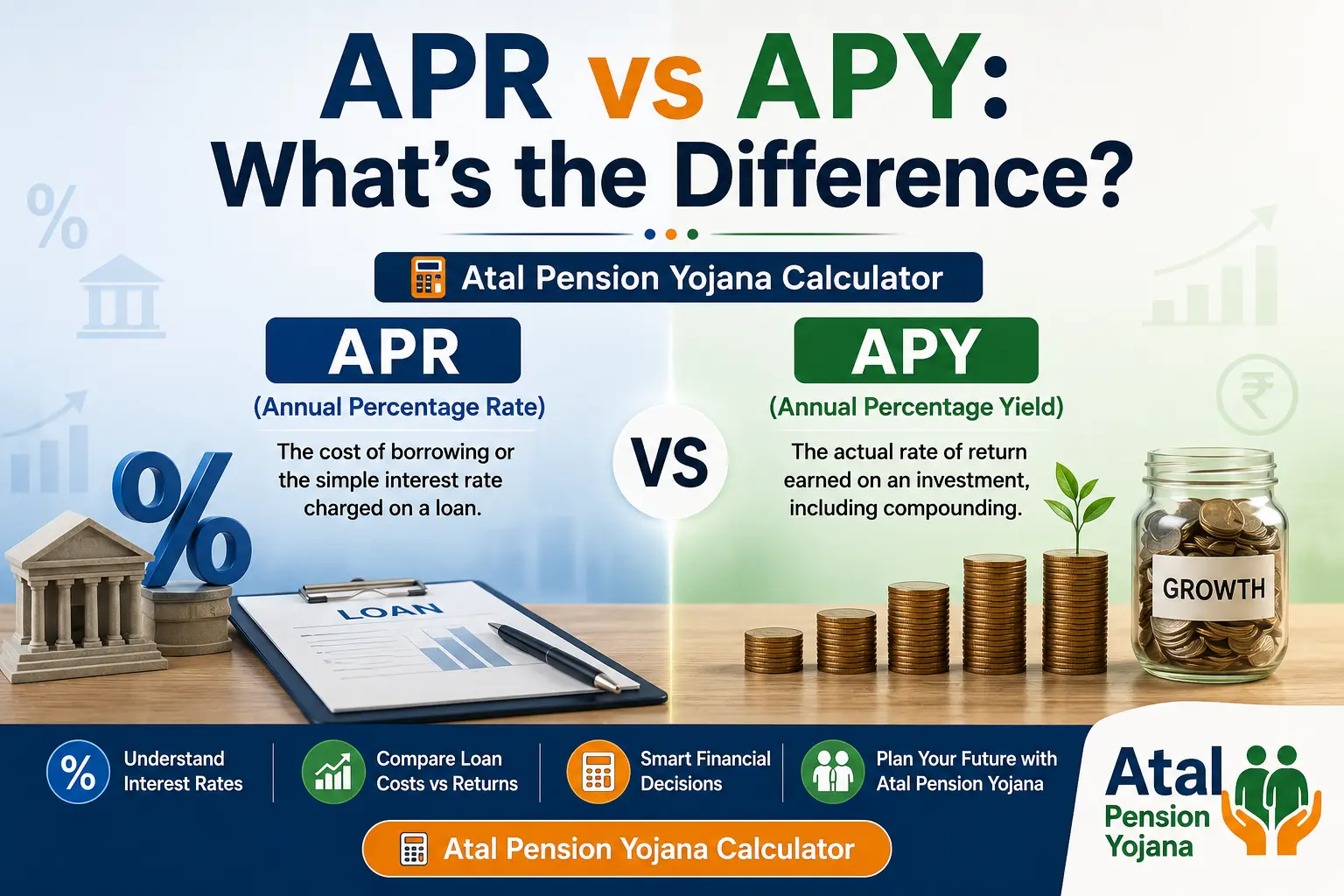
APR and APY look almost identical on a bank statement or loan offer. But one number includes compounding and the other doesn't — and the difference can cost or earn you hundreds of dollars per year.
The one-sentence difference
APR (Annual Percentage Rate) is the simple annual rate. It doesn't account for compounding — interest charged or earned on interest.
APY (Annual Percentage Yield) is the true annual rate after compounding is included. It's always equal to or higher than the APR for the same nominal rate.
APR → APY conversion formula
Where n = number of compounding periods per year:
- n = 12: monthly compounding (most personal loans, mortgages)
- n = 365: daily compounding (high-yield savings, credit cards)
- n = 1: annual compounding (APY = APR, no difference)
Conversion table: APR → APY
| APR | APY (monthly) | APY (daily) |
|---|---|---|
| 1.00% | 1.005% | 1.005% |
| 3.00% | 3.042% | 3.045% |
| 4.50% | 4.594% | 4.601% |
| 5.00% | 5.116% | 5.127% |
| 7.00% | 7.229% | 7.250% |
| 12.00% | 12.683% | 12.747% |
| 24.99% | 28.391% | 28.405% |
The higher the APR, the bigger the gap to APY — and the more important the distinction becomes.
Which rate applies where
| Product | Rate shown | What it means |
|---|---|---|
| Savings account / CD | APY | What you actually earn, including compounding |
| Mortgage | APR | Base cost + fees, not accounting for compounding |
| Car loan | APR | Stated cost of the loan including fees |
| Credit card | APR | Annual rate; actual cost with daily compounding is higher |
| Money market / HYSA | APY | True annual yield including daily or monthly compounding |
| Certificate of deposit | APY | Effective annual yield on the CD |
The credit card trap
Credit cards advertise APR. But they compound daily. A card with 24.99% APR that compounds daily has a true APY of 28.4%. If you carry a $5,000 balance:
| As "APR" (incorrect) | As "APY" (true cost) | |
|---|---|---|
| Annual interest on $5,000 | $1,249 | $1,420 |
The true cost is $171/year more than the APR suggests — and this compounds if you don't pay it off.
The savings account reward
Two high-yield savings accounts, both advertising "5.00%":
- Account A: 5.00% APY, compounded monthly
- Account B: 5.00% APY, compounded daily
On a $10,000 balance: Account A earns $511.16/year; Account B earns $512.71/year. The difference is small ($1.55), but it compounds over multiple years — and comparing APY directly makes this comparison immediate without any calculation.
APY → APR conversion formula
For a 5.00% APY compounded monthly: APR = 12 × [(1.05)^(1/12) − 1] ≈ 4.89%
Frequently asked questions
What's the difference between APR and APY?
APR doesn't include compounding; APY does. For the same stated rate, APY is always higher than APR because it accounts for interest earned on interest. Savings products advertise APY (what you earn); loan products advertise APR (the base cost before compounding effects).
How do I convert APR to APY?
APY = (1 + APR/n)^n − 1, where n = compounding periods per year. A 4.5% APR compounded monthly: APY = (1 + 0.045/12)^12 − 1 = 4.59%.
Why does my credit card APR cost more than it looks?
Credit cards compound daily. A 24.99% APR compounded daily has a true APY of 28.4% — this is what carrying a balance actually costs per year, not 24.99%.
Should I compare APY or APR when choosing a savings account?
Always compare APY. It's the true annual yield. Two accounts may have the same nominal rate but different APYs depending on how frequently they compound.
Disclaimer: This article is for educational purposes only. Actual APY and APR terms vary by institution and product. Rates change frequently. Verify terms directly with your lender or bank before making financial decisions.