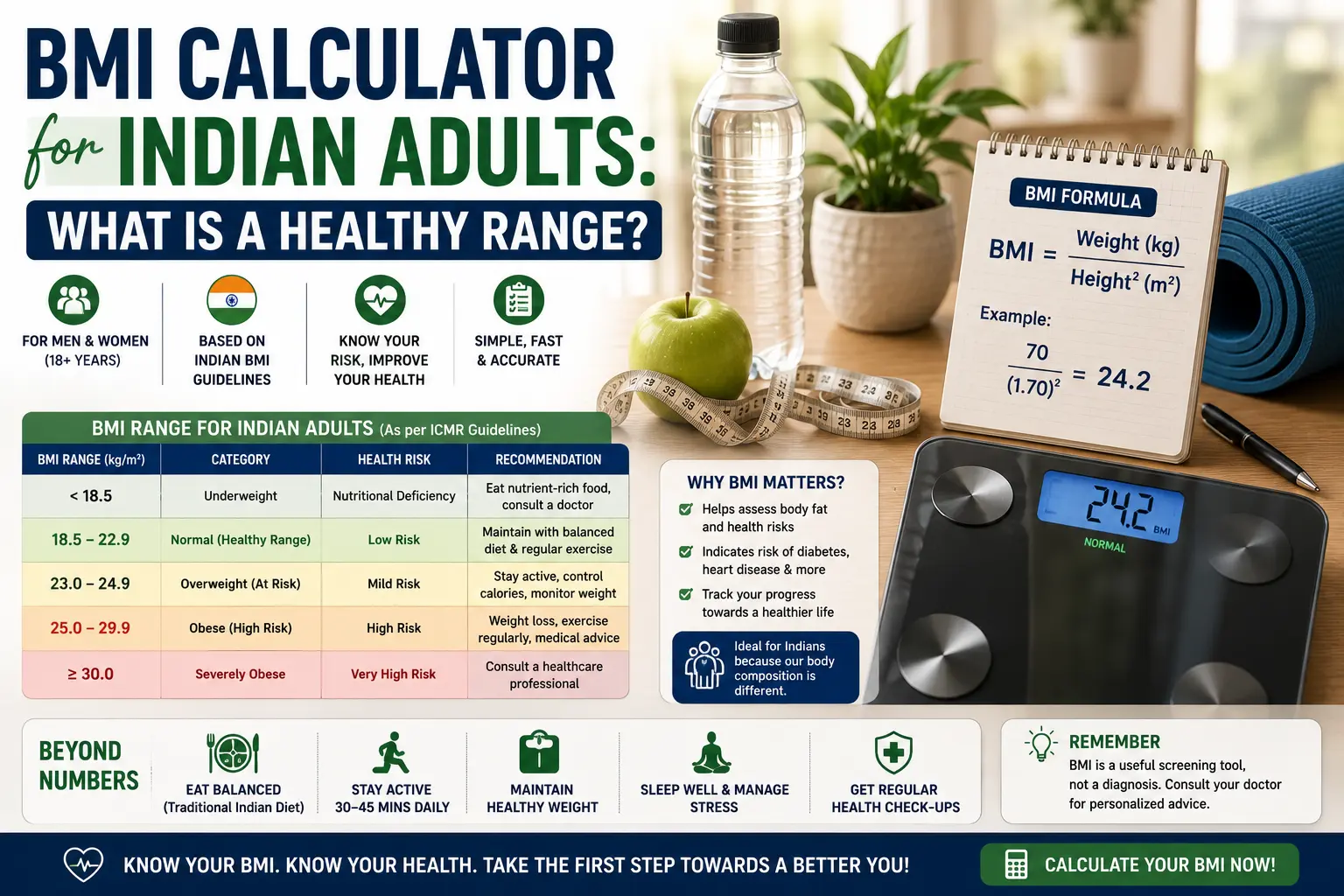
Indian bodies run a higher metabolic risk at the same BMI as Western populations — more visceral fat at the same weight, earlier diabetes, earlier heart disease. That is why India uses its own BMI cut-offs, and why an "average" BMI of 24 that looks healthy on an American chart is already flagged overweight for Indian adults. This guide explains the ranges, the calculation, and the two extra numbers that matter more than BMI itself.
The two BMI charts
| Category | WHO (international) | Asian-Indian (ICMR) |
|---|---|---|
| Underweight | < 18.5 | < 18.0 |
| Normal | 18.5 – 24.9 | 18.0 – 22.9 |
| Overweight | 25.0 – 29.9 | 23.0 – 24.9 |
| Obese | ≥ 30 | ≥ 25 |
A BMI of 24.2 — "high normal" by WHO — is overweight on the Indian chart. The consensus statement for Asian Indians adopted these lower thresholds because Indians develop insulin resistance and cardiovascular risk at lower body weights.
How to calculate your BMI (and what the number cannot see)
The formula is identical for Indian men and women; what differs is risk interpretation and body composition. BMI’s blind spots: it cannot distinguish muscle from fat (a fit 78 kg at 170 cm reads "overweight"), it misses central obesity — thin limbs with a heavy trunk, the classic Indian pattern — and it over-flags muscular builds. That is why doctors pair it with waist circumference: under 90 cm for Indian men, under 80 cm for Indian women.
Healthy weight ranges by height (Indian adults)
| Height | Healthy weight (BMI 18–22.9) | Overweight starts (BMI 23) |
|---|---|---|
| 150 cm | 40.5 – 51.5 kg | 51.8 kg |
| 155 cm | 43.2 – 55.0 kg | 55.2 kg |
| 160 cm | 46.1 – 58.6 kg | 58.9 kg |
| 165 cm | 49.0 – 62.3 kg | 62.6 kg |
| 170 cm | 52.0 – 66.2 kg | 66.5 kg |
| 175 cm | 55.1 – 70.1 kg | 70.4 kg |
| 180 cm | 58.3 – 74.2 kg | 74.5 kg |
If your number is above the Indian range
A 5–10% weight loss is enough to move most metabolic markers — far more achievable than chasing a "perfect" BMI:
- Waist first: shrinking waist circumference below the 90/80 cm thresholds usually improves insulin sensitivity faster than scale weight.
- Strength 3–4×/week + protein 1.2–1.6 g/kg: preserves muscle while losing fat, so BMI falls without losing metabolism.
- Screen annually once BMI ≥ 23: HbA1c, lipid profile, blood pressure — Indian guidelines recommend earlier screening than Western ones, especially with family history of diabetes or PCOS.
Where BMI does not apply
Children (use BMI-for-age percentiles), athletes with high lean mass, pregnant women, and adults over ~65 (where slightly higher BMI correlates with better outcomes) should not be judged by the adult cut-off table. For everyone else, BMI is the cheapest first signal — not a diagnosis. Check yours on the calculator, then measure your waist; the two numbers together tell you nearly everything a screening visit would.
Related tools: Ideal Weight Calculator · Body Fat Calculator · Calorie Calculator for a 5–10% loss plan.