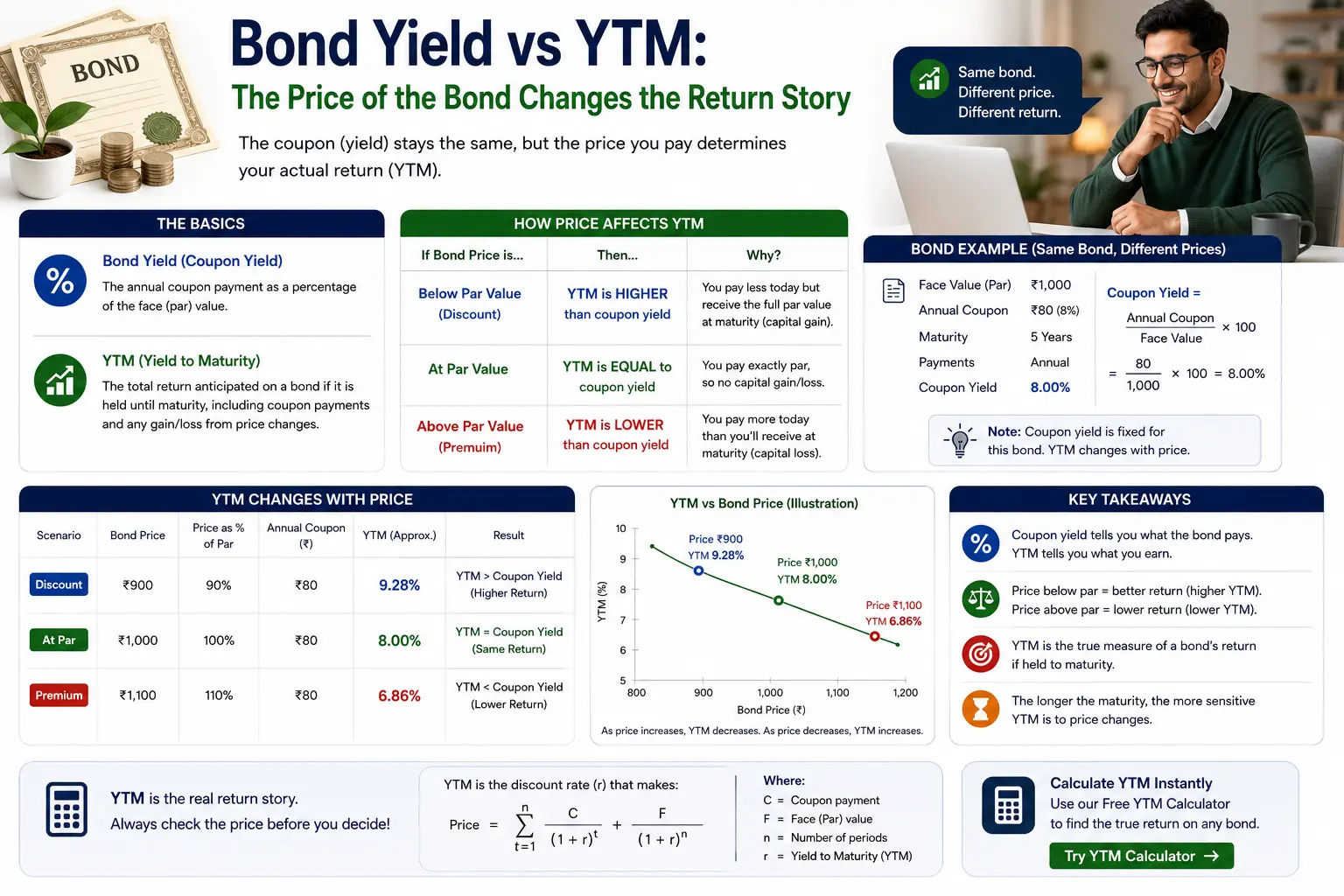
Coupon, current yield and YTM are different
Coupon rate applies to face value. Current yield divides annual coupon by the current market price. Yield to maturity also accounts for the price-to-face-value gain or loss if all cash flows are paid as scheduled.
Why YTM rises below face value
A bond priced below face value returns face value at maturity. That discount becomes part of the return, so the solved YTM can exceed the coupon rate. Above face value, a premium reduces YTM.
A worked example: same coupon, different price
Take a ₹1,000 face-value bond with a 8% annual coupon and 5 years to maturity:
| Market price | Current yield | YTM (approx) | Reading |
|---|---|---|---|
| ₹1,000 | 8.0% | 8.0% | At par |
| ₹920 | 8.7% | 10.1% | Discount adds to return |
| ₹1,080 | 7.4% | 6.1% | Premium eats return |
Same issuer, same coupon — the price you pay decides your true return. That is why YTM is the only fair way to compare two bonds.
What YTM assumes
The conventional calculation assumes you hold to maturity, all contractual payments are received, and coupons can be reinvested at the same yield. That makes it a comparison metric, not a promised return.
Assess risk and taxes separately
Credit quality, liquidity, call features, duration, taxation and settled accrued interest can change the real outcome. Read the offer document and evaluate YTM alongside those risks.
Sources and further reading
Financial disclaimer: This guide is educational and does not constitute investment, tax, credit or legal advice. Product terms, regulations, rates, taxes and personal circumstances change; verify the latest offer and consult a qualified professional where appropriate.