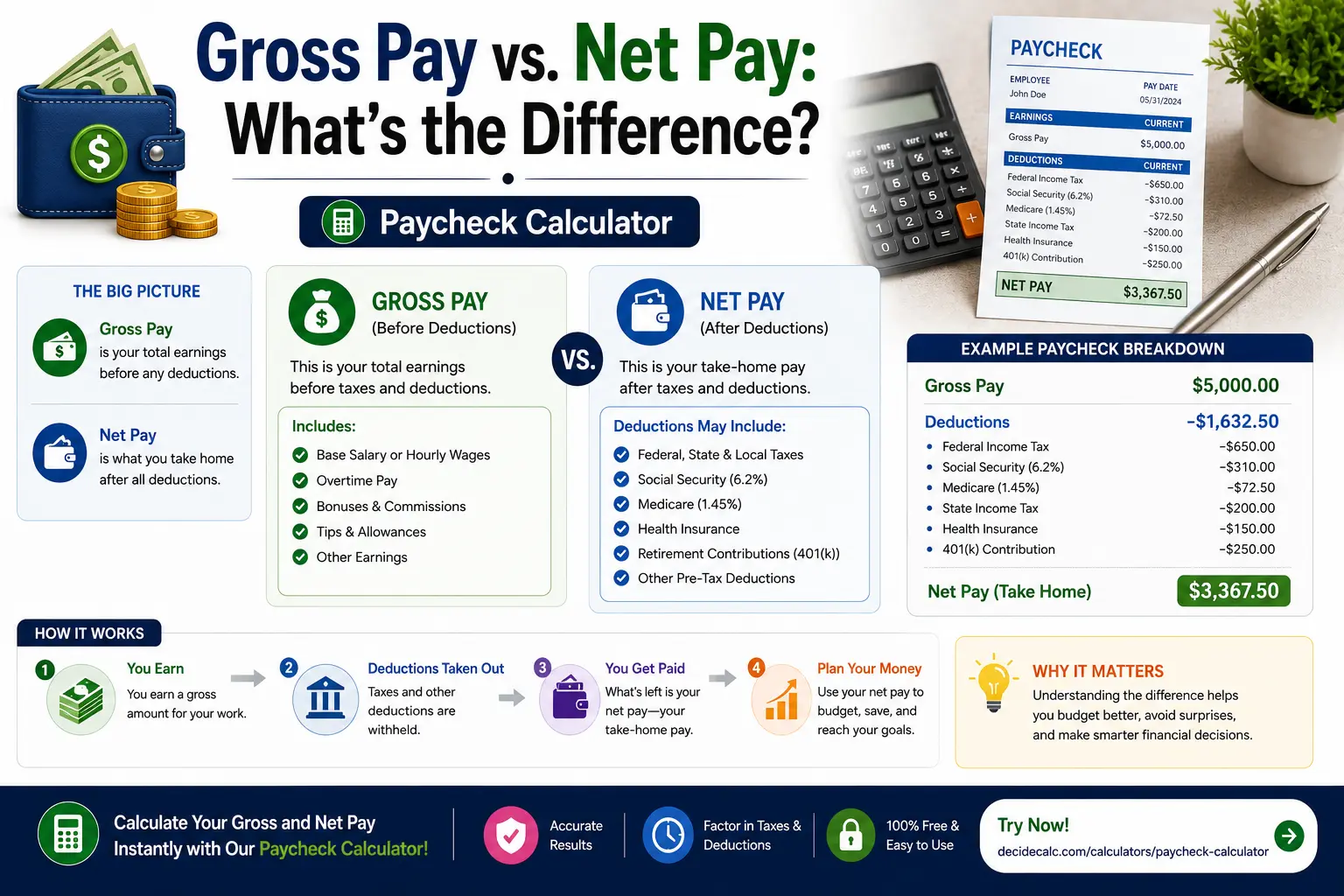
If you've ever accepted a job offer and then been surprised by your first paycheck, you've experienced the gap between gross pay and net pay. A $65,000 salary doesn't put $65,000 in your bank account. After federal income tax, Social Security, Medicare, and state taxes, that number can drop to $48,000–$52,000 depending on where you live. Here's exactly how the deductions stack up.
Gross pay — the starting number
Gross pay is your total compensation before any deductions are taken out. For a salaried employee it's the agreed annual pay divided by the number of pay periods. For hourly workers it's hours worked multiplied by the hourly rate, plus any overtime, bonuses, or commissions earned during the period.
Gross pay is the number on the job offer letter. It's also the number you give to lenders when applying for a mortgage or car loan.
Net pay — what you actually receive
Net pay (also called take-home pay) is what's left after mandatory and voluntary deductions are subtracted from gross pay. This is the amount deposited into your bank account or printed on the check.
The full deduction breakdown: $65,000 salary, single filer, no-tax state
| Line item | Annual | Per bi-weekly paycheck |
|---|---|---|
| Gross pay | $65,000 | $2,500.00 |
| 401(k) contribution (5% pre-tax) | −$3,250 | −$125.00 |
| Health insurance premium (est.) | −$2,400 | −$92.31 |
| Taxable income after pre-tax deductions | $59,350 | $2,282.69 |
| Federal income tax (2026 brackets, single) | −$6,617 | −$254.50 |
| Social Security (6.2% of gross) | −$4,030 | −$155.00 |
| Medicare (1.45% of gross) | −$943 | −$36.25 |
| State income tax (0% — no-tax state) | $0 | $0 |
| Net (take-home) pay | $48,160 | $1,852.25 |
The effective total deduction rate is about 25.9% — nearly $1 in $4 goes to taxes and benefits before you see it.
The biggest deductions explained
Federal income tax
The US uses a progressive bracket system. In 2026, a single filer pays 10% on the first ~$11,600, 12% on income up to ~$47,150, and 22% on income above that up to ~$100,525. Your marginal rate is the rate on the last dollar earned; your effective rate is the actual percentage of total income paid. On $59,350 of taxable income, the effective rate is about 11.1%.
FICA: Social Security + Medicare
FICA totals 7.65% of gross pay — 6.2% for Social Security (up to the $176,100 wage base in 2026) and 1.45% for Medicare (no cap). Your employer matches the same 7.65%, so the government collects 15.3% of your pay total. There is no way to reduce FICA with pre-tax deductions.
State income tax
Nine states have no income tax: Alaska, Florida, Nevada, New Hampshire, South Dakota, Tennessee, Texas, Washington, and Wyoming. The other 41 states charge anywhere from a flat 3% (Illinois) to a top marginal rate of 13.3% (California). In a high-tax state like California, the $65,000 example above could lose an additional $3,200+ per year.
Pre-tax deductions (voluntary)
Contributions to a traditional 401(k), HSA, FSA, and employer-sponsored health/dental/vision plans are deducted from gross pay before federal and state income tax is calculated. They still attract FICA. This means a $3,250 401(k) contribution doesn't reduce take-home by $3,250 — it reduces it by roughly $2,300 because you're also avoiding ~$715 in income tax on that amount.
Same salary, different states — net pay comparison
| State | State tax (approx.) | Annual net pay | Per paycheck (bi-weekly) |
|---|---|---|---|
| Texas (no state tax) | $0 | $48,160 | $1,852 |
| Georgia (~5.39%) | −$3,198 | $44,962 | $1,729 |
| New York (~6.33%) | −$3,756 | $44,404 | $1,708 |
| California (~6.0%) | −$3,561 | $44,599 | $1,715 |
Living in Texas versus New York on a $65,000 salary means about $3,756 more per year in take-home — roughly $144 per paycheck.
How to increase your net pay without a raise
- Increase 401(k) or HSA contributions to reduce taxable income (you don't lose the money — it goes into your retirement account).
- Adjust W-4 withholding if you consistently get a large refund — you've been giving the IRS an interest-free loan all year.
- Enroll in an FSA for predictable medical or childcare expenses — up to $3,300 (medical) and $5,000 (dependent care) can reduce taxable income in 2026.
- Check your filing status — if you've recently married, divorced, or had a child, your optimal status and withholding may have changed.
Frequently asked questions
What is the difference between gross pay and net pay?
Gross pay is your total earnings before any deductions — taxes, Social Security, Medicare, or benefit contributions. Net pay is what you actually receive after all deductions are subtracted. It is sometimes called take-home pay.
What percentage of gross pay is taken out for taxes?
For most US workers, roughly 20–30% of gross pay is withheld for federal income tax, FICA (7.65%), and state income tax. The exact amount depends on your income, filing status, state, and pre-tax deductions like 401(k).
Does gross pay include overtime?
Yes. Gross pay includes base wages plus overtime, bonuses, commissions, tips, and any other compensation before deductions. All are subject to FICA and income tax withholding.
How does a 401(k) contribution affect take-home pay?
A traditional (pre-tax) 401(k) reduces your taxable income before federal and state income tax is calculated. FICA is still owed on the full gross amount. A $200/month contribution typically reduces take-home by only $140–$160, not the full $200.
Disclaimer: Tax figures are estimates based on 2026 US federal brackets and approximate state rates. Individual withholding depends on filing status, exemptions, and employer-specific benefits. Consult a tax professional for personalized advice.