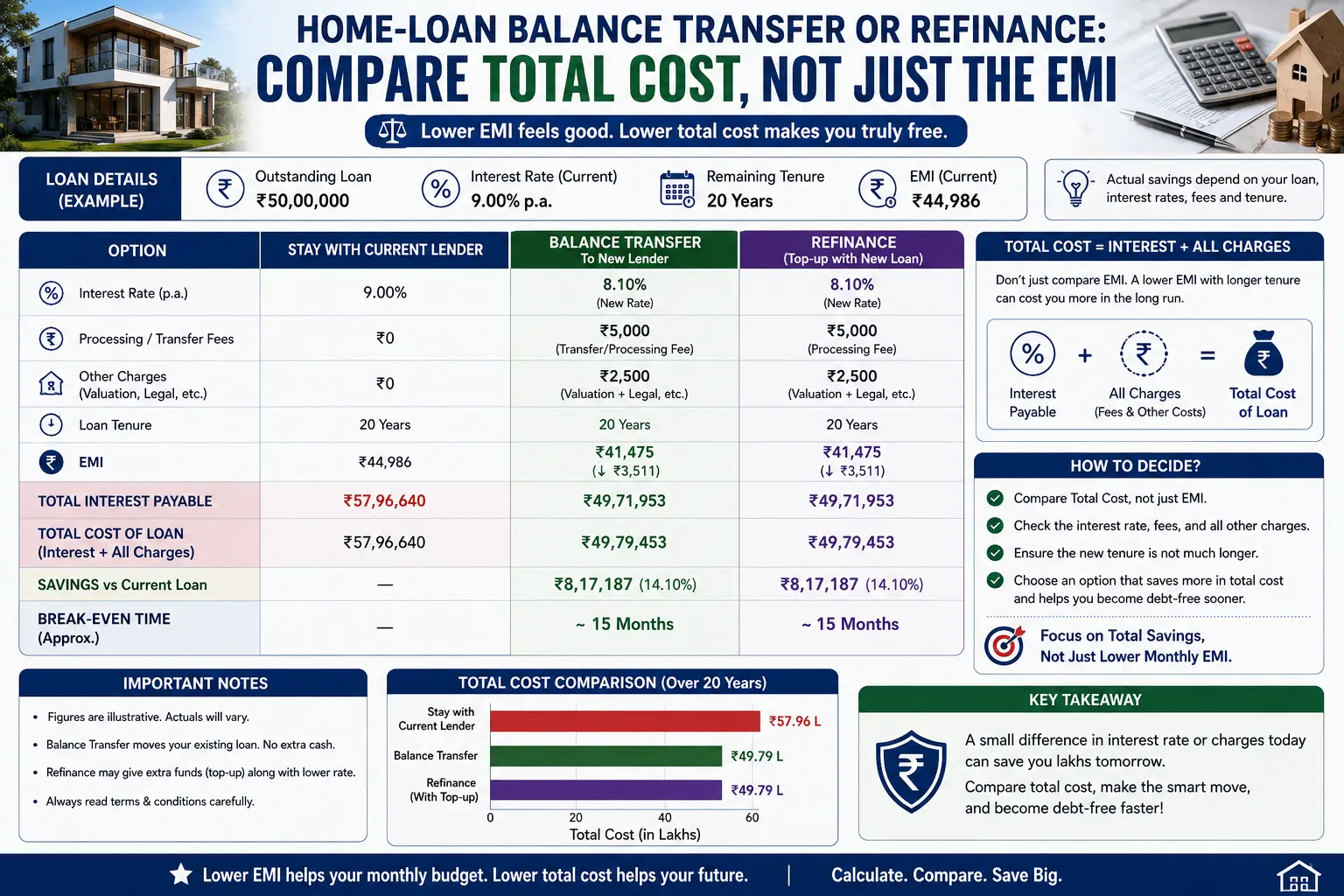
Start with the true remaining cost
Estimate the payments left on your current loan. Then compare that to a new loan’s scheduled payments and every rupee needed to switch, including processing, documentation, legal, valuation and closure costs.
A worked example
Suppose you have a ₹40-lakh balance with 12 years left at 9.5%. A new lender offers 8.75% with ₹35,000 in total switching costs (processing + legal + valuation + GST). Your options:
| Monthly EMI | Total interest remaining | Net benefit | |
|---|---|---|---|
| Stay at 9.5% | ₹49,450 | ₹31.21 lakh | — |
| Transfer to 8.75% (same tenure) | ₹47,092 | ₹27.81 lakh | Save ₹3.40 lakh minus ₹35k costs |
| Transfer to 8.75% (extend to 15 years) | ₹41,780 | ₹35.20 lakh | +₹4 lakh despite lower rate |
The middle option cuts interest by over ₹3 lakh. But the third — despite the same lower rate — actually costs ₹4 lakh more because the tenure stretched three extra years.
Do not stretch the tenure accidentally
A lower EMI sometimes comes only because the new lender restarts a longer clock. This can leave more interest-bearing months even when the rate is slightly lower.
Check floating-rate and reset terms
Floating-rate retail loans in India are generally linked to an external benchmark and do not carry RBI-mandated prepayment penalties for individuals. Fixed-rate or some non-individual loans can have different conditions. Confirm the actual contract.
Ask better questions before signing
Ask whether the lower rate is promotional, when it reprices, whether insurance is mandatory, how fees are financed, and how application enquiries may affect your credit profile.
Sources and further reading
Financial disclaimer: This guide is educational and does not constitute investment, tax, credit or legal advice. Product terms, regulations, rates, taxes and personal circumstances change; verify the latest offer and consult a qualified professional where appropriate.