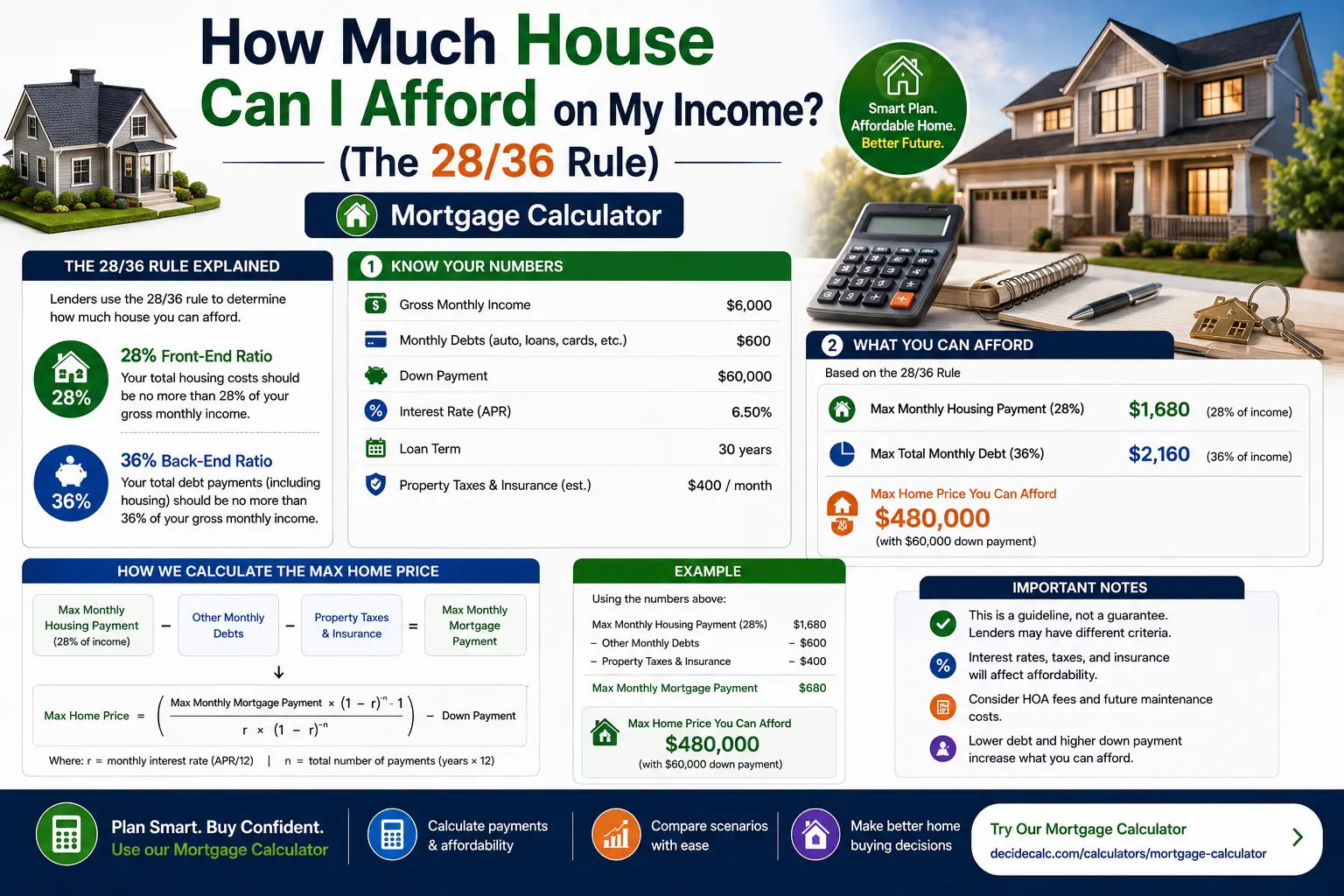
Before you start touring homes, you need to know your budget. Most lenders use the 28/36 rule to set the maximum mortgage they'll approve. Understanding this rule — and its limits — is the difference between buying a home you can comfortably afford and one that stretches you to the breaking point.
The 28/36 rule explained
The rule has two parts:
- Front-end ratio (28%): Your monthly housing costs — principal, interest, property taxes and home insurance (PITI) — should not exceed 28% of your gross monthly income.
- Back-end ratio (36%): Your total monthly debt payments — housing plus car loans, student loans, credit card minimums — should not exceed 36% of gross monthly income.
Both rules apply simultaneously. If your car payment is already $500/month, that eats into both limits.
Step 1 — Find your maximum PITI payment
For a $90,000 annual salary: $90,000 ÷ 12 = $7,500/month. Max PITI = $7,500 × 28% = $2,100/month.
Step 2 — Check the back-end rule with your other debts
At $7,500/month: max total debt = $7,500 × 36% = $2,700/month. If you have $600/month in existing debt (car + student loan), your housing budget drops from $2,100 to $2,700 − $600 = $2,100 still holds — but if your debts were $900/month, your housing cap would fall to $1,800, overriding the 28% front-end limit.
Step 3 — Convert monthly payment to home price
At 7% APR, 30-year term, 20% down, a $2,100 P&I payment supports a loan of about $316,000 and a home price of roughly $395,000 (since the loan is 80% of price). But remember: $2,100 is for PITI — taxes and insurance reduce the P&I you can afford.
Assuming 1.2% annual property tax and $1,500/year insurance:
- Monthly property tax: $395,000 × 1.2% ÷ 12 = $395
- Monthly insurance: $1,500 ÷ 12 = $125
- Available for P&I: $2,100 − $395 − $125 = $1,580
- Loan this supports at 7%/30yr: ~$237,000
- Home price (with 20% down): ~$296,000
Home affordability by salary (7% APR, 30-year, 20% down)
| Annual salary | Max PITI/mo (28%) | Available P&I (after tax+ins) | Max home price |
|---|---|---|---|
| $70,000 | $1,633 | ~$1,050 | ~$175,000 |
| $90,000 | $2,100 | ~$1,580 | ~$296,000 |
| $110,000 | $2,567 | ~$2,000 | ~$360,000 |
| $130,000 | $3,033 | ~$2,450 | ~$430,000 |
Assumes 1.2% property tax rate, $1,500 annual insurance, no other debts, 20% down payment. Actual limits vary by location, lender and debt load.
Conventional vs. FHA affordability limits
| Loan type | Max front-end DTI | Max back-end DTI | Min down payment |
|---|---|---|---|
| Conventional | 28% | 36–45% | 3–20% |
| FHA | 31% | 43–50% | 3.5% |
| VA (veterans) | No hard cap | 41% preferred | 0% |
| USDA (rural) | 29% | 41% | 0% |
What the 28/36 rule doesn't account for
Lenders approve loans based on gross income. But you pay your mortgage from net income. On a $90,000 salary you might take home $65,000–$68,000 after taxes. A $2,100 PITI payment is 38–39% of your actual take-home — that's tighter than the 28% front-end ratio implies.
The 28/36 rule also ignores:
- Maintenance: Expect 1–2% of home value per year in upkeep.
- HOA fees: In condos and planned communities these can run $200–$800/month.
- Utilities: A 2,500 sq ft home may add $300–$500/month in energy costs vs. renting an apartment.
- Emergency reserves: Most financial advisors recommend 3–6 months of housing costs in a liquid emergency fund at closing.
Frequently asked questions
What is the 28/36 rule for a mortgage?
The 28/36 rule says monthly housing costs (PITI) should not exceed 28% of gross monthly income, and total monthly debt payments should not exceed 36% of gross income.
How much house can I afford on a $70,000 salary?
On $70,000 gross ($5,833/month), the 28% rule allows up to $1,633/month for PITI. At 7% APR for 30 years with 10% down, that supports a home price of roughly $175,000–$200,000 depending on local property taxes and insurance.
Does the 28/36 rule use gross or net income?
The 28/36 rule uses gross income. Lenders also use gross income for DTI calculations. However, your actual budget should account for take-home pay — you pay the mortgage from net income, not gross.
What is a good debt-to-income ratio for a mortgage?
Most conventional lenders want a back-end DTI below 43%. FHA loans allow up to 50% in some cases. A DTI below 36% is considered strong and will typically get you the best rate offers.
Disclaimer: This article is for informational and educational purposes only and does not constitute financial or mortgage advice. Home prices, interest rates and property taxes vary significantly by location. Consult a licensed mortgage professional before making home-buying decisions.