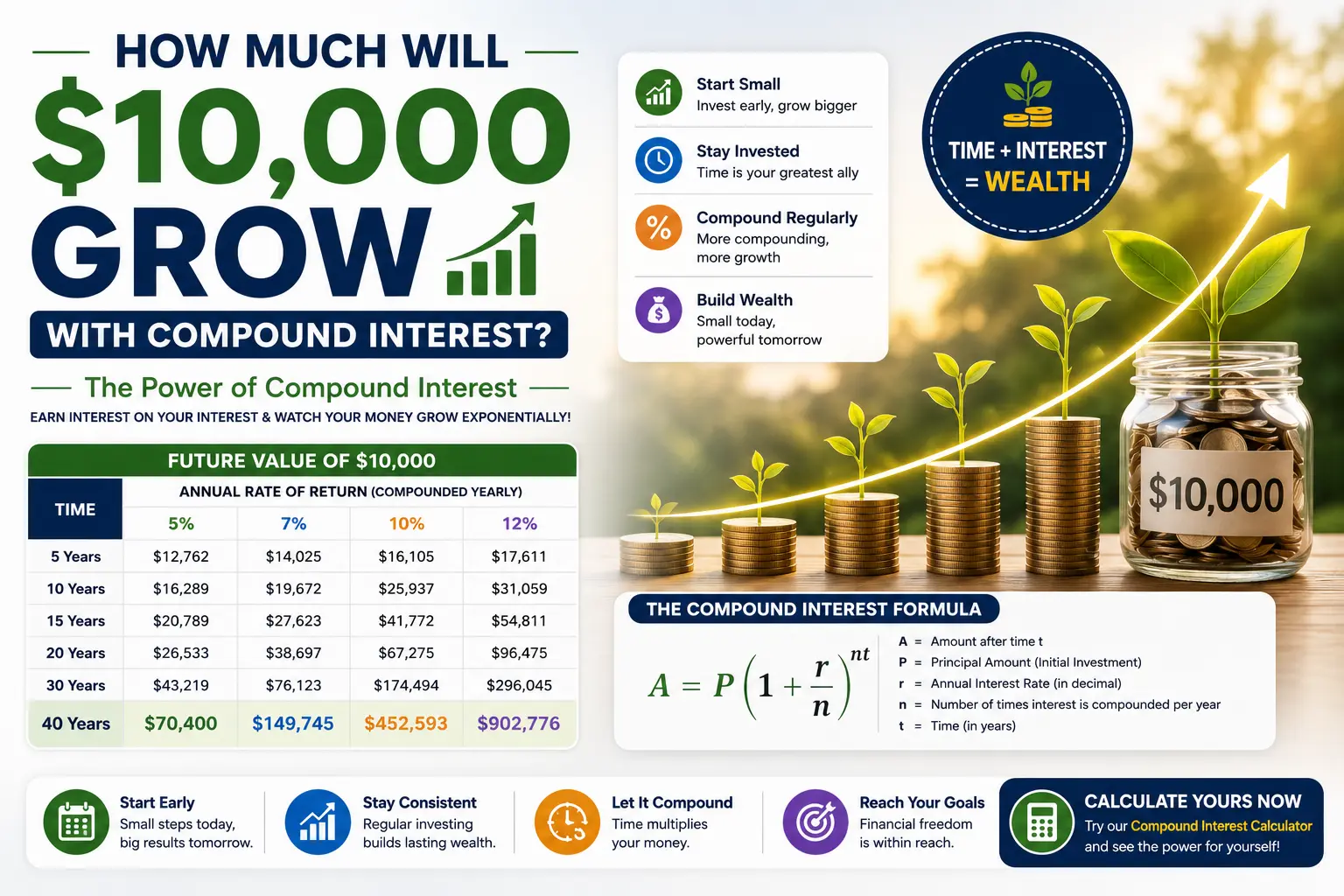
 0,000 compound interest growth across rates and time horizons with year-by-year table" width="1536" height="1024" loading="eager" decoding="async" fetchpriority="high" style="width:100%;height:auto;aspect-ratio:1536/1024;object-fit:cover;display:block">
The honest reason most people don't run these numbers is that they assume they'll be modest. They aren't. The difference between 5% and 10% over 30 years is not a 2× difference in outcome — it is the difference between $43,219 and $174,494. That gap is almost entirely the result of exponential compounding.
The formula behind every number in this guide
P = $10,000 | r = annual rate | n = compounding periods/year | t = years
$10,000 growth table: 5%, 7%, and 10%
All figures use monthly compounding (n = 12), which reflects most savings accounts, CDs, and investment accounts.
| Rate | 10 years | 20 years | 30 years |
|---|---|---|---|
| 5% | $16,470 | $27,126 | $44,677 |
| 7% | $20,097 | $40,388 | $81,165 |
| 10% | $27,048 | $73,162 | $197,885 |
At 10% for 30 years, $10,000 becomes nearly $200,000 — almost 20× your money. That is not a trick of cherry-picked data; it is the mechanical consequence of interest compounding on itself, month after month, for three decades.
Does compounding frequency actually matter?
The short answer: yes, but less than you might think. The compounding frequency effect is real but small compared to the rate and the time horizon.
| Frequency | $10,000 @ 7% / 30 years | vs. Annual |
|---|---|---|
| Annual (n=1) | $76,123 | — |
| Monthly (n=12) | $81,165 | +$5,042 |
| Daily (n=365) | $81,560 | +$5,437 |
The jump from annual to monthly is meaningful (~$5,000 extra on $10K over 30 years). Going from monthly to daily adds only another ~$395. When you see a bank advertising daily compounding, it's technically better — just not dramatically so. The big win is getting a higher rate or waiting longer.
The Rule of 72: estimate growth in seconds
Divide 72 by your annual interest rate and you get the approximate number of years to double your money:
- 5% → 72 ÷ 5 = 14.4 years to double ($10,000 → $20,000)
- 7% → 72 ÷ 7 ≈ 10.3 years to double
- 10% → 72 ÷ 10 = 7.2 years to double
At 7%, $10,000 doubles to $20,000 by year 10, doubles again to $40,000 by year 20, and is approaching $80,000 by year 30. Each doubling period compounds the one before it — that's the exponential effect in plain arithmetic.
What rate is realistic?
- High-yield savings account / money market: 4–5% in 2026 (varies with Fed rate).
- US Treasury bonds / I-bonds: 4–6% depending on duration and inflation.
- Diversified US index fund (S&P 500): Historical inflation-adjusted average ~7%; nominal ~10%. Future returns are not guaranteed.
- CDs: 4–5% locked for 1–5 years in 2026.
None of these guarantees are forward-looking. The above are historical benchmarks for illustration purposes only.
Turning $10,000 into $100,000
A 10× return requires either a very long runway or a high rate — ideally both:
- At 7%: it takes approximately 34 years.
- At 10%: approximately 24 years.
- At 12%: approximately 20 years.
The implication: starting at 25 with a 7% return gets you to $100,000 by age 59 on a $10,000 deposit alone, before you add a single extra dollar.
Use the DecideCalc Compound Interest Calculator
The exact numbers above were computed with the same formula our free Compound Interest Calculator runs live in your browser. You can enter any principal, rate, and time period and see both the future value and the year-by-year growth breakdown. If you want to test the Rule of 72's accuracy, the calculator also shows you the growth multiple.