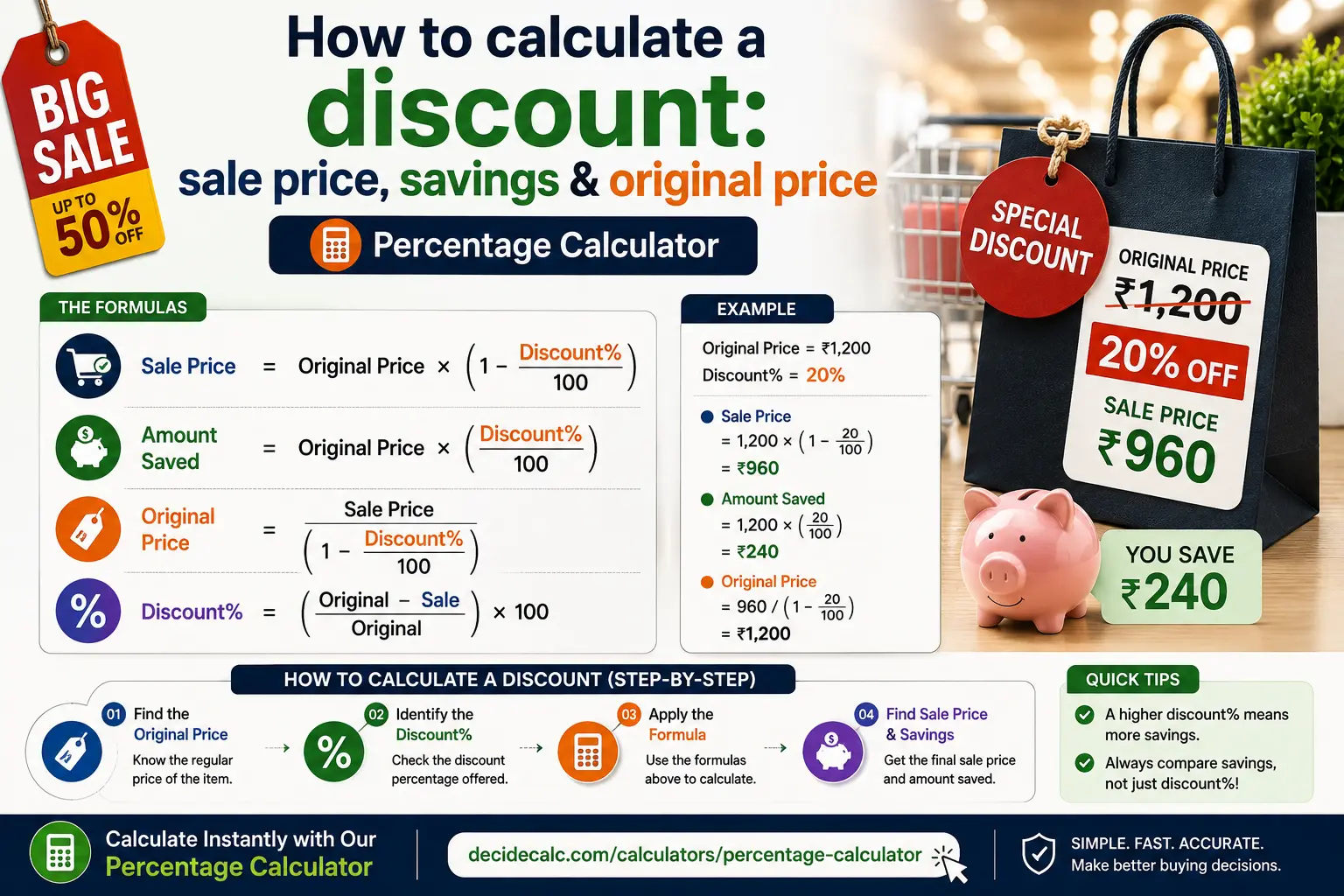
A "30% off" tag is simple enough in your head for a $10 item, but not so easy on a $279 laptop or a $1,800 appliance. These three formulas handle every discount scenario — forward (what's the sale price?), backward (what was the original price?), and percentage (how big a discount was that?).
Formula 1 — Find the sale price after a discount
This works because you're paying the remaining percentage — if 30% is off, you pay 70%.
| Original price | Discount | Multiplier | Sale price |
|---|---|---|---|
| $150 | 20% | × 0.80 | $120.00 |
| $150 | 30% | × 0.70 | $105.00 |
| $279 | 25% | × 0.75 | $209.25 |
| $1,800 | 40% | × 0.60 | $1,080.00 |
Formula 2 — Find how much you saved
Or equivalently: Amount Saved = Original Price − Sale Price.
On a $279 item with 25% off: $279 × 0.25 = $69.75 saved. Sale price = $279 − $69.75 = $209.25.
Formula 3 — Reverse-engineer the original price
You see a sale tag that says "$105 — 30% off." What was the original price?
$105 / (1 − 0.30) = $105 / 0.70 = $150.00
This is the formula retailers rely on when marking items up before applying a "discount." If the original price seems suspiciously high, this formula lets you verify what it would have had to be.
Formula 4 — Find the discount percentage
An item was $80, now $60. What's the discount percentage?
((80 − 60) / 80) × 100 = (20 / 80) × 100 = 25%
Stacked discounts — why 20% + 20% ≠ 40% off
Some retailers apply two sequential discounts, such as "20% off, then an extra 20% off." These don't add up to 40%.
- Start: $100
- First 20% off: $100 × 0.80 = $80
- Second 20% off the new price: $80 × 0.80 = $64
- Effective discount: ($100 − $64) / $100 = 36%, not 40%
To compound discounts: multiply the keep-rate factors. Two 20% discounts = 0.80 × 0.80 = 0.64 → 36% off. Three 10% discounts = 0.90 × 0.90 × 0.90 = 0.729 → 27.1% off, not 30%.
Discount quick reference table
| Discount | Pay this % | $50 item | $100 item | $250 item |
|---|---|---|---|---|
| 10% off | 90% | $45.00 | $90.00 | $225.00 |
| 15% off | 85% | $42.50 | $85.00 | $212.50 |
| 20% off | 80% | $40.00 | $80.00 | $200.00 |
| 25% off | 75% | $37.50 | $75.00 | $187.50 |
| 30% off | 70% | $35.00 | $70.00 | $175.00 |
| 40% off | 60% | $30.00 | $60.00 | $150.00 |
| 50% off | 50% | $25.00 | $50.00 | $125.00 |
Watch out: "up to X% off" markdowns
Retailers often advertise "up to 50% off" during sales. That headline rate applies to only the deepest-discounted items in the sale, not the average item. The actual average discount across all sale items is typically 15–25% even when the headline says 50%. Always calculate the actual sale price on the specific item you want, not the advertised maximum.
Real Indian shopping scenarios (MRP maths)
Big Billion Days-style flip: a ₹52,999 phone at "32% off" prices at 52,999 × 0.68 = ₹36,039; with an additional 10% bank offer stacked, ×0.9 = ₹32,435 — a real 38.8% total discount, not 42%. The stacking rule (multiply remaining fractions, never add percentages) is what checkout pages quietly rely on.
Festival markdown vs MRP: a kurta marked MRP ₹2,999 selling at ₹1,199 is (2999 − 1199) ÷ 2999 = 60% off — but if the same kurta routinely sells at ₹1,499 through the year, the honest everyday discount is 50%, and the festival "extra" saving is ₹300. Discount percentages only mean something against the price you would otherwise have paid.
Buy-2-get-1: three ₹999 items for ₹1,998 = a 33.3% effective discount per item — straightforward. "Flat ₹500 off above ₹1,999" on a ₹2,100 cart = 23.8%; on a ₹3,500 cart = 14.3%. Flat-rupee offers weaken as the cart grows; percentage offers stay constant. Compare both at your actual cart size — instantly, with the Discount Calculator.
Three questions before any "deal"
- Is the base price real? Compare against the 90-day typical price, not the MRP (inflated MRPs make fake discounts).
- What is the effective discount after stacking? Multiply the complements: 30% + extra 10% = 1 − (0.7 × 0.9) = 37%.
- Would I buy it at full price? A 70% discount on something you never needed is a 100% loss.
Frequently asked questions
How do you calculate the sale price after a discount?
Sale Price = Original Price × (1 − Discount% / 100). For a 30% discount on a $150 item: $150 × (1 − 0.30) = $150 × 0.70 = $105.
How do you find the original price before a discount?
Original Price = Sale Price / (1 − Discount% / 100). If an item sells for $70 after a 30% discount: $70 / 0.70 = $100 original price.
What is the formula to find how much you saved?
Amount Saved = Original Price × (Discount% / 100). On a $150 item with 30% off: $150 × 0.30 = $45 saved.
How do you calculate the discount percentage?
Discount% = ((Original Price − Sale Price) / Original Price) × 100. Item was $80, now $60: ((80 − 60) / 80) × 100 = 25%.
Disclaimer: This article is for educational and informational purposes only. Retail prices and discount terms vary. Always verify prices at the point of purchase.