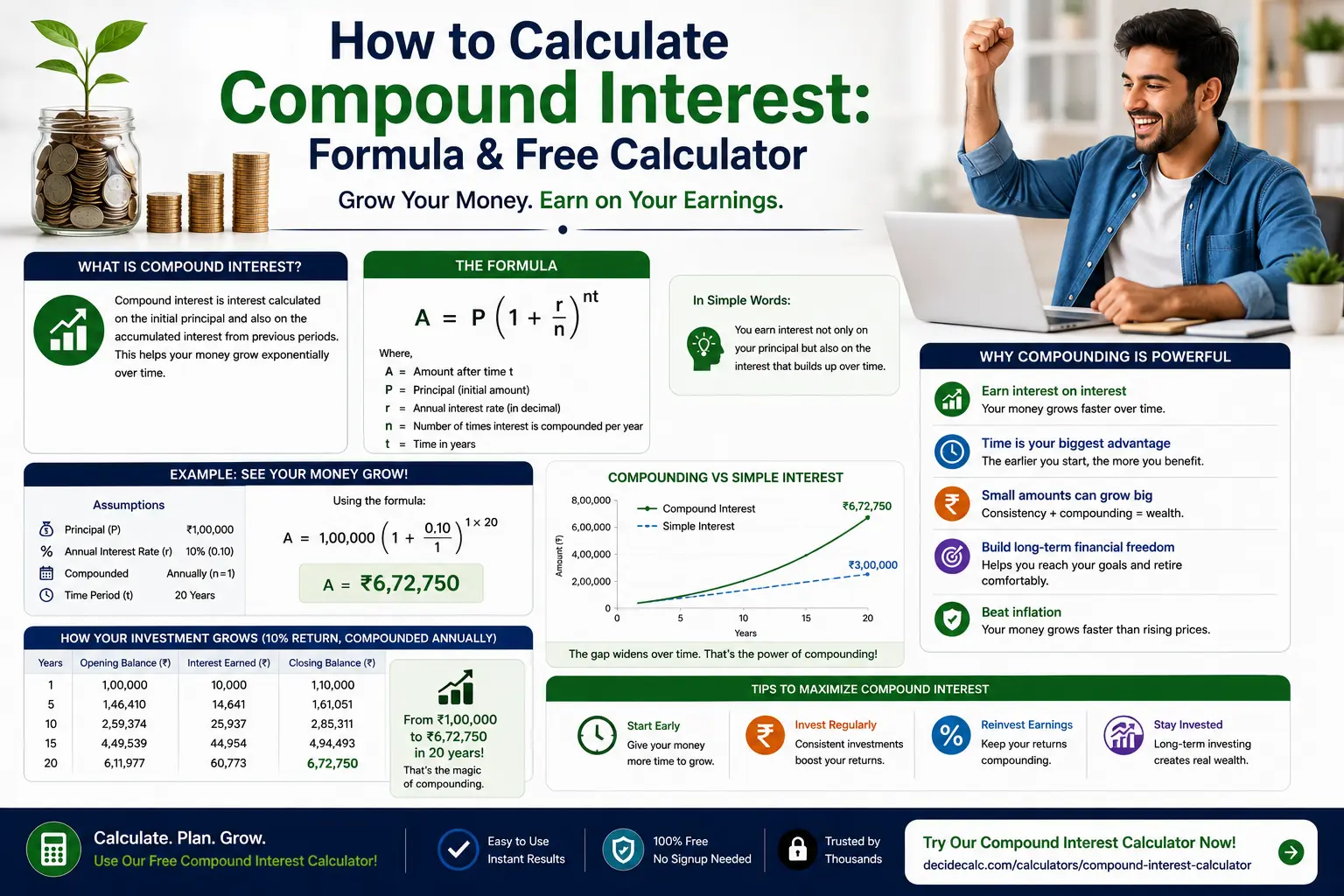
The single most important idea in personal finance is also one of the simplest: your money starts earning money on the money it has already earned. That loop — interest on interest — is what separates a flat $10,000 from a balance that quietly doubles without you having to lift a finger. The challenge is that the formula looks intimidating until you see each piece working together. Let’s break it down in plain English.
What is compound interest?
Compound interest is interest calculated on the original principal plus the interest that has already accumulated. Each period, the interest earned is added to the balance, and the next period’s interest is calculated on the larger amount. Compare that to simple interest, which only ever pays on the original principal. The gap grows every year, and it is exponential in the long run. A US savings account, a 401(k), an IRA, or a mortgage you pay down — all compound behind the scenes.
The compound interest formula
The universal formula is compact once you label each variable:
A = future value of the investment; P = principal (the amount you start with); r = annual interest rate, expressed as a decimal (7% → 0.07); n = number of compounding periods per year (12 for monthly, 4 for quarterly, 1 for yearly); t = number of years
Keep the order of operations clean: divide r/n, add 1, raise to the power nt, then multiply by P. Do this on a phone calculator and you’ll get the right answer every time.
A worked example: $10,000 at 7% for 10 years
| Step | What to do | Result |
|---|---|---|
| 1 | r = 0.07, n = 12, t = 10, P = 10,000 | A = 10,000 (1 + 0.07/12)(12×10) |
| 2 | Inside the bracket: 0.07 / 12 = 0.005833 | A = 10,000 × (1.005833)120 |
| 3 | Raise to power 120: (1.005833)120 ≈ 2.0096 | A = 10,000 × 2.0096 |
| 4 | Multiply by principal | A ≈ $20,096 |
That’s the magic: your $10,000 more than doubles in ten years, with the first $10,096 arriving automatically — no extra deposits, no fancy investment skill. Just time and a sensible rate.
How monthly vs. yearly compounding changes the result
Compounding frequency matters, but less than the number of years. The table below shows exactly how much more monthly compounding earns, at the same 7% rate over 10 years:
| Compounding | Future value of $10,000 | Interest earned |
|---|---|---|
| Annually (n=1) | $19,671.51 | $9,671.51 |
| Quarterly (n=4) | $20,015.19 | $10,015.19 |
| Monthly (n=12) | $20,096.10 | $10,096.10 |
| Daily (n=365) | $20,136.14 | $10,136.14 |
Switching from annual to daily compounding adds only about $464 over a decade. The far bigger lever is staying invested for 20 years instead of 10 — that single change nearly quadruples your total return.
Principal, rate, time, frequency — which matters most?
When you adjust the four knobs, their sensitivity is very different:
- Time (t) is exponential — double it and you more than double the result. A 25-year-old putting in $200 a month at 8% beats a 40-year-old putting in $600 a month.
- Rate (r) is the second-biggest mover — each extra percentage point lifts the ending value by roughly 10% over 20 years.
- Principal (P) scales linearly — double the starting amount and you double the ending amount.
- Frequency (n) helps, but only a little at the margins.
Use the DecideCalc Compound Interest Calculator
The formula above is perfect for one-time spot checks. But when you want to compare “what if I wait five more years?” or “what if the rate drops from 8% to 6%?”, do not rebuild the formula each time — slide the inputs and let the chart redraw itself. Our free Compound Interest Calculator runs the projection with any principal, rate, term, and compounding frequency, and shows how each dollar grows year by year.
Common mistakes to avoid
1. Forgetting to convert the rate. 7% is 0.07, not 7. Entering 7 instead of 0.07 makes the formula explode to an absurd figure.
2. Mixing up the exponent. The exponent is nt (periods per year × years), not just the number of years. Monthly for 10 years is 120 periods, not 10.
3. Using the simple-interest figure as “close enough.” For short horizons the two are similar, but for 20 years simple interest on $10,000 at 7% gives $24,000 while compound interest gives $38,697 — a $14,697 difference you never want to wave away.
A ₹5 lakh example, Indian rates
Deposit ₹5,00,000 in an 8% instrument — close to what quality debt funds and long FDs have delivered — and compound yearly for 10 years: 5,00,000 × (1.08)¹⁰ = ₹10,79,462. Monthly compounding (8% ÷ 12 per month) lifts it to ₹11,09,570. At equity-like 12% for 15 years the same ₹5 lakh becomes ₹27,45,716 — but with market risk attached. See the difference frequency and rate make for your own numbers in the Compound Interest Calculator.
Tax drag, honestly: at the 30% slab, FD interest taxed yearly turns the 8% into ~5.5% post-tax — ₹8.9 lakh instead of ₹10.8 lakh over the decade. Equity gains taxed once at 12.5% LTCG on redemption preserve more of the compounding (details in FD vs Mutual Fund).