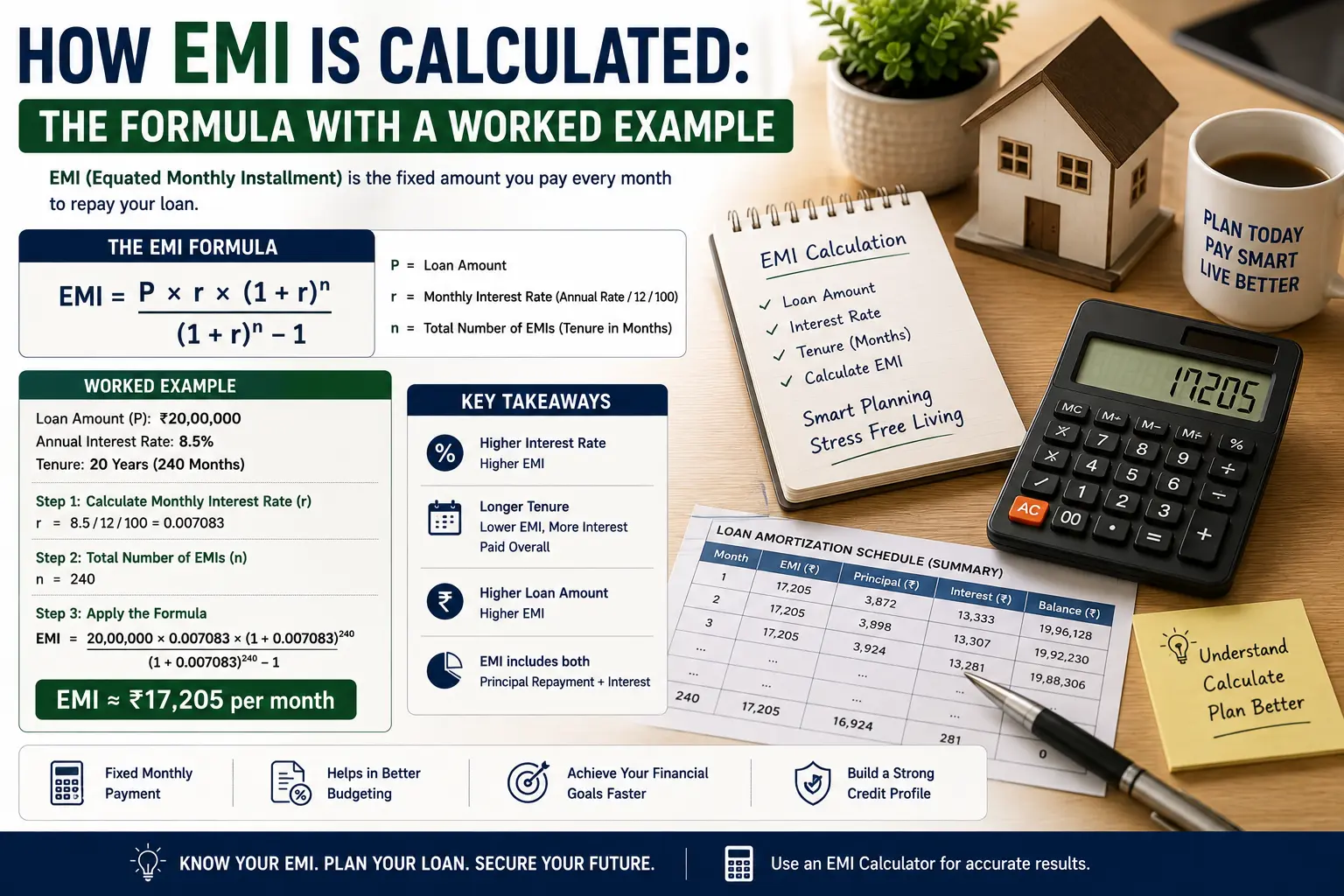
Every loan advertisement hides the same single formula. Learn it once and you can sanity-check any banker, compare any two offers, and understand exactly why a 20-year loan collects more interest than principal. No app required — just the formula, a pencil, and four steps.
The EMI formula
Where P = principal (loan amount), r = monthly interest rate (annual rate ÷ 12 ÷ 100), and n = tenure in months. The numerator charges one month’s interest on the full principal scaled by compounding; the denominator spreads it as equal payments so the loan exactly zeroes out at month n.
Worked example: ₹10 lakh, 9%, 15 years — by hand
Step 1 — convert the rate: r = 9 ÷ 12 ÷ 100 = 0.0075 per month.
Step 2 — months: n = 15 × 12 = 180.
Step 3 — the power term: (1.0075)¹⁸⁰. Evaluate by logs: ln(1.0075) ≈ 0.007472; × 180 = 1.3450; e¹·³⁴⁵⁰ ≈ 3.838. So (1+r)ⁿ ≈ 3.838, and (1+r)ⁿ − 1 ≈ 2.838.
Step 4 — assemble: EMI = 10,00,000 × 0.0075 × 3.838 ÷ 2.838. Piece by piece: 10,00,000 × 0.0075 = 7,500; 7,500 × 3.838 = 28,785; 28,785 ÷ 2.838 ≈ ₹10,143. (A calculator gives ₹10,142.67 — the hand method was off by half a rupee.)
Over 180 months you pay ₹18.26 lakh on a ₹10 lakh loan — interest of ₹8.26 lakh. Now the punchline experiment: the same loan at 20 years (n = 240, (1.0075)²⁴⁰ ≈ 6.009) gives EMI ≈ ₹8,997 but total interest ≈ ₹11.59 lakh. ₹1,150 less per month; ₹3.3 lakh more overall. That trade — in one line of arithmetic — is what every tenure decision actually hinges on.
Mental-math shortcuts
- The 4-slabs rule: per ₹1 lakh borrowed: ≈₹2,000/month at 20 years, ₹2,650 at 15, ₹3,750 at 10, ₹7,750 at 5 (8.5–9% band). ₹40 lakh over 20 years ≈ 40 × 2,000 = ₹80,000/month, instantly.
- Rate sensitivity: each 0.5% on a 20-year loan moves the EMI ~₹33 per lakh. A 25-basis-point concession on ₹50 lakh saves roughly ₹800/month.
- Interest ≈ principal check: at 8–9% over 20 years, total interest roughly equals the principal (100:95–115 ratio). If a quote shows far more, re-read the tenure.
Common mistakes in manual EMI maths
- Using the annual rate as r — always divide by 12 (and by 100). 9% ≠ 0.09 per month; it is 0.0075.
- Years instead of months — n must be instalments: 15 years = 180.
- Flat-rate confusion — some dealer finance quotes flat rates (interest on original principal throughout). Flat 10% ≈ reducing 17–18%. Convert before comparing.
- Forgetting the first-month timing — EMIs are typically advance/arrears; a day’s difference shifts the first instalment’s interest split, though not the EMI itself.
From formula to decision
The formula also explains why prepayment works: interest each month = balance × r, and early EMIs are mostly interest because the balance is large. Any prepayment attacks that balance directly — one extra EMI a year on a 20-year loan removes roughly 3–4 years. Verify all of this with your own numbers in the EMI Calculator (it also produces the full year-wise amortization schedule), and see 7 practical ways to reduce your EMI for the decision framework around the arithmetic.