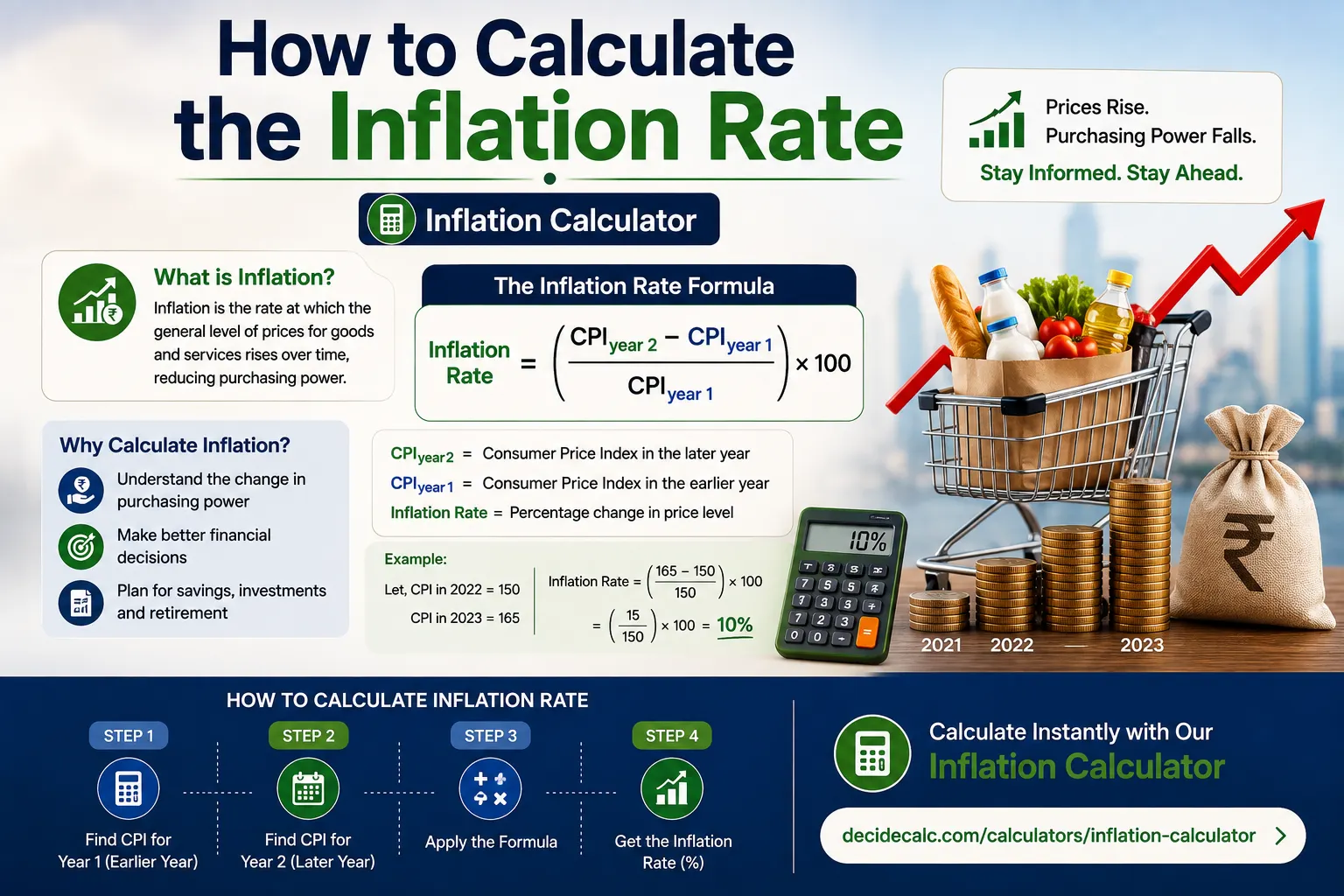
Inflation is the rate at which the general price level rises — or equivalently, the rate at which a dollar loses purchasing power. The Bureau of Labor Statistics (BLS) publishes the Consumer Price Index (CPI) monthly. Understanding how to calculate inflation helps you evaluate whether your salary is keeping pace, whether your savings rate is sufficient, and whether an investment return is real or just nominal.
The inflation rate formula
This is simply the percentage change formula applied to the CPI. The CPI measures the price of a representative basket of goods and services relative to a base year.
Worked example: US inflation in 2022
| Item | Value |
|---|---|
| CPI June 2021 | 271.0 |
| CPI June 2022 | 296.3 |
| Difference | 25.3 |
| Inflation rate | (25.3 ÷ 271.0) × 100 = 9.3% |
The BLS reported 9.1% average year-over-year inflation for June 2022 — one of the highest rates in four decades.
How to calculate the real value of your money
The real value formula converts today's dollars to their purchasing power in another year:
If you had $50,000 in savings in 2020 (CPI = 258.8) and want to know what that money is worth today (CPI = 300):
$50,000 × (258.8 / 300) = $43,133 in 2020 purchasing power. Your savings lost 13.7% of its real value even though the dollar amount stayed the same.
Real vs nominal return on investment
The nominal return is what the investment pays before inflation. The real return subtracts inflation to show actual purchasing power gained:
| Scenario | Nominal return | Inflation | Real return |
|---|---|---|---|
| High-yield savings | 4.5% | 3.0% | +1.5% |
| S&P 500 average | 10.0% | 3.0% | +7.0% |
| Checking account | 0.01% | 3.0% | −2.99% |
| High-inflation year | 6.0% | 9.0% | −3.0% |
A 6% investment gain in a 9% inflation year is actually a loss of purchasing power. This is why real return, not nominal return, is the number that matters for long-term planning.
How inflation compounds over time
A single year of 3% inflation seems small. But it compounds. Here's what $50,000 in cash actually buys after each decade at different inflation rates:
| Inflation rate | After 10 years | After 20 years | After 30 years |
|---|---|---|---|
| 2% | $41,018 | $33,669 | $27,629 |
| 3% | $37,177 | $27,676 | $20,498 |
| 4% | $33,778 | $22,829 | $15,052 |
| 5% | $30,691 | $18,862 | $11,578 |
At 3% inflation, $50,000 today buys what only $20,498 will buy in 30 years. This is why financial planners target returns above inflation, not above zero.
How to adjust your salary for inflation
The real wage formula:
Example: you earned $55,000 in 2018 (CPI 251.1). You earn $65,000 today (CPI = 300).
2018 salary in today's dollars: $55,000 × (300/251.1) = $65,714
Your current $65,000 is actually below the inflation-adjusted equivalent of your 2018 salary. You need $65,714 just to break even on purchasing power. This is why "I make more than I did 5 years ago" doesn't always mean you're ahead.
India-specific: CPI and your real inflation
India's headline CPI is published monthly by MoSPI (Ministry of Statistics and Programme Implementation) and has averaged roughly 5–6% over the long run. But your personal inflation rate depends on your basket: food and fuel weigh heavily in Indian household spend, education inflation runs 8–10%, and health inflation runs 10–14% — well above headline CPI. A family with school-age children and elderly parents typically experiences 2–3 percentage points more than the printed number.
Worked Indian example: if CPI moves from 198.5 to 210.4 over a year, inflation = (210.4 − 198.5) ÷ 198.5 = 6.0%. Your ₹50,000 monthly budget needs ₹53,000 next year to buy the same things; your ₹10 lakh savings account at 3% interest is losing about ₹28,000 a year in real terms. Enter any two CPI values or a rate directly in the Inflation Calculator to price your own basket.
What compounds, what doesn’t
At a steady 6%, ₹1 lakh of purchasing power becomes ₹74,000 in 5 years, ₹55,800 in 10 and ₹31,100 in 20 — the same compounding that grows investments runs in reverse on idle cash. This is why fixed-income planning (FDs, PPF) must be judged on real return: a 7% FD at 6% inflation nets ~1%. Compare with the FD vs Mutual Fund calculator or see how SIPs historically outpace inflation in the SIP Calculator.
Frequently asked questions
How do you calculate the inflation rate?
Inflation Rate = ((CPI this year − CPI last year) / CPI last year) × 100. If CPI rose from 280 to 300, the inflation rate is ((300−280)/280)×100 = 7.14%.
What does the CPI actually measure?
The CPI tracks the average price of a fixed basket of goods and services — food, housing, transportation, healthcare, education — relative to a base year. A CPI of 120 means prices are 20% above the base year.
How do I calculate real wage growth?
Real wage = current salary × (CPI base year / CPI current year). If you earned $55,000 in 2018 (CPI 251) and earn $65,000 today (CPI 300), your real salary is $65,000 × (251/300) = $54,417 in 2018 dollars — less than your 2018 wage. Your nominal raise didn't keep pace with inflation.
Why does my money lose value in a savings account?
If your savings account pays 1% APY and inflation is 3%, you lose 2% of purchasing power each year. To preserve value, your savings rate must at least match inflation. To grow real wealth, it must exceed it.
Disclaimer: This article is for educational purposes only. CPI values are illustrative. Actual inflation rates and their impact on your finances depend on your location, spending profile, and investment returns. Consult a qualified financial advisor for personalized advice.