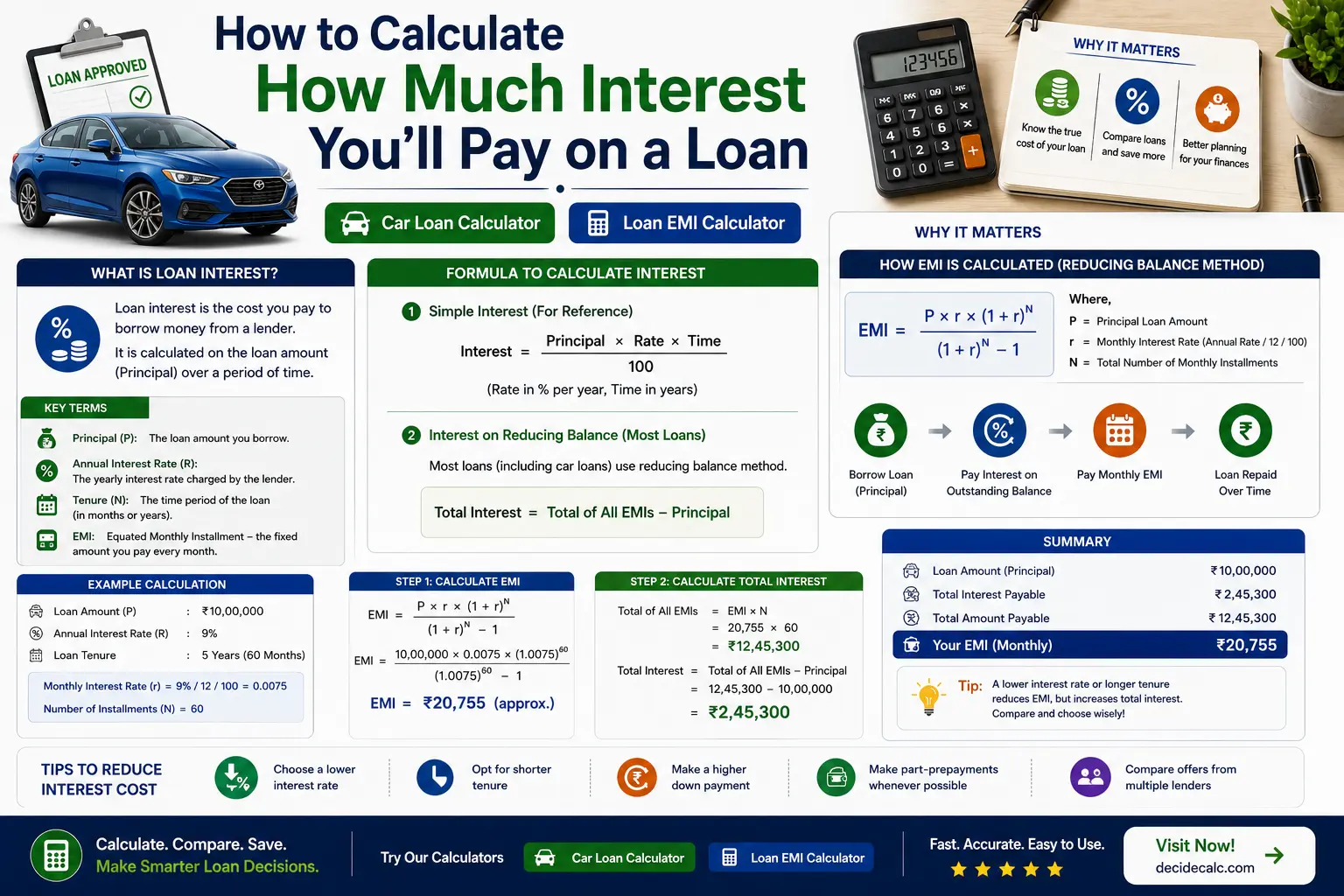
When you borrow money, you repay the principal plus interest. On a $35,000 car loan at 7% for five years, that interest adds up to $6,502 — nearly a fifth of the purchase price. Knowing the formula tells you not just the monthly payment but the true cost of the loan and how to cut it.
The two types of loan interest
Most consumer loans in the US — car loans, personal loans, mortgages, student loans — use amortizing interest. Your monthly payment stays the same, but the split between principal and interest shifts over time. A few lenders still use simple interest on short-term personal loans.
- Amortizing (installment) loans: same payment every month; early payments are mostly interest, later payments are mostly principal.
- Simple interest loans: I = P × r × t — interest is a flat percentage of the original principal, not the remaining balance. Less common for multi-year consumer loans.
The amortizing loan formula
The monthly payment formula (identical to the Excel PMT function) is:
- M = monthly payment
- P = principal (loan amount)
- r = monthly interest rate = APR ÷ 12
- n = total number of monthly payments = years × 12
Once you have M, total interest is simply: Total Interest = (M × n) − P
Worked example: $35,000 car loan at 7% for 60 months
| Variable | Value |
|---|---|
| Principal (P) | $35,000 |
| Annual rate (APR) | 7.00% |
| Monthly rate (r) | 7% ÷ 12 = 0.5833% |
| Term (n) | 60 months |
| Monthly payment (M) | $693.00 |
| Total paid (M × n) | $693.00 × 60 = $41,580 |
| Total interest | $41,580 − $35,000 = $6,580 |
That $6,580 is the real cost of borrowing — 18.8% added to the sticker price.
How amortization works month by month
Every month, the lender charges interest on the remaining balance. In month 1:
- Interest: $35,000 × 0.5833% = $204.17
- Principal: $693.00 − $204.17 = $488.83
- Remaining balance: $35,000 − $488.83 = $34,511.17
By month 60:
- Interest: ~$4.00 (balance is almost zero)
- Principal: ~$689.00
- Remaining balance: $0.00
This is why paying off a loan early saves so much — you skip the future months where most of the payment was going to interest anyway.
Interest cost by loan term (same $35,000 @ 7%)
| Term | Monthly payment | Total interest | Total paid |
|---|---|---|---|
| 36 months | $1,081 | $3,903 | $38,903 |
| 48 months | $837 | $5,192 | $40,192 |
| 60 months | $693 | $6,580 | $41,580 |
| 72 months | $597 | $7,953 | $42,953 |
| 84 months | $529 | $9,399 | $44,399 |
Going from 60 months to 72 months cuts your monthly bill by $96, but costs you $1,373 more in total interest over the life of the loan.
How one extra payment saves money
On the same $35,000 loan, making one extra $693 principal-only payment in month 6 — when the balance is about $31,600 — saves roughly $320 in interest and cuts the payoff by one month. The earlier in the loan you make an extra payment, the greater the savings, because the extra principal prevents every subsequent month's interest from accruing on that amount.
APR vs. interest rate — what to compare
The interest rate is just the base borrowing cost. APR (Annual Percentage Rate) adds in origination fees, dealer markup on financing, and points — then annualizes the total. When comparing loan offers from different lenders, always compare APRs, not stated rates. A 6.9% rate with a 1% origination fee can cost more than a 7.2% no-fee loan on a short-term loan.
Frequently asked questions
What is the formula for loan interest?
For an amortizing loan: Monthly Payment M = P × [r(1+r)^n] ÷ [(1+r)^n − 1], where P = principal, r = monthly rate (APR ÷ 12), n = number of months. Total interest = (M × n) − P.
How is loan interest calculated each month?
Each month, the interest charge is the remaining balance multiplied by the monthly rate. Because the balance shrinks with every payment, early payments are mostly interest and later payments are mostly principal — this is amortization.
How does one extra payment reduce total loan interest?
One extra principal-only payment reduces the outstanding balance immediately, lowering every future month's interest. On a $35,000, 60-month, 7% loan, one extra $693 payment early in the loan saves roughly $250–$350 in total interest.
What is the difference between APR and interest rate?
The interest rate is the base cost of borrowing. APR includes the interest rate plus fees — origination, dealer markup, points — spread over the loan term. APR is the true cost and the right number to compare across lenders.
Disclaimer: This article is for informational purposes only and does not constitute financial or legal advice. Loan rates and terms vary by lender, credit profile and state. Always consult a licensed financial professional before making borrowing decisions.