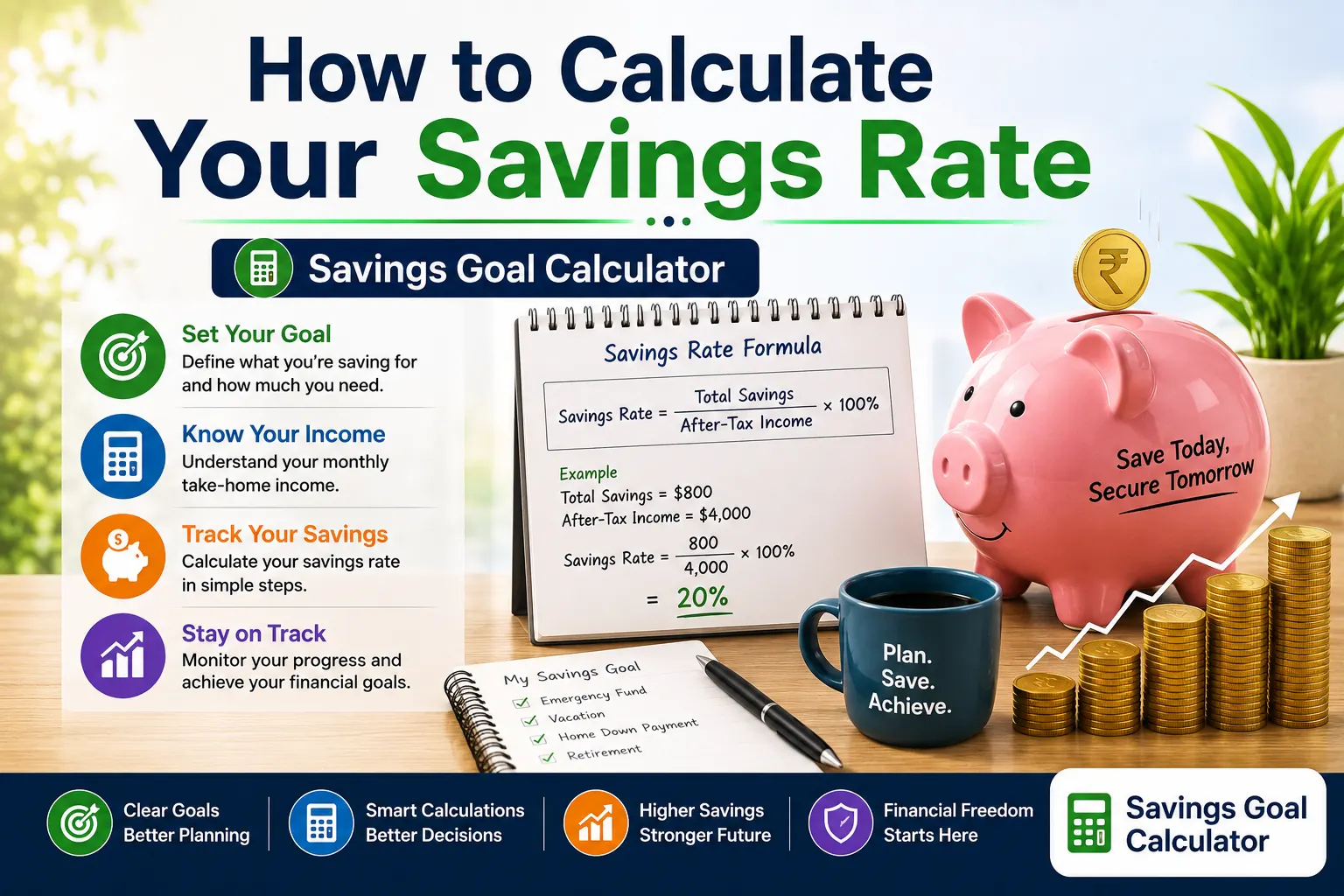
Your savings rate is the single most important number in personal finance. More than your income, more than your investment returns, it determines when you can stop working for money. The calculation is simple — but what you count as "savings" changes the answer significantly.
The savings rate formula
Both numbers must cover the same time period. Monthly savings and monthly income; annual savings and annual income.
Gross vs net income — which to use?
There are two common conventions:
| Basis | Formula | Who uses it |
|---|---|---|
| Gross savings rate | Savings / Pre-tax income | Financial planners (conservative view) |
| Net savings rate | Savings / Take-home income | FIRE community (more common) |
The same $1,200/month saved on a $6,000 gross salary yields different rates: gross rate = 20%, net rate (at $4,500 take-home) = 26.7%. Always state which basis you're using. FIRE benchmarks conventionally use net income.
Worked example: $72,000 salary
| Component | Monthly | Annual |
|---|---|---|
| Gross salary | $6,000 | $72,000 |
| Federal tax + FICA (about) | −$930 | −$11,160 |
| Net (take-home) income | $5,070 | $60,840 |
| 401(k) contribution (self) | +$500 | +$6,000 |
| 401(k) employer match | +$300 | +$3,600 |
| Roth IRA contribution | +$500 | +$6,000 |
| High-yield savings | +$400 | +$4,800 |
| Total saved | $1,700 | $20,400 |
| Net savings rate | $1,700 ÷ $5,070 = 33.5% | |
| Gross savings rate | $1,700 ÷ $6,000 = 28.3% | |
What counts as "savings"?
Include:
- 401(k), 403(b), 457 contributions (yours and employer match)
- IRA / Roth IRA contributions
- HSA contributions (if invested, not spent)
- Taxable brokerage or investment account contributions
- High-yield savings, CD, money market deposits
- Principal portion of mortgage payment (builds home equity, not just interest)
Exclude:
- Interest payments on any debt (mortgage, car, student loan)
- Money saved for a specific purchase you're about to make (vacation fund, car replacement sinking fund)
- Employer "contributions" to health insurance or other benefits you don't control
FIRE benchmarks: savings rate to years of work
At a 7% average real investment return, here's how long it takes to accumulate 25× your annual expenses (the standard FIRE target):
| Net savings rate | Years to FIRE | Spending rate at retirement |
|---|---|---|
| 10% | 51 years | 90% of income |
| 15% | 43 years | 85% of income |
| 25% | 32 years | 75% of income |
| 35% | 25 years | 65% of income |
| 50% | 17 years | 50% of income |
| 65% | 11 years | 35% of income |
| 75% | 7 years | 25% of income |
At a 50% savings rate, you work 17 years and then never have to work again. This is why extremely high savings rates are so powerful — they both accelerate the accumulation and reduce the required final portfolio.
How to raise your savings rate
- Reduce the big three: housing, transportation, and food represent about 60% of most household budgets. A 20% reduction in any of these moves your savings rate more than cutting streaming subscriptions.
- Automate before you see it: contributions that go directly to a 401(k) or IRA are never "available" to spend — they bypass willpower entirely.
- Bank the raise: direct 100% of any salary increase to savings until your rate hits your target, then adjust from there.
- Track it monthly: savings rate is a moving number. Review it quarterly against your target.
Frequently asked questions
How do I calculate my savings rate?
Savings Rate = (Amount saved / Income) × 100. If you save $1,500/month on $5,000 take-home pay, your net savings rate is 30%. Use net income for FIRE benchmarks; use gross for a more conservative planning figure.
Should I include employer 401(k) match in my savings rate?
Yes — employer match is real money being saved on your behalf. If your employer matches 4% of your $72,000 salary, that $2,880/year belongs in your savings numerator just like your own contributions.
What savings rate do I need to retire in 20 years?
At a 7% real return, you need approximately a 40% net savings rate to reach financial independence in 20 years. At 50%, you get there in 17 years. At 60%, in about 13 years.
Does paying off my mortgage count as savings?
Only the principal portion. The interest portion is consumption (cost of borrowing). Extra principal payments build home equity and do count toward your savings rate — but only the amount that exceeds the standard amortization schedule.
Disclaimer: This article is for educational purposes only. Savings rate targets assume constant real returns and do not account for sequence-of-returns risk, taxes, or unexpected expenses. Consult a qualified financial planner before making retirement decisions.