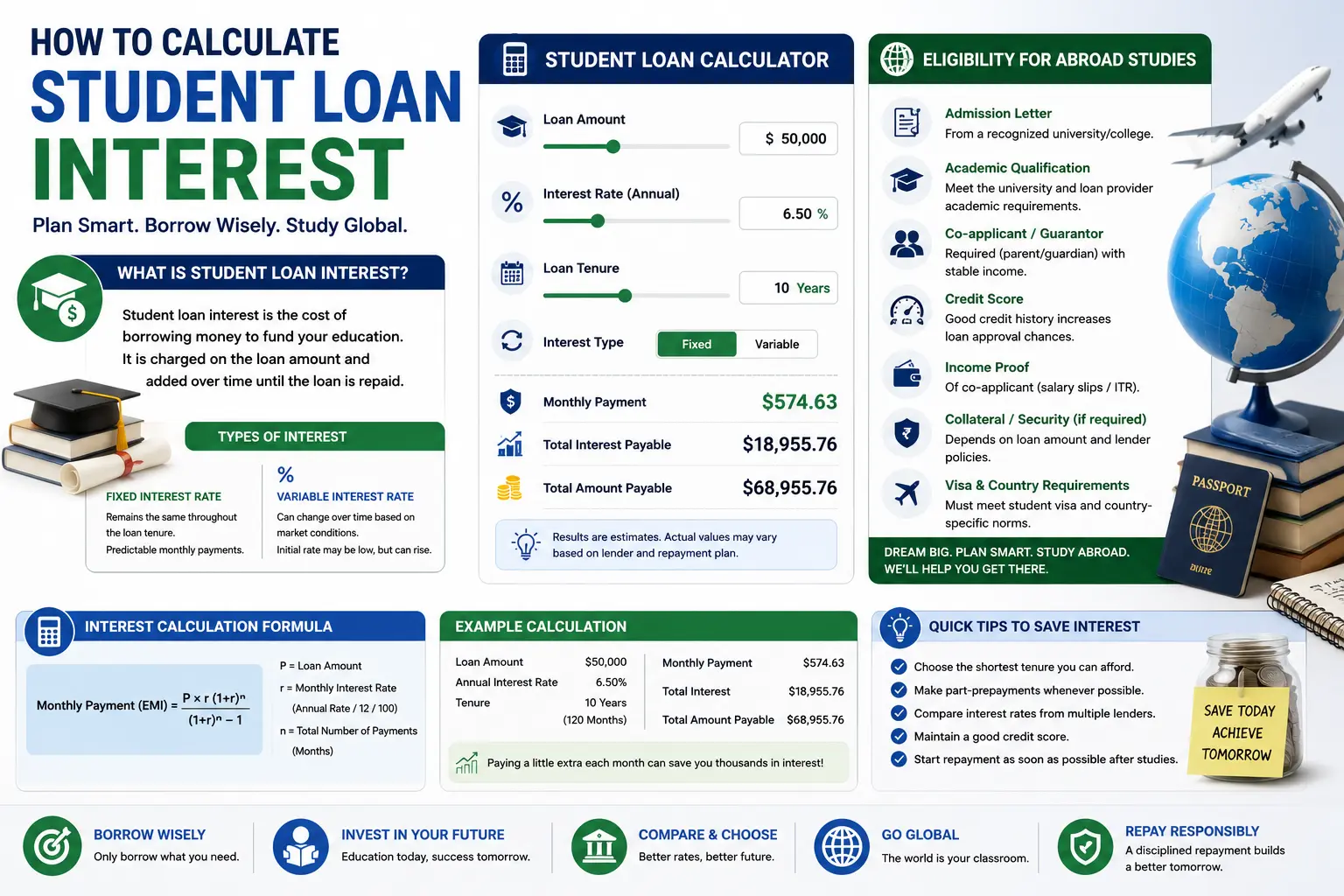
Student loan interest doesn't behave the way most people expect. Unlike a mortgage or car loan, federal student loans accrue interest every single day — including while you're in school if your loan is unsubsidized. Understanding the daily accrual formula tells you exactly how much your balance grows between payments and why paying just $50 extra per month changes your payoff date.
The daily interest formula
Federal student loans use this simple daily accrual method — not the amortizing formula used for mortgages and car loans.
Worked example: $30,000 at 5.5%
| Variable | Value |
|---|---|
| Principal balance | $30,000 |
| Annual interest rate | 5.5% |
| Daily interest rate | 5.5% ÷ 365 = 0.01507% |
| Daily interest charge | $30,000 × 0.0001507 = $4.52/day |
| Monthly interest (30 days) | $4.52 × 30 = $135.62 |
As your balance shrinks, the daily interest charge shrinks proportionally. After two years of payments, if the balance is $24,000, daily interest is $3.62 — and more of each payment goes to principal.
Unsubsidized loans: interest during school
Unlike subsidized loans, unsubsidized federal loans accrue interest from the day they're disbursed. If you borrow $20,000 in your freshman year at 5.5%:
| Year | Balance at start | Interest accrued | Balance at end |
|---|---|---|---|
| Freshman (Year 1) | $20,000 | +$1,100 | $21,100 |
| Sophomore | $21,100 | +$1,161 | $22,261 |
| Junior | $22,261 | +$1,224 | $23,485 |
| Senior | $23,485 | +$1,292 | $24,777 |
| At graduation | $24,777 |
You borrowed $20,000. At graduation you owe $24,777 — 24% more — without making a single payment.
Monthly payment on $30,000 at 5.5% for 10 years
Federal loans in repayment use the amortizing formula (same as the PMT formula):
| Item | Value |
|---|---|
| Principal (P) | $30,000 |
| Monthly rate (r) | 5.5% ÷ 12 = 0.4583% |
| Term (n) | 120 months |
| Monthly payment (M) | $325.65 |
| Total paid over 10 years | $325.65 × 120 = $39,078 |
| Total interest paid | $39,078 − $30,000 = $9,078 |
Income-driven repayment (IDR) plans
If your federal payment is unaffordable, IDR plans cap the monthly payment at 10–20% of discretionary income (5% for undergraduate loans under the SAVE plan):
- SAVE plan: 5% of income above 225% of the federal poverty guideline (about $32,800 for a single person in 2026).
- PAYE: 10% of discretionary income, forgiven after 20 years.
- IBR: 10–15% of discretionary income (depending on when you borrowed), forgiven after 20–25 years.
Under SAVE, any interest your monthly payment doesn't cover is not added to your balance — preventing the "ballooning balance" problem that plagued earlier IDR plans.
Federal vs private: the key differences
| Feature | Federal loans | Private loans |
|---|---|---|
| Interest rate set by | Congress (fixed) | Lender (fixed or variable) |
| IDR plans available | Yes | No |
| Forgiveness programs | Yes (PSLF, IDR forgiveness) | No |
| Deferment options | Broad (hardship, school, military) | Limited or none |
| Credit check required | No (Direct Loans) | Yes |
How extra payments reduce total interest
Every extra dollar of principal paid immediately reduces the balance, which reduces every subsequent day's interest charge. On $30,000 at 5.5% over 10 years:
| Extra payment | Monthly total | Total interest | Savings |
|---|---|---|---|
| No extra | $326 | $9,078 | — |
| +$50/month | $376 | $7,857 | $1,221 |
| +$100/month | $426 | $6,906 | $2,172 |
| +$200/month | $526 | $5,597 | $3,481 |
Frequently asked questions
How is student loan interest calculated daily?
Daily Interest = Balance × (Annual Rate ÷ 365). For $30,000 at 5.5%: $30,000 × (0.055 ÷ 365) = $4.52/day. As your balance decreases, the daily charge decreases proportionally.
What's the difference between subsidized and unsubsidized loans?
Subsidized loans don't accrue interest during enrollment, grace periods, or deferment. Unsubsidized loans accrue interest from disbursement — meaning you graduate owing more than you borrowed. Subsidized loans require demonstrated financial need.
What is income-driven repayment?
IDR plans (SAVE, PAYE, IBR) cap your federal payment at 5–20% of discretionary income and forgive remaining balances after 20–25 years of payments. Under SAVE, unpaid interest on subsidized loans is covered, so your balance doesn't grow while on the plan.
Should I refinance my federal student loans?
Only if you have excellent credit, a stable income, and don't expect to use IDR or forgiveness programs. Refinancing federal loans into private loans saves money if the rate drops significantly, but you permanently lose access to federal safety nets. Calculate the total interest difference carefully before refinancing.
Disclaimer: This article is for educational purposes only. Federal student loan programs change frequently. Interest rates, IDR plan terms, and forgiveness policies are set by Congress and the Department of Education and may change. Always verify current terms at studentaid.gov or consult a financial aid adviser.