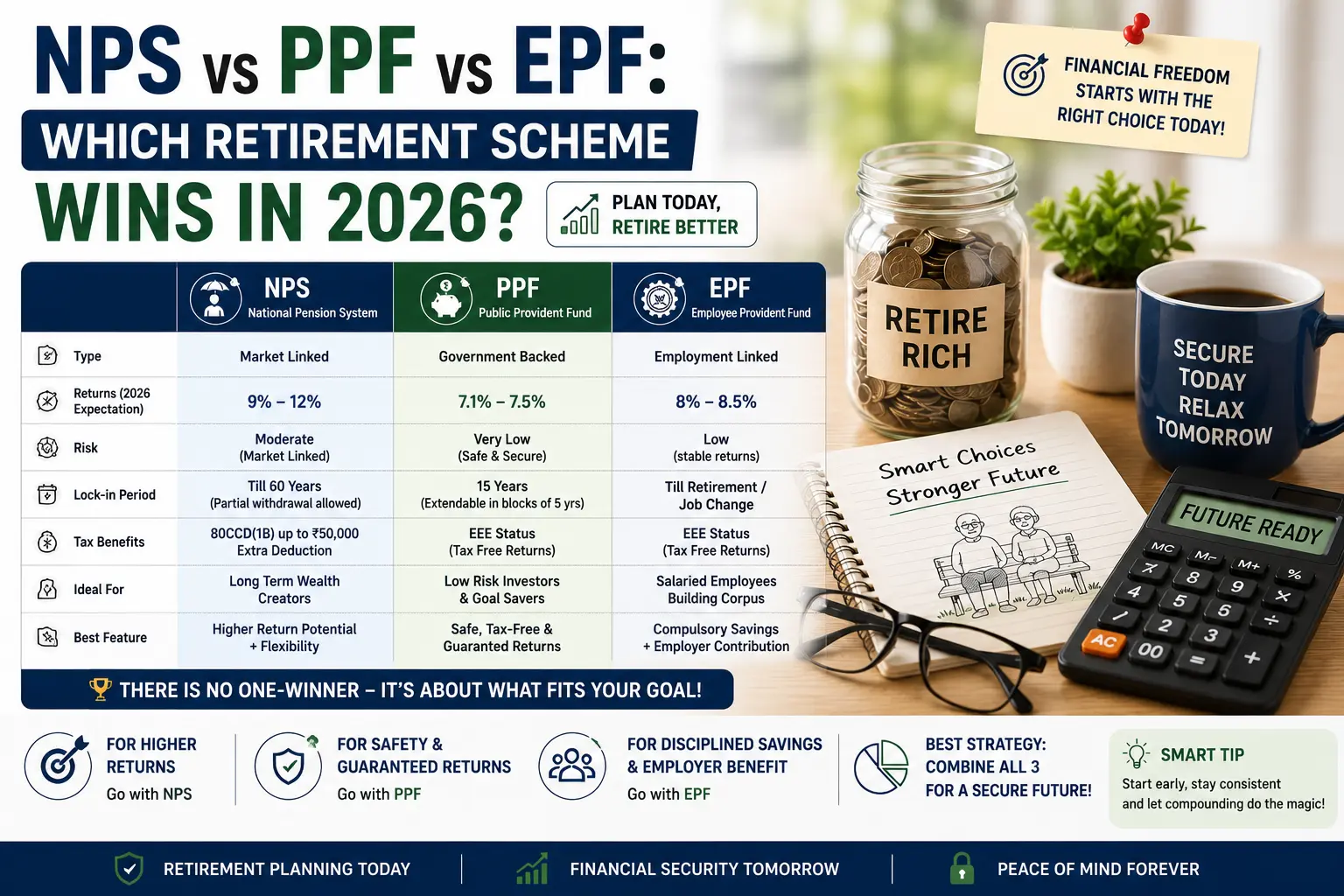
Indian savers rarely choose between NPS, PPF and EPF deliberately — they end up with all three in random proportions and no idea which is doing the work. The three schemes differ sharply on returns, tax treatment, liquidity and risk. This comparison settles which scheme deserves your next rupee.
The one-table comparison
| Feature | EPF | PPF | NPS |
|---|---|---|---|
| Who can open | Salaried (orgs with 20+ employees) | Any Indian resident | Any Indian resident, age 18–65 |
| Current returns | ~8.25% p.a. (declared yearly) | 7.1% p.a. (reset quarterly) | Market-linked, 9–12% historically |
| Annual cap | 12% of basic (mandatory) + voluntary | ₹1.5 lakh | No hard cap for investing |
| Risk | Sovereign-backed | Sovereign-guaranteed | Market risk (equity up to 75%) |
| Lock-in | Till retirement/resignation | 15 years (extendable) | Till 60 (partial from year 3) |
| Tax on maturity | Tax-free (EEE) | Tax-free (EEE) | 60% lumpsum tax-free; 40% must annuitise (taxable as pension) |
| Extra deduction | 80C | 80C | 80CCD(1B): extra ₹50,000 beyond 80C |
The tax story, honestly
EPF and PPF are EEE — exempt at deposit, accrual and withdrawal — the gold standard. NPS is EET-with-a-twist: deposits get 80CCD(1) inside 80C plus an extra ₹50,000 under 80CCD(1B) beyond the 80C ceiling, but at 60 only 60% of the corpus is tax-free; the remaining 40% must buy an annuity whose payouts are taxed at slab. For a 30% taxpayer, NPS’s extra deduction saves up to ₹15,600/year today in exchange for future pension taxation — worth it for most, but not free money.
Returns over 20 years: ₹10,000/month in each
At their representative rates — EPF 8.25%, PPF 7.1%, NPS 60:40 blend at 11% — ₹10,000/month for 20 years grows to approximately:
- EPF: ≈ ₹62.2 lakh (guaranteed-ish, fully tax-free)
- PPF: ≈ ₹54.4 lakh (sovereign-guaranteed, fully tax-free)
- NPS: ≈ ₹86.5 lakh (market-linked; ~₹52 lakh tax-free lumpsum + ~₹34.6 lakh annuity purchase whose pension is taxed)
The NPS number is bigger but carries equity risk and the annuity constraint; the PPF number is the smallest but is the only one with a sovereign guarantee. Model your own mix with the NPS Calculator and PPF Calculator.
So which one gets your next rupee?
- EPF first — it is mandatory, and any contribution beyond the compulsory 12% still earns the highest near-guaranteed rate.
- PPF for the debt slice — lock in the sovereign guarantee up to ₹1.5L/year if you want zero market risk; see the full PPF guide.
- NPS for growth + the extra ₹50k deduction — ideal once your 80C is full and you want equity exposure you cannot touch before 60 (the illiquidity is the feature).
If you are a freelancer, EPF drops out entirely: PPF becomes your safe base, NPS your growth engine. High earners in the 30% bracket get the most from NPS’s 80CCD(1B).
What NPS vs PPF vs EPF cannot do
None of the three is an emergency fund — all lock money for decades. Keep 3–6 months of expenses in a liquid fund or FD before adding to any of these. And none replaces a term insurance policy or health cover; a ₹1 crore retirement corpus evaporates fast against one uninsured hospitalization (size your cover with the Health Insurance Calculator).