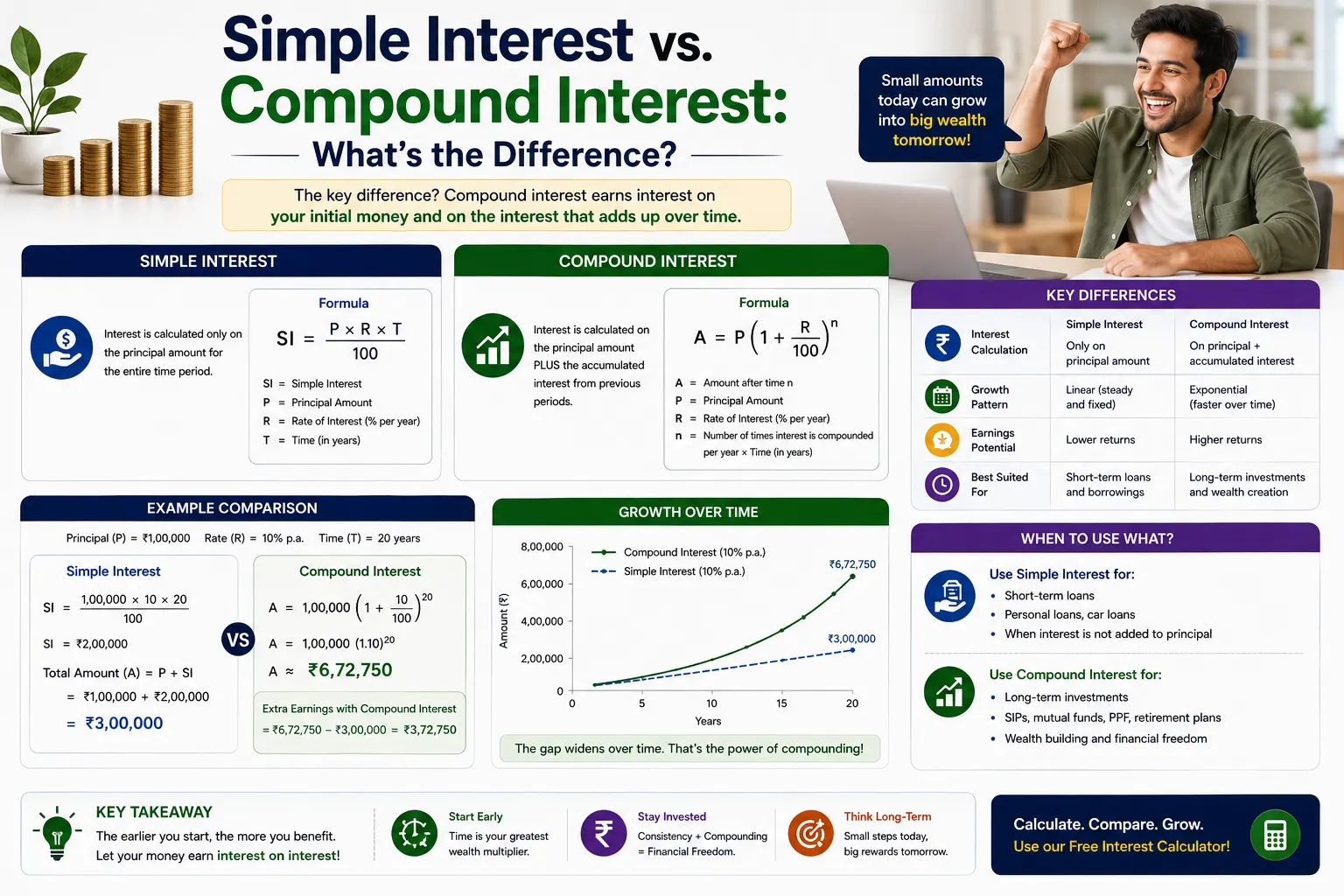
People hear the word “interest” and assume it is one thing. It isn’t. Two methods of calculating it lead to wildly different totals — and the difference widens every single year. Knowing which one your account or loan uses is the difference between saving as efficiently as possible and leaving thousands of dollars on the table (or paying thousands more than you needed to).
What is simple interest?
Simple interest is calculated only on the original principal, forever. The formula is one of the cleanest in finance:
I = total interest earned; P = principal; r = annual interest rate (decimal); t = time in years
Notice what is missing: no exponent, no compounding frequency, no time for interest to snowball. The interest earned each year is identical to the year before. That makes simple interest easy to audit, which is why it shows up in certain car loans, some student loans, and many short-term or personal loans.
What is compound interest?
Compound interest pays interest on the growing pile of interest itself:
A = future value
P = principal
r = annual rate
n = compounding periods per year
t = years
Every period, the interest you just earned becomes part of the base for the next period’s calculation. This is the engine behind every high-yield savings account, every 401(k), every Roth IRA, every stock portfolio left to grow for decades, and every mortgage that slowly devours itself over 30 years.
Side-by-side: $10,000 at 8% for 20 years
| Method | Formula | Future value | Interest earned |
|---|---|---|---|
| Simple interest | 10,000 × 0.08 × 20 | $26,000 | $16,000 |
| Compound interest (monthly) | 10,000 × (1 + 0.08/12)240 | $49,268 | $39,268 |
The compound version earns 2.4× more interest for exactly the same starting amount and rate. The only difference is that interest was reinvested. That is why the choice between the two matters so much.
Why the Rule of 72 captures the difference
The Rule of 72 is a quick mental-math shortcut for compound growth: Years to double = 72 ÷ interest rate. At 8%, money doubles every 9 years. Simple interest never doubles — it grows linearly, so that same $10,000 would take 12.5 years to reach $20,000. The shortcut only makes sense in a compound world.
Which one do US financial products actually use?
- High-yield savings accounts, money-market accounts, CDs → compound daily or monthly (look at APY, not nominal rate).
- 401(k), Roth IRA, taxable brokerage accounts → compound based on the underlying investment’s growth.
- Mortgages, auto loans, personal loans → amortized loans that work like compound interest in reverse: each payment first covers the interest for that month, then reduces principal.
- Some federal student loans and vehicle loans → simple interest (but check your note — many still compound after you consolidate).
Use the DecideCalc Compound Interest Calculator
When you want to move past theory and compute your own balance, our free Compound Interest Calculator projects a lump sum at any rate, any term, and any compounding frequency. It shows the growth multiple, the total interest earned, and the exact chart of how each year stacks on the one before.