Most mortgage calculators give you the answer to the wrong question. They show you the monthly payment and let you pick the lower one. The more useful question is: over every year you own this home, which option actually leaves you with more money? The answer is nuanced and depends on what you do with the difference.
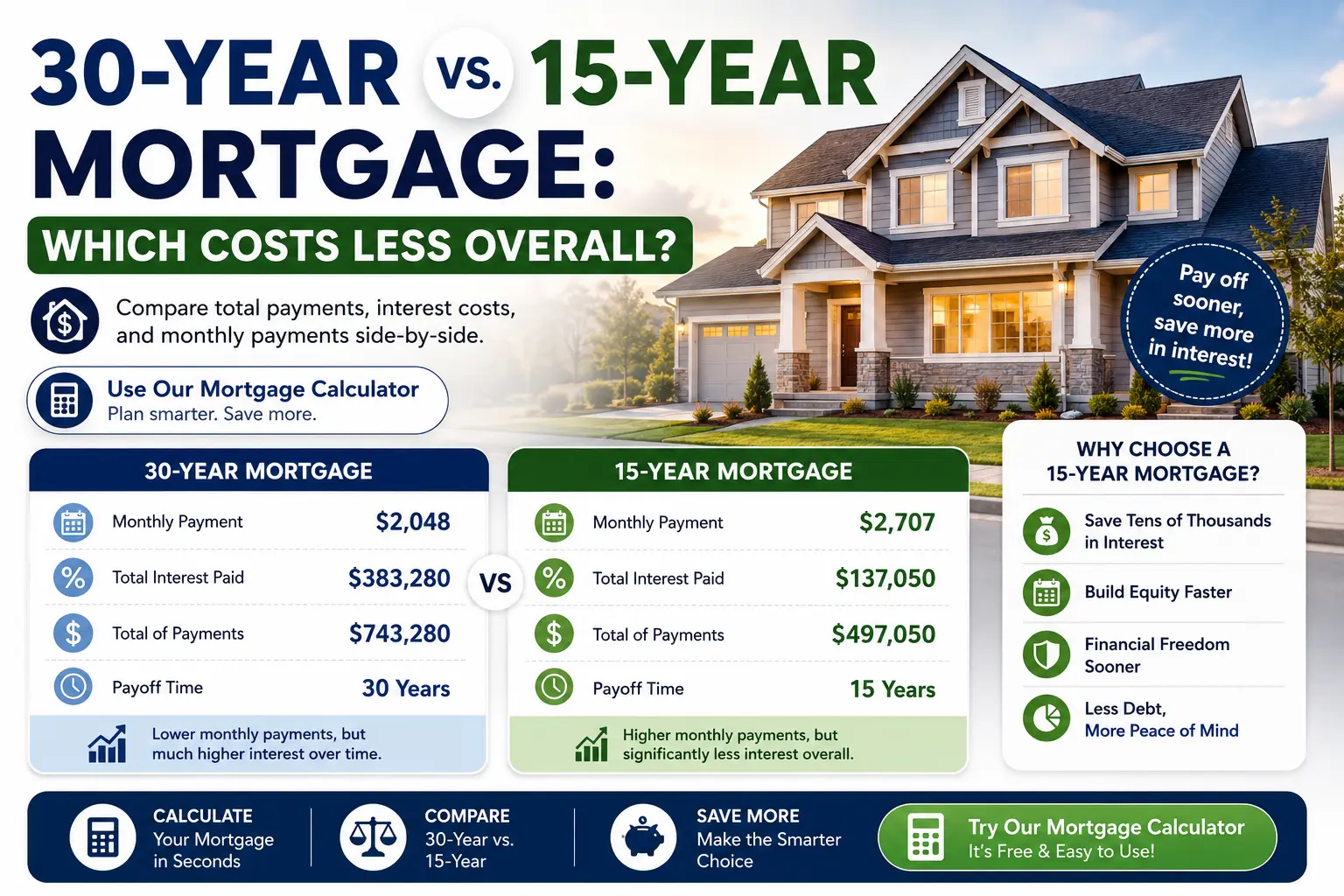
The numbers side-by-side: $320,000 loan
Using the same purchase scenario from the mortgage payment guide — $400,000 home, $80,000 down, $320,000 financed. Current typical rate spread in the US: 30-year at 7.0%, 15-year at 6.35%.
| Metric | 30-Year @ 7.0% | 15-Year @ 6.35% |
|---|---|---|
| Monthly P&I | $2,129 | $2,769 |
| Monthly difference | — | +$640/month |
| Total payments | $766,440 | $498,420 |
| Total interest paid | $446,440 | $178,420 |
| Interest saved | — | $268,020 |
The 15-year saves over $268,000 in interest on this one loan. That is an enormous difference. But it costs $640 more per month for 15 years — which is where the real trade-off lives.
The opportunity cost argument for the 30-year
Here is the counter-argument that mortgage advisors rarely show you upfront. If you take the 30-year and invest the $640/month difference in an index fund at 7% over 15 years (the period where the payment gap exists), you would accumulate approximately $201,000. After taxes that is roughly $155,000–$175,000 in after-tax value — partially offsetting the interest cost gap.
This math only holds if you actually invest the difference every month without fail. Most people don't. If the $640 disappears into lifestyle spending, the 15-year wins unambiguously.
Other factors that affect the decision
- Income stability. The 30-year's lower required payment is a safety net if income drops. The 15-year locks you into a higher obligation with no flexibility.
- Emergency fund. If the extra $640/month depletes your cash reserves, a single job loss becomes a foreclosure risk. Do not underestimate liquidity.
- How long you plan to stay. If you'll sell in 7 years, the amortization schedules converge. Total interest paid on both terms is much closer at year 7 than year 30.
- Tax deduction. Mortgage interest is potentially deductible (if you itemize). A higher interest payment gives more deduction room — though tax law changes often, so don't make the decision on deductibility alone.
- PMI. If your down payment is under 20%, PMI applies to both. You'll hit 20% equity faster on the 15-year, eliminating PMI sooner and saving an extra $100–$200/month.
The hybrid strategy: 30-year loan, 15-year payoff
You can get most of the 15-year's benefit with the 30-year's flexibility by making extra principal payments equivalent to the payment difference. One extra principal payment per year cuts a 30-year loan to roughly 25 years. Match the 15-year payment amount every month and you pay off in about 16–17 years — slightly longer than a true 15-year, and at a slightly higher rate, but with the option to scale back payments if you ever need to.
Use the DecideCalc Mortgage Calculator
The DecideCalc Mortgage Calculator lets you run both scenarios in the same session. Enter your loan amount, then switch the term between 15 and 30 years to see the payment and total-cost comparison instantly. For the full formula walkthrough, see How to Calculate Your Monthly Mortgage Payment.