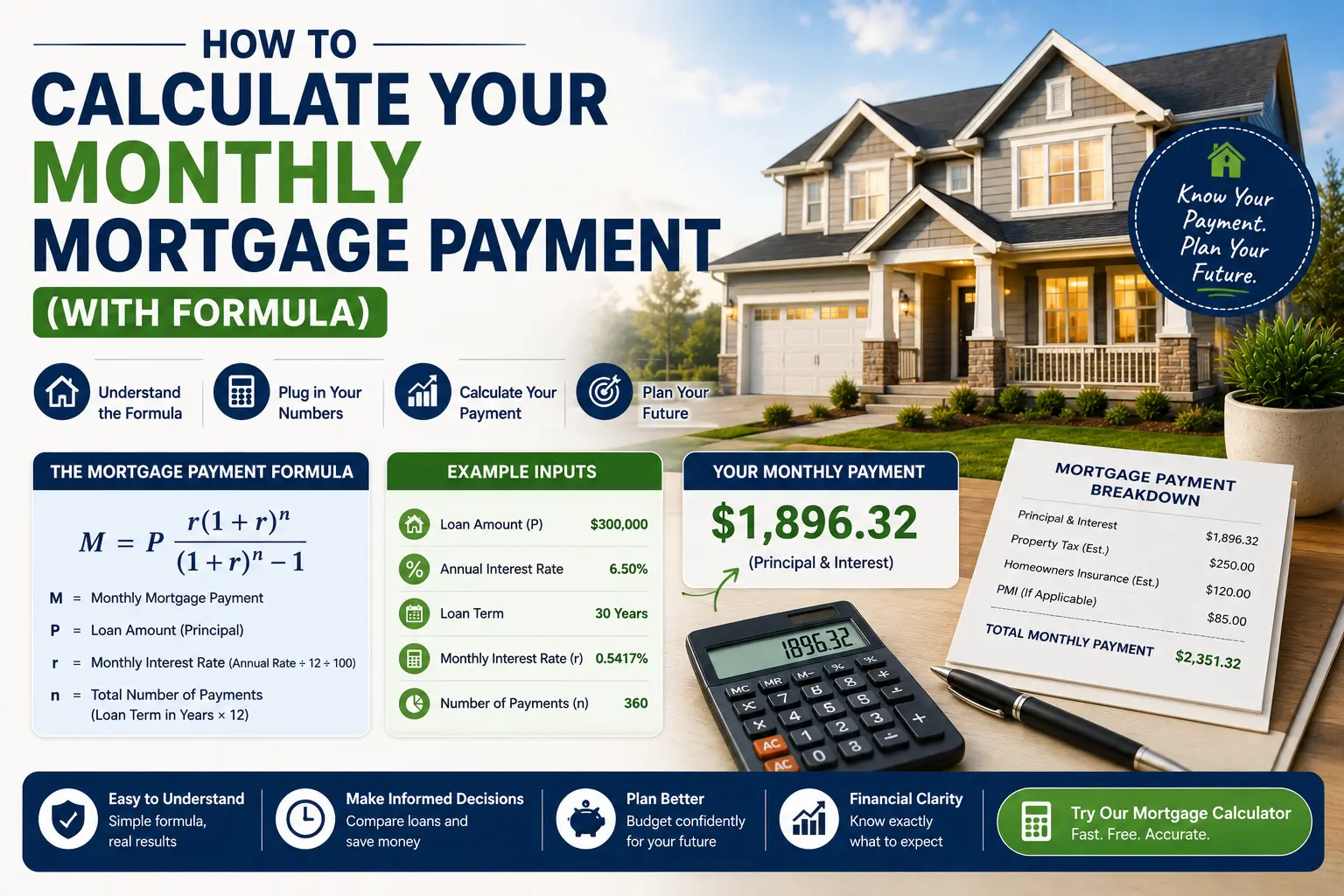
A monthly mortgage payment is not one number — it is four, and they get lumped together into a single withdrawal. The principal-and-interest portion follows a mathematical formula; the other two components depend on your local tax rate, your insurance premium, and whether you made at least a 20% down payment. Let's pull all four apart.
The P&I formula every borrower should know
The principal-and-interest (P&I) portion of your mortgage is calculated using the standard loan payment formula:
M = monthly P&I payment; P = loan principal (amount borrowed); r = monthly interest rate = annual rate ÷ 12; n = total number of payments = years × 12
Worked example: $320,000 at 7% for 30 years
This is a realistic scenario for a median-priced US home purchase in 2026. Say you put $80,000 down on a $400,000 home, leaving a $320,000 loan.
- P = $320,000
- Annual rate = 7%; monthly rate r = 0.07 ÷ 12 = 0.005833
- n = 30 × 12 = 360 payments
Plugging in: M = 320,000 × [0.005833 × (1.005833)360] ÷ [(1.005833)360 − 1]
(1.005833)360 ≈ 8.1164
M = 320,000 × (0.005833 × 8.1164) ÷ (8.1164 − 1) = 320,000 × 0.04734 ÷ 7.1164 ≈ $2,129/month
The full PITI payment: what you actually pay each month
P&I is only part of what hits your bank account. Lenders almost always collect the full PITI in one payment:
| Component | What it covers | Est. monthly ($400K home, TX) |
|---|---|---|
| Principal | Reduces loan balance | $2,129 combined |
| Interest | Cost of borrowing | |
| Taxes | Property tax held in escrow | ~$600–$700 |
| Insurance | Homeowners insurance | ~$150–$200 |
| PMI (if <20% down) | Protects lender, not you | ~$100–$200 |
That $2,129 P&I payment on a Texas home could easily become $3,100–$3,300 per month all-in once you add realistic property tax, insurance, and PMI.
How amortization works: early payments are mostly interest
Despite your $2,129 payment in month 1, only about $257 of it reduces the balance. The rest — $1,872 — goes to interest. Why? Because interest is calculated on the current outstanding balance, and at the start that balance is $320,000. As you pay down the principal, the interest portion shrinks and the principal portion grows.
By year 15, the split is roughly 50/50. By year 28, most of your payment is actually reducing the balance. This is why extra principal payments early in a mortgage are so powerful — they compound forward through every future month's interest calculation.
How much does the interest rate change your payment?
| Rate | Monthly P&I ($320K, 30yr) | Total interest paid |
|---|---|---|
| 5.5% | $1,817 | $334,104 |
| 6.5% | $2,023 | $408,190 |
| 7.0% | $2,129 | $446,515 |
| 7.5% | $2,237 | $484,948 |
Each 0.5% rate increase on a $320,000 loan costs roughly $108/month and over $38,000 more in total interest. That's why rate shopping before locking matters enormously.
Use the DecideCalc Mortgage Calculator
The DecideCalc Mortgage Calculator handles every variable: loan amount, rate, term, down payment, property tax rate, homeowners insurance, and PMI. It outputs your monthly PITI estimate plus the full amortization table so you can see exactly how the balance shrinks year by year.
If you're deciding between a 15-year and 30-year term, see the 30-Year vs. 15-Year Mortgage guide for a complete side-by-side comparison on total cost and monthly payment trade-offs.