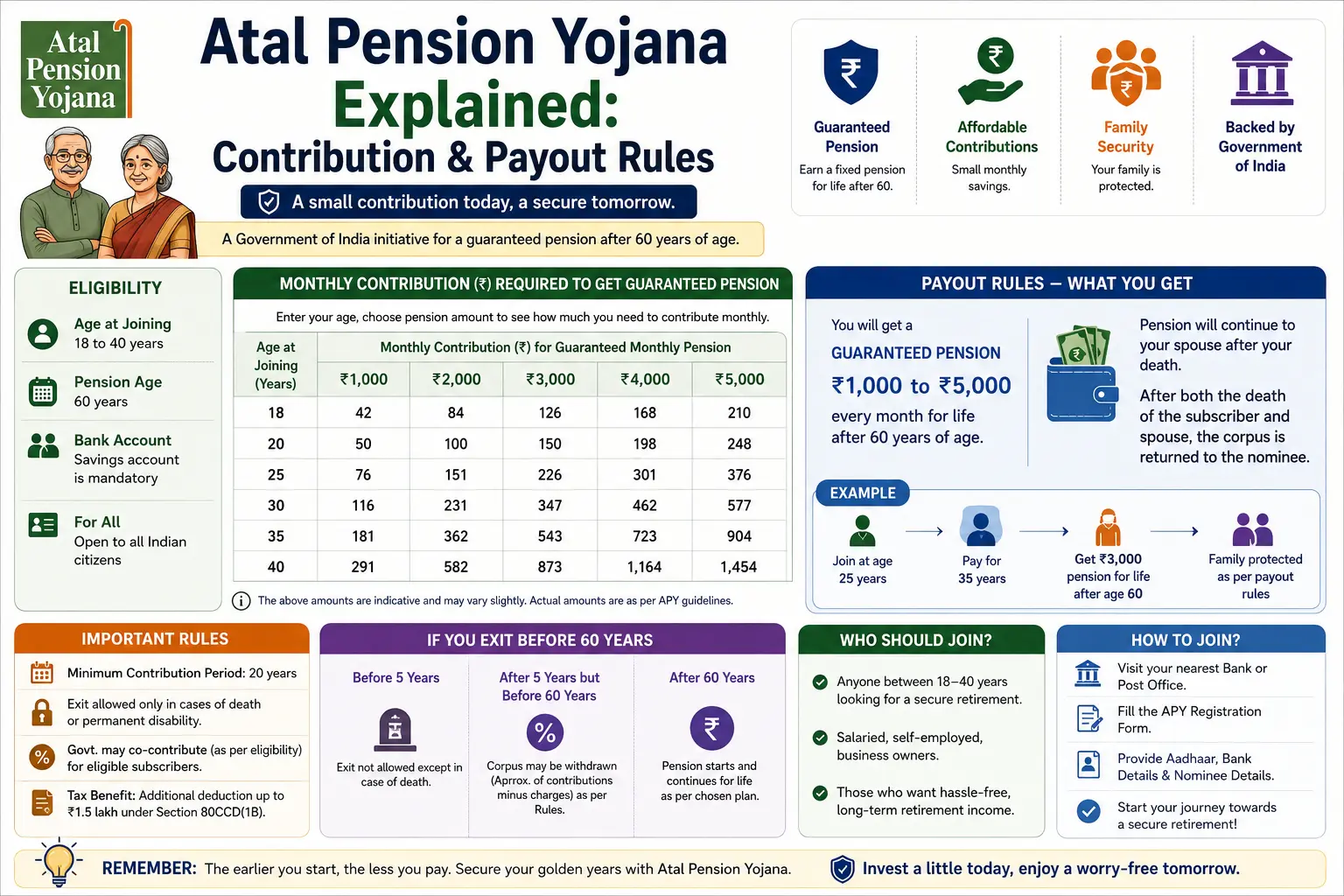
Atal Pension Yojana (APY) is the government’s guarantee-backed micro-pension: contribute a fixed monthly amount until 60, receive a guaranteed pension of ₹1,000–₹5,000 per month for life, with the corpus returned to your spouse or nominee. It is not the highest-return product in the market — it is the most certain one. This guide covers contributions by age, payouts, exit rules and who should (and shouldn’t) enrol.
The pension slabs and who can join
Eligibility: any Indian citizen aged 18–40 with a savings bank account, with at least 20 years of contribution before 60. Since October 2022, income-tax payers are not eligible — APY is aimed at unorganised-sector workers.
Pension options: ₹1,000, ₹2,000, ₹3,000, ₹4,000 or ₹5,000 per month from age 60, for life. On death, the spouse continues receiving the same pension; after both pass, the accumulated corpus goes to the nominee.
Monthly contribution by entry age (indicative)
| Entry age | For ₹1,000 pension | For ₹2,000 pension | For ₹5,000 pension |
|---|---|---|---|
| 18 | ₹42 | ₹84 | ₹210 |
| 25 | ₹76 | ₹151 | ₹376 |
| 30 | ₹116 | ₹231 | ₹577 |
| 35 | ₹181 | ₹362 | ₹902 |
| 40 | ₹291 | ₹582 | ₹1,454 |
Indicative 2026 figures for monthly auto-debit; exact premiums are on the bank’s APY registration form and vary marginally with mode (monthly/quarterly/half-yearly). The pattern is the lesson: joining at 18 instead of 40 cuts the required contribution by roughly 85% — the same pension for one-seventh the price, purely from 22 extra years of compounding.
Tax benefit and returns reality
- Tax: APY contributions qualify for deduction under Section 80CCD(1) within the overall 80C limit (old regime); the pension received is taxable as income.
- Returns: implied internal returns historically run in the 7–8% p.a. band — below equity, comparable to debt products, but with a sovereign guarantee on the outcome that no market product offers.
- Inflation: the pension is fixed at the slab — ₹5,000 in 2046 buys materially less than ₹5,000 today. APY is a floor, not a plan (see the Inflation Calculator for the erosion maths).
Exit, death and delay rules
- Voluntary exit before 60: permitted; you get back your contributions plus the portion of government co-contribution earned (the co-contribution for eligible early joiners ended for new entrants after 2015–16) plus actual accrued income — less the nominal ₹20–₹100 account-operation charges.
- Death before 60: spouse can continue the scheme to completion or claim refund of accumulated corpus; nominee claims if no spouse.
- Delayed payments: auto-debit bounces attract penalties per period (₹1–₹10/month by contribution size); prolonged default leads to account deactivation and eventual closure.
- After 60: the pension starts automatically to the registered account; higher slabs require proportionally longer contribution history at the same age.
APY vs the alternatives — where it fits
For an unorganised-sector worker with no EPF and low risk appetite, APY’s guaranteed floor plus nominee protection is hard to beat at these contribution levels. Salaried investors should typically prioritise EPF first (higher returns, also government-backed), then PPF (flexible, lumpsum at maturity — see NPS vs PPF vs EPF), and treat APY as a small guaranteed floor if eligible. To size a full retirement corpus rather than a ₹5,000 floor, start with the Retirement Calculator or the NPS Calculator for market-linked growth.