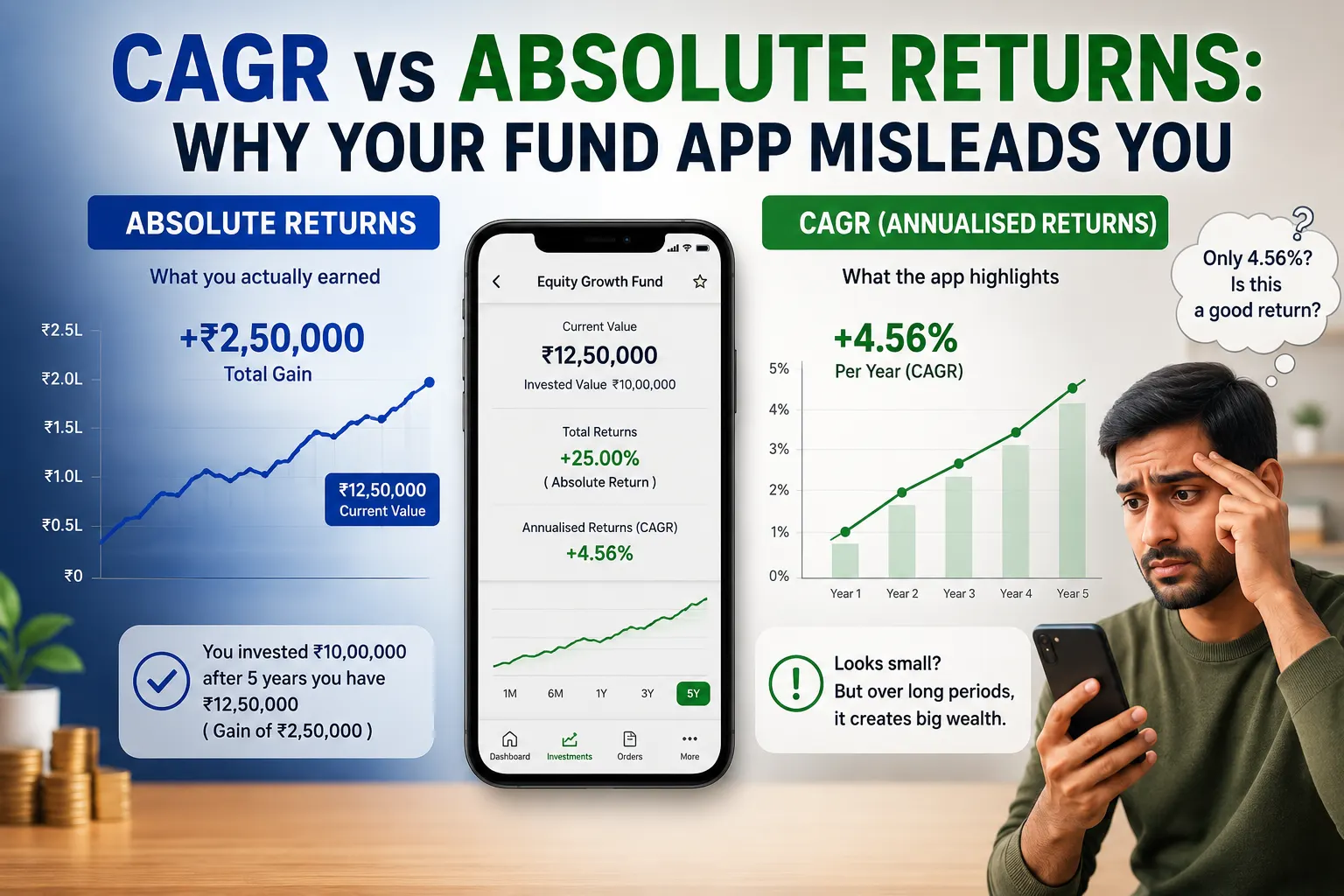
Open any mutual fund app and you’ll see a big green number next to your investment. Whether that number is honest depends on one thing the app rarely says: over how long? "Absolute return" measures the total percentage change; "CAGR" converts it to a per-year rate. For anything held over a year, comparing — or celebrating — absolute returns is how investors fool themselves.
The two formulas
CAGR = (Final ÷ Initial)^(1 ÷ years) − 1
Example: ₹5 lakh grows to ₹7.35 lakh in 3 years. Absolute return = 47%. CAGR = (7.35 ÷ 5)^(1/3) − 1 = 13.7% per year. Same investment, same rupees — 47% sounds like a triumph, 13.7% is the honest annual pace.
Why apps show absolute returns for short holdings
Industry convention (and SEBI’s disclosure norms) uses absolute returns for periods under one year and CAGR/XIRR beyond. Apps exploit the seam: a 14-month holding flashes "31%" absolute instead of "19.8% CAGR". Both are true; one is designed to feel better. For SIP investments, even CAGR is wrong — money entered in instalments needs XIRR, which weights each SIP’s own holding period. A ₹10k/month SIP for 2 years showing "26% return" might be ~15% XIRR.
The comparison table that ends arguments
| Scenario | Absolute return | CAGR (per year) | What it means |
|---|---|---|---|
| ₹5L → ₹5.6L in 1 year | 12% | 12% | Identical under a year — no compounding yet |
| ₹5L → ₹7.35L in 3 years | 47% | 13.7% | Solid equity-like pace |
| ₹5L → ₹10L in 10 years | 100% | 7.2% | Average, not spectacular |
| ₹5L → ₹10L in 20 years | 100% | 3.5% | Barely beats old FDs |
Same rupee outcome (₹10 lakh), four different annualised truths. This is why every goal — retirement, education, a house — must be planned in CAGR terms. Run your own numbers in the CAGR Calculator.
Where each measure belongs
- Under 1 year: absolute return is the only option (annualising short bursts exaggerates noise).
- 1 year+ lumpsum: CAGR.
- SIPs / instalments: XIRR (a CAGR that accounts for cash flowing in over time).
- Comparing funds: always CAGR/XIRR over identical periods — 3-year CAGR of fund A vs 3-year CAGR of fund B, never "returns since inception" vs "1-year return".
Inflation: the silent second discount
Real return = CAGR − inflation. A 12% CAGR at 6% inflation is a ~5.7% real return — still good, but a third of the headline. Over 20 years, ₹10 lakh at "12%" grows to ₹96 lakh nominal, worth about ₹30 lakh in today’s money. For the full purchasing-power picture, run the same numbers through the Inflation Calculator, and see how to calculate investment returns for the complete method.