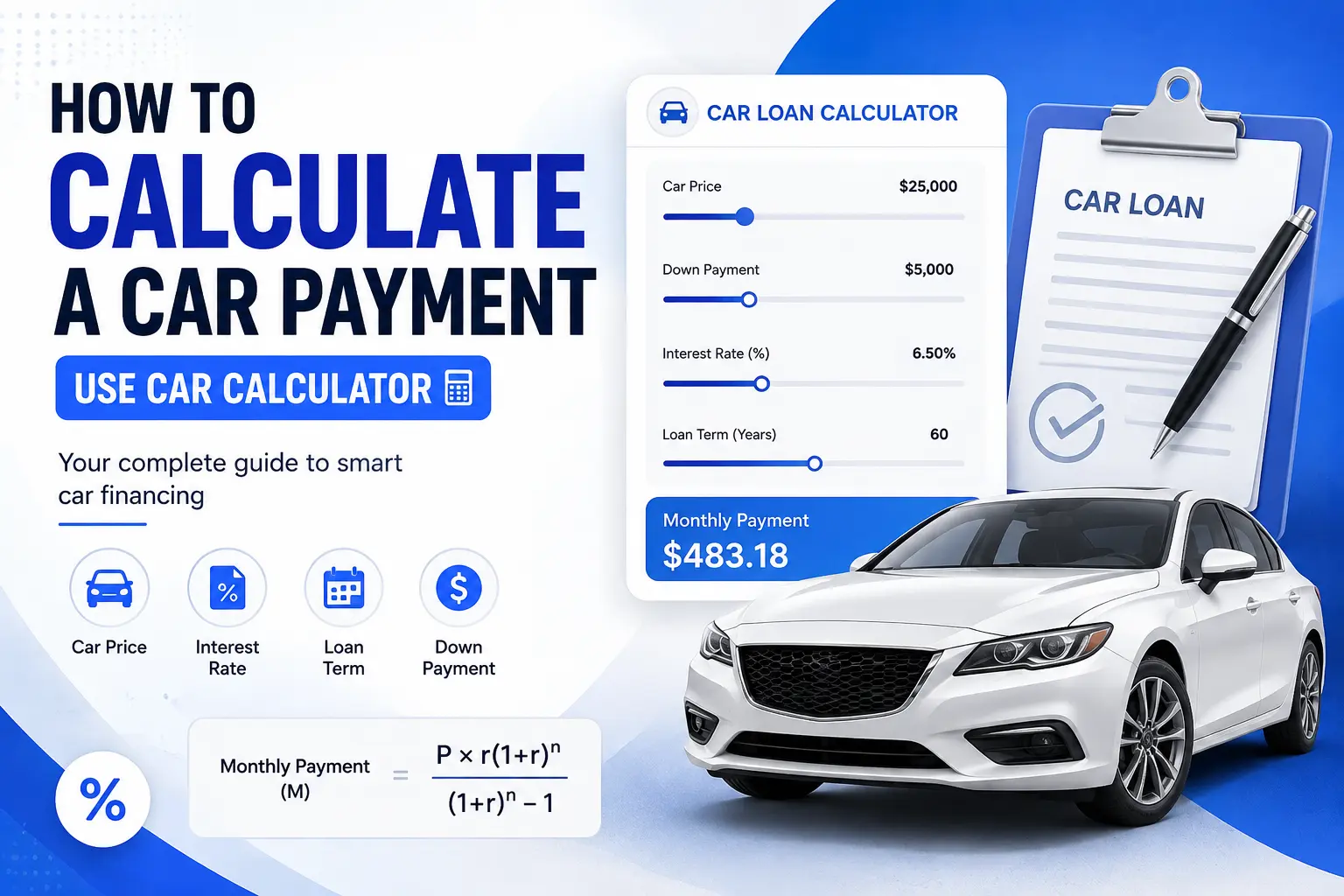
Every car payment comes from the same amortization formula banks use for mortgages — the only difference is the loan size and the term length. Once you can reproduce the number yourself, dealer finance offices lose their biggest advantage: you stop negotiating from the monthly payment and start negotiating from the price and the rate.
The car payment formula, decoded
M = monthly payment; P = amount financed (price − down payment − trade-in + any rolled-in taxes and fees); r = monthly interest rate = APR ÷ 12; n = loan term in months
The amount financed matters more than the sticker price. If you negotiate a $33,000 SUV, put $5,000 down, and roll in nothing extra, P = $28,000 — even though the car costs $33,000.
Worked example: $28,000 financed at 7% for 60 months
- P = $28,000
- APR = 7%; monthly rate r = 0.07 ÷ 12 = 0.005833
- n = 60 payments
(1.005833)60 ≈ 1.41763
M = 28,000 × (0.005833 × 1.41763) ÷ (1.41763 − 1) = 28,000 × 0.0082694 ÷ 0.41763 ≈ $554 per month
Over those 60 months you pay $33,240 in total — which means $5,240 is pure interest. That number, not the monthly payment, is what you should minimize.
How each of the four levers moves the payment
| What changes | From → to | Monthly effect | Total cost effect |
|---|---|---|---|
| Price negotiated $1,000 lower | $33K → $32K | −$20/mo | −$1,190 |
| Down payment $2,000 bigger | $5K → $7K | −$40/mo | −$2,380 in interest |
| APR 2 points lower | 7% → 5% | −$26/mo | −$1,560 in interest |
| Term 60 → 48 months | −12 payments | +$116/mo | −$1,060 in interest |
Notice the pattern: shortening the term is the only lever that raises your payment yet saves you money overall. Every other lever is free money if you can get the dealer or lender to move it.
Why "what monthly payment do you want?" is a trap
When a salesperson asks what payment you are comfortable with, they are not trying to fit the car to your budget — they are trying to fit the loan to the payment. A $450/month target can be hit with a 48-month loan on a modest car or an 84-month loan on a much pricier one. Same payment, wildly different total cost. Fix your floor before the visit: the maximum price and maximum APR you will accept, not just the monthly figure.
Used cars: the rate penalty nobody mentions
Lenders charge more for used vehicles because the collateral depreciates faster and resale values are less predictable. Expect used-car APRs to run 1–3 percentage points above new-car rates for the same credit profile. A borrower quoted 6.5% on a new sedan might see 8.5–9% on a four-year-old one. That difference adds roughly $15–$20 per month on a typical used-car loan — the used car loan calculator lets you test those higher rates before you shop.
Before you sign: the 20/4/10 sanity check
- 20% down. Puts you ahead of depreciation so you are not underwater in year one.
- 4 years or less. Keeps interest contained and matches the warranty window of most vehicles.
- 10% of gross income all-in. Payment plus insurance and fuel stays predictable even in a bad month.
Break all three and the car owns your budget, not the other way around. See our deeper breakdown in how to calculate loan interest for the amortization math behind every auto loan, no matter the lender.