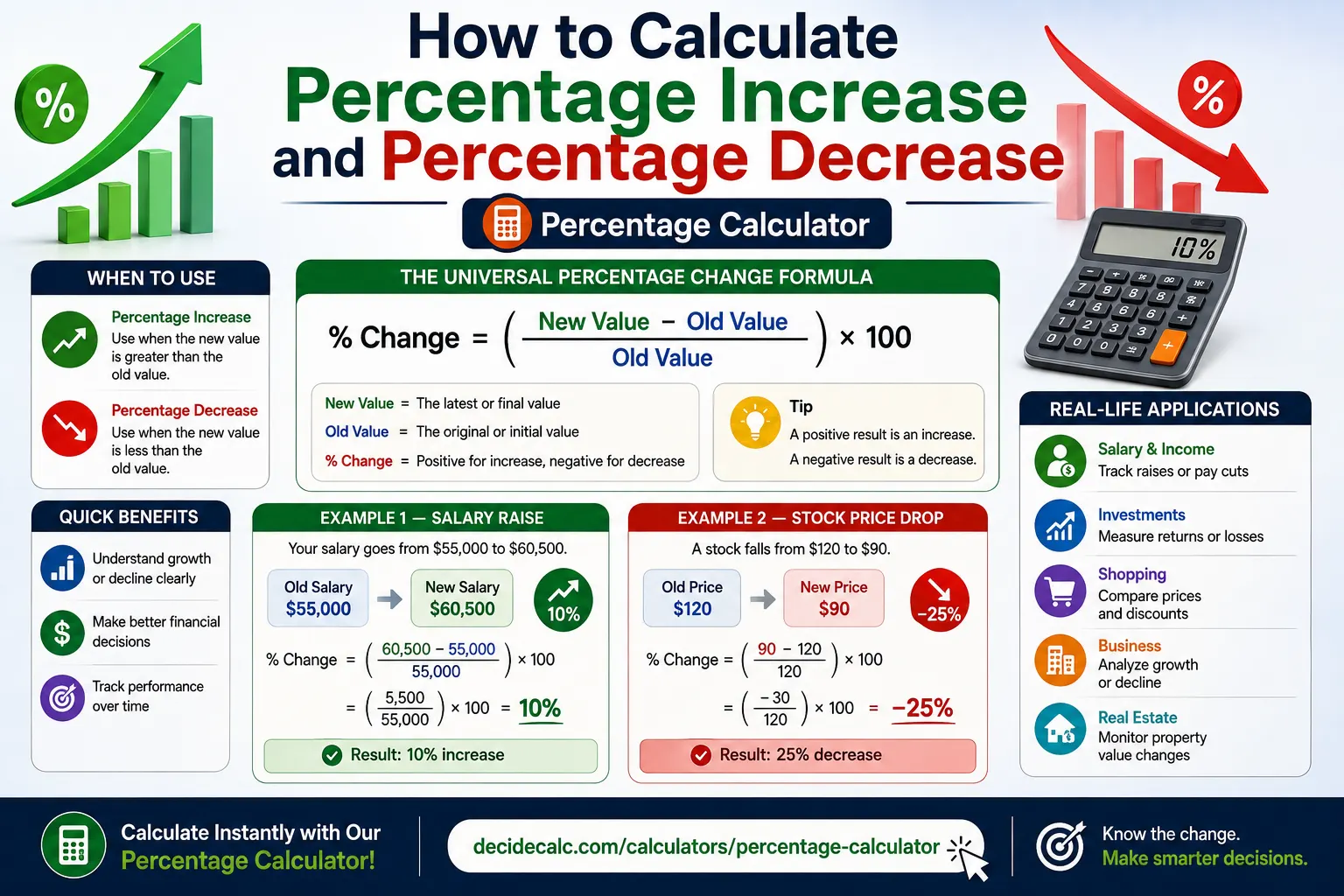
Whether you're evaluating a salary raise, tracking a stock loss, or comparing last year's prices, percentage change is the number that matters. The formula is the same whether you're going up or down — the sign tells you which direction.
The universal percentage change formula
- A positive result = percentage increase
- A negative result = percentage decrease
The key rule: always divide by the old (original) value, not the new one.
Example 1 — Salary raise
Your salary goes from $55,000 to $60,500.
That's a 10% raise. To find a new salary after a known percentage raise: New = Old × (1 + %/100). A 7% raise on $55,000: $55,000 × 1.07 = $58,850.
Example 2 — Stock price drop
A stock falls from $120 to $90.
The stock fell 25%. To find a new price after a known percentage drop: New = Old × (1 − %/100). A 15% drop from $200: $200 × 0.85 = $170.
Percentage increase and decrease quick reference
| Scenario | Formula | Example | Result |
|---|---|---|---|
| Find % change | ((New − Old) / Old) × 100 | $80 → $100 | +25% |
| Find new value after % up | Old × (1 + %/100) | $80 × 1.25 | $100 |
| Find new value after % down | Old × (1 − %/100) | $100 × 0.75 | $75 |
| Find original before % up | New / (1 + %/100) | $100 / 1.25 | $80 |
| Find original before % down | New / (1 − %/100) | $75 / 0.75 | $100 |
The asymmetry trap: why a 50% loss needs a 100% gain
This is the most important concept in percentage math, and the one most people get wrong.
Start with $1,000. It drops 50% → $500. To get back to $1,000 from $500, you need a gain of $500 on a base of $500 — that's 100%, not 50%.
| Drop | Amount left | Gain needed to recover |
|---|---|---|
| 10% drop | $900 | 11.1% gain |
| 20% drop | $800 | 25% gain |
| 33% drop | $670 | 49% gain |
| 50% drop | $500 | 100% gain |
| 75% drop | $250 | 300% gain |
This is why avoiding large losses matters more in investing than chasing large gains. Percentage changes are not symmetric — their base changes each time.
Consecutive percentage changes
If a price rises 20% and then falls 20%, does it return to the original? No.
- Start: $100
- After +20%: $120
- After −20% on $120: $120 × 0.80 = $96
You end up 4% below where you started. To compound multiple percentage changes, multiply the factors: 1.20 × 0.80 = 0.96 → −4% net.
Common percentage change errors
- Dividing by the wrong base: Dividing by the new value instead of the old value gives a different (wrong) percentage. Always use the starting value as the denominator.
- Treating consecutive changes as additive: A 10% raise followed by a 10% raise is not a 20% raise — it's 1.10 × 1.10 = 1.21, or a 21% raise.
- Confusing percentage points with percent: If an interest rate goes from 4% to 6%, it increased by 2 percentage points — but by 50% relative to the original rate.
Percentage change in Indian money terms
Salary hike maths: ₹45,000 → ₹54,000 is a (54000 − 45000) ÷ 45000 = 20% increase. After 10% average inflation over two years, though, the same raise is only ~8% real across that period — judge offers against inflation, not just the old salary. For the full decision (not just the percentage), see should you switch jobs for a 20% hike?
Price change between two prices: petrol moving ₹94.72 → ₹102.86/L is (102.86 − 94.72) ÷ 94.72 = +8.6%; your monthly fuel bill rises by the same percentage at constant usage. Grocery inflation works identically: a monthly basket ₹8,000 → ₹8,720 is +9%. Compute any two prices instantly with the Percentage Calculator.
The percentage-points trap: a fixed deposit rate rising from 6.5% to 7.25% is a +0.75 percentage point move, but an (0.75 ÷ 6.5) = 11.5% relative increase in your interest income. News headlines mix the two constantly; know which one you are reading.
Frequently asked questions
What is the formula for percentage increase?
Percentage increase = ((New Value − Old Value) / Old Value) × 100. If a salary goes from $55,000 to $60,500: ((60,500 − 55,000) / 55,000) × 100 = 10%.
What is the formula for percentage decrease?
Same formula: ((New − Old) / Old) × 100. If a stock drops from $120 to $90: ((90 − 120) / 120) × 100 = −25%.
Why does a 50% drop need a 100% gain to recover?
Because the base changes. $100 drops 50% to $50. To get from $50 back to $100 needs a $50 gain on a $50 base — that's 100%. Percentage losses are always more damaging than same-numbered gains.
How do I find the new value after a percentage change?
New Value = Old Value × (1 + percentage/100) for an increase, or Old Value × (1 − percentage/100) for a decrease. For a 7% raise on $55,000: $55,000 × 1.07 = $58,850.
Disclaimer: This article is for educational purposes only. Examples use simplified numbers for illustration. Always verify calculations with actual figures before making financial decisions.