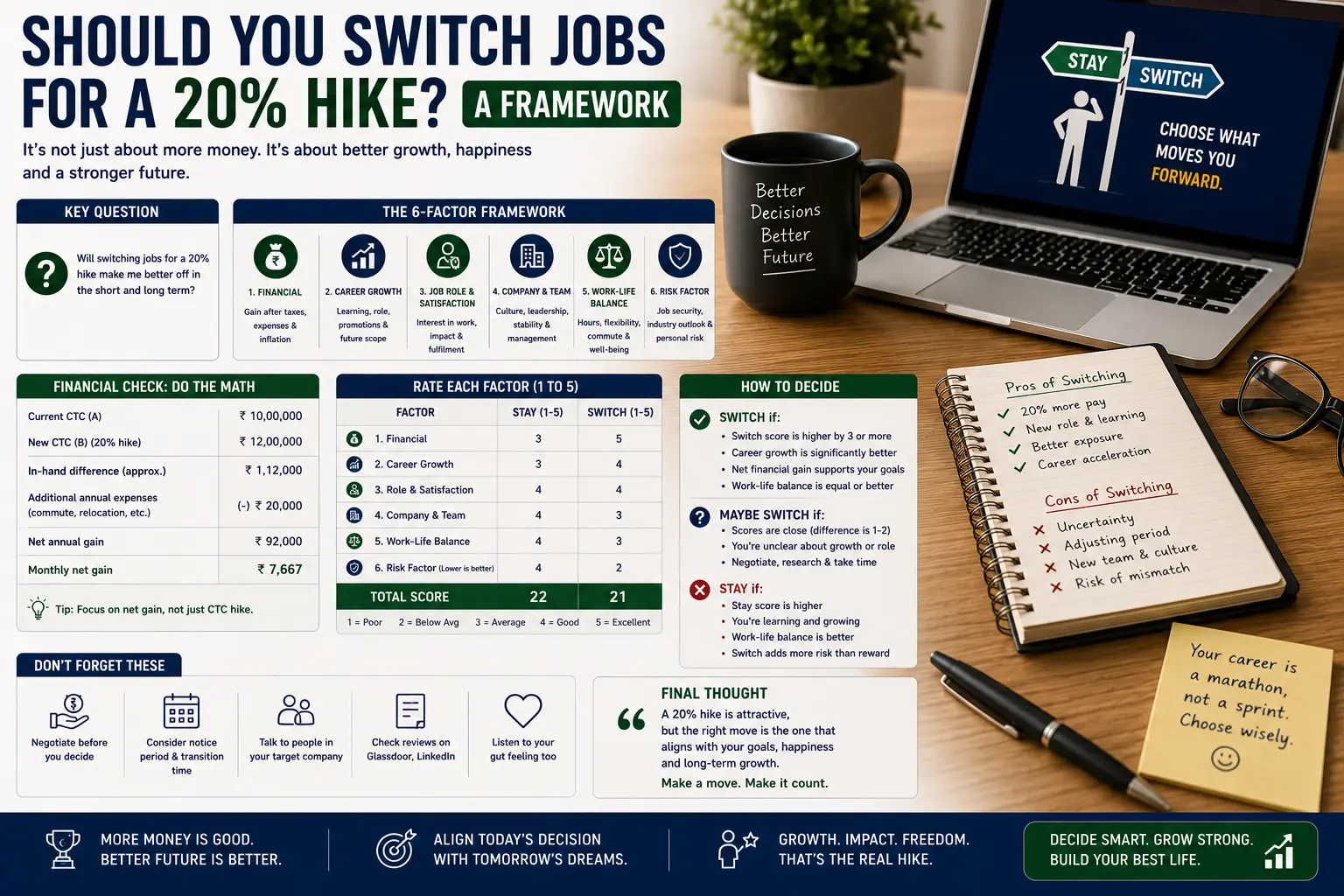
"Should I switch jobs for a 20% hike?" is not one question — it is four: Is the money actually 20% more in-hand? What do I forfeit on the way out? What could go wrong in the new role? And what does staying cost me two hikes from now? Answer them in order and the decision usually makes itself.
Question 1: Is it really 20% more money?
Compare monthly in-hand, not CTC. A 20% CTC jump structured with higher variable pay, a bigger PF base on a lower basic, or gratuity loaded into "CTC" can shrink to 10–12% in-hand. Work each offer through the layers in how CTC becomes in-hand salary, or compute both directly in the Take-Home Calculator. Then adjust for location: a 20% hike to a city with 30% higher rent can be a real-terms pay cut.
Question 2: What do you walk away from?
- Pending bonus/increment: switching in March-April often forfeits an appraisal cycle — effectively lending your old employer money.
- Gratuity clock: gratuity needs 5 years of continuous service (see the gratuity formula). Leaving at 4 years 6 months walks away from a rounded-up 5th year — at ₹60,000 basic that is ₹1.73 lakh.
- ESOPs/RSUs: unvested options are real money; a 20% cash hike against a vesting cliff due in 8 months needs explicit arithmetic.
- Leave encashment and notice pay: smaller, but real — factor them into month-one cash flow.
Question 3: What is the risk you are buying?
New roles fail for reasons money cannot fix: a manager you never met in the interview, a team in restructuring, a "growth" mandate that means doing three jobs. Practical de-risking:
- Ask to speak to a future teammate before accepting — refusal is data.
- Check the role’s attrition on LinkedIn: three departures in a year from one team is a pattern.
- Get variable-pay triggers in writing; "up to 20% variable" often means 10%.
- Probe the first-90-days expectations — the answer tells you whether the role is build or rescue.
Question 4: What does staying cost?
Counter-offers and internal hikes compound too. Job-switch hikes in India average 25–40% versus 8–12% internal. Over five years, two well-timed switches versus two internal cycles can compound to a 40–60% permanent base difference — but so can two strong internal promotions with zero role risk. The honest comparison is your internal trajectory versus the market’s current bid for your skills, refreshed every 12–18 months (interviewing without switching is free information).
The decision worksheet
- Compute both in-hands (link above). If the gap is under 10%, money is not the reason to move.
- Add forfeitures (bonus + gratuity reset + unvested equity) as a one-time negative; divide by 24 months to see the drag on the monthly gain.
- Score role quality 1–5 on manager, team stability, skill growth and commute/remote.
- Run the whole thing through the Job Switch Decision tool (it scores money + non-money factors together), and if you decide to negotiate rather than leave, the Salary Hike Negotiator sets the counter-offer maths.