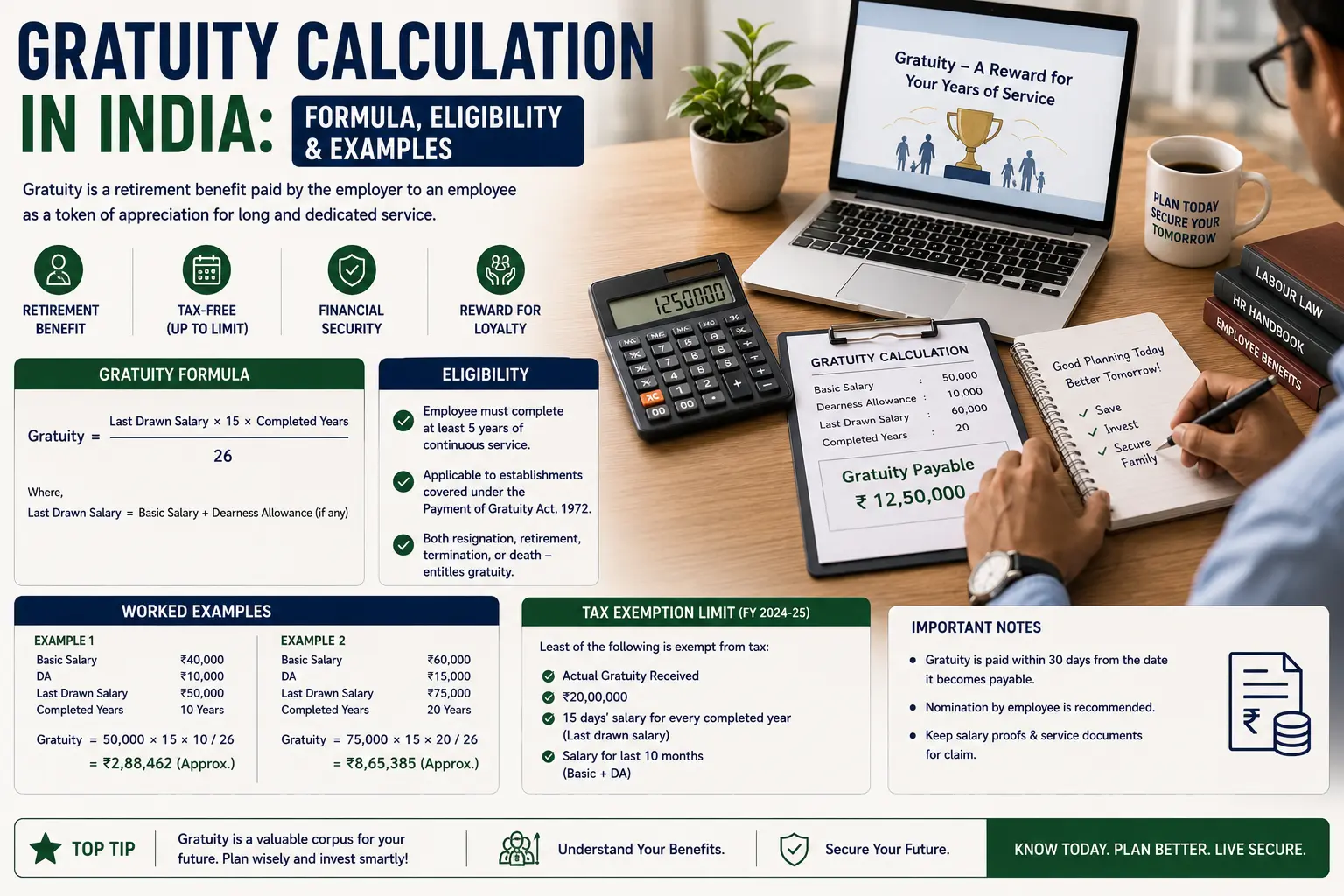
Gratuity is the thank-you payment your employer owes you after five years of continuous service — and it follows one of Indian payroll’s cleanest formulas. Yet most employees cannot check the figure the HR sheet hands them. After this guide, you will compute it faster than the payroll system, and know exactly how much escapes tax.
Eligibility: who gets gratuity
- 5 years of continuous service with one employer (the 5-year rule is waived if death or disability ends service — then gratuity is payable for every completed year regardless).
- Applies to establishments with 10+ employees under the Payment of Gratuity Act, 1972 — which covers virtually all organised-sector employers.
- Payable on resignation, retirement, termination, or superannuation — and on death/disability, paid to the nominee.
The formula: 15/26 of salary per year
Why 15/26? Labour law counts 26 working days a month (weekly offs excluded), so "15 days of salary per year of service" = 15/26 of the monthly basic + DA. Two details matter: service beyond six months in the final year rounds up to a full year (7 years 7 months counts as 8; 7 years 5 months counts as 7), and it is the last drawn basic+DA — not your average.
Worked examples
Example 1 — 20 years, basic ₹60,000: (15 × 60,000 × 20) ÷ 26 = ₹6,92,307.
Example 2 — 8 years 7 months, basic ₹45,000: the 7 months rounds up to 9 years: (15 × 45,000 × 9) ÷ 26 = ₹2,33,653.
Example 3 — death after 3 years, basic ₹40,000: the 5-year rule is waived: (15 × 40,000 × 3) ÷ 26 = ₹69,230, paid to the nominee, fully tax-free.
Check your own case instantly with the Gratuity Calculator — Gratuity is one of DecideCalc’s strongest ranking tools, and the calculator handles the rounding rules automatically.
Tax treatment: the ₹20 lakh question
For government employees, gratuity is fully exempt. Death-cases are fully exempt for everyone. Gratuity received before 5 years of service (resignation early, paid contractually) is fully taxable at slab.
Gratuity vs your other exits
Gratuity is only one of three resignation-day payments — EPF withdrawal/transfer and leave encashment are the others. EPF (your + employer contributions plus interest) usually dwarfs gratuity, but is taxable if withdrawn before 5 years of continuous service. Leave encashment (30 days’ wage basis for non-government, with a ₹25 lakh exemption limit for non-government employees introduced in 2023) is the third piece. Add all three before you judge a resignation decision — see the job-switch framework for how these figure into a move.