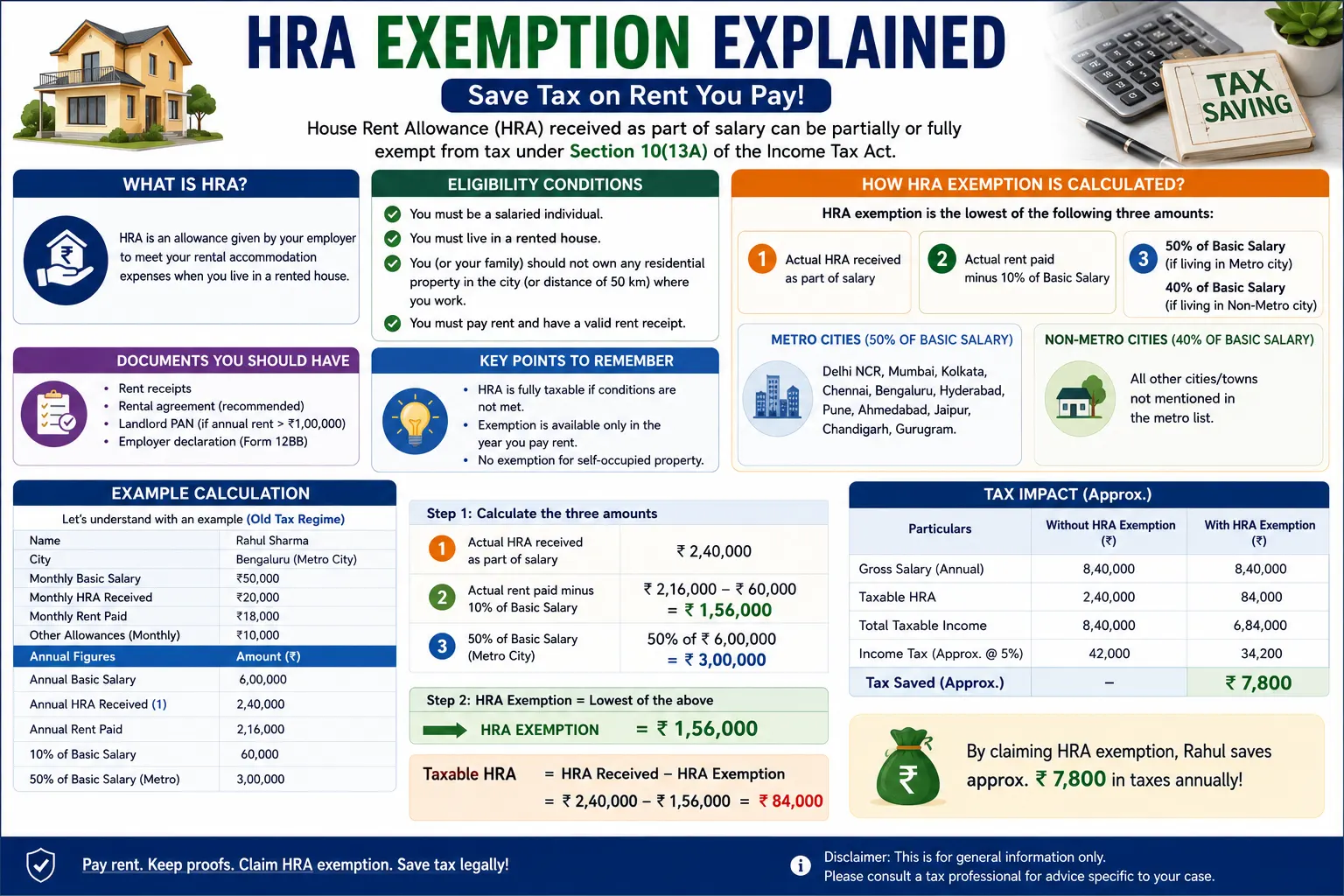
House Rent Allowance is the most commonly claimed — and most commonly mis-claimed — salary exemption in India. The calculation itself is one line: your exemption is the least of three amounts. The trouble is in the inputs: which city counts as metro, whose rent counts, and the ₹1 lakh/year cash-payment reporting rule. Work through the examples below and your claim will survive any notice.
The three-rule formula
1. Actual HRA received
2. Rent paid − 10% of (Basic + DA)
3. 50% of (Basic + DA) if in a metro*, else 40%
*Metro for HRA means Delhi, Mumbai, Kolkata or Chennai — Bengaluru, Hyderabad and Pune are non-metro (40%) despite their rents. Note: HRA exemption is available only under the old regime; the new regime excludes it (which is exactly why high-rent earners often still choose old).
Worked example 1: metro, ₹60,000 basic + ₹25,000 HRA
Priya lives in Mumbai: Basic + DA ₹60,000, HRA ₹25,000, rent ₹30,000.
- Rule 1: actual HRA = ₹25,000
- Rule 2: 30,000 − (10% × 60,000) = ₹24,000
- Rule 3: 50% × 60,000 = ₹30,000
Exemption = ₹24,000/month (rule 2 is the least). Yearly saving at the 30% slab + cess ≈ ₹89,860 — real money for ten minutes of paperwork.
Worked example 2: non-metro, high rent
Arun lives in Bengaluru: Basic ₹50,000, HRA ₹20,000, rent ₹22,000.
- Rule 1: ₹20,000 · Rule 2: 22,000 − 5,000 = ₹17,000 · Rule 3: 40% × 50,000 = ₹20,000
Exemption = ₹17,000/month. Notice that in expensive non-metro cities, rule 2 (rent-driven) usually binds — extra rent paid beyond a point buys no additional exemption.
Worked example 3: rent below 10% of basic
Nikhil pays ₹8,000 rent on a ₹80,000 basic. Rule 2: 8,000 − 8,000 = ₹0. His entire HRA is taxable. If your rent is less than a tenth of your basic, HRA gives you nothing — a useful fact when negotiating salary structure.
The five mistakes that trigger notices
- No rent receipts or agreement — keep receipts (or landlord-acknowledged bank transfers) for every month claimed; employers may ask if HRA exceeds ₹3,000/month.
- Paying rent above ₹1 lakh/year in cash to a landlord without reporting their PAN — report the landlord’s PAN or the claim can be disallowed.
- Rent paid to spouse or parents without genuine documentation — paying parents is legitimate if there is a real agreement and actual transfer, and they must show it as income.
- Claiming HRA and home-loan interest deduction for the same city without a genuine reason (job in a different city works; same-city dual claims invite scrutiny).
- Claiming HRA in the new regime — it simply is not allowed; if your HRA is large, re-run both regimes before switching.
Deciding between HRA and the new regime
HRA exemption size is one of the three big old-regime levers (with 80C and home-loan interest). A useful quick test: total old-regime deductions (HRA + 80C + 80D + Section 24 interest) above roughly ₹3–3.5 lakh usually makes the old regime win at middle incomes. Run your exact case in the Income Tax Calculator — it computes both regimes side by side — and let the HRA Calculator produce the exemption figure to enter.