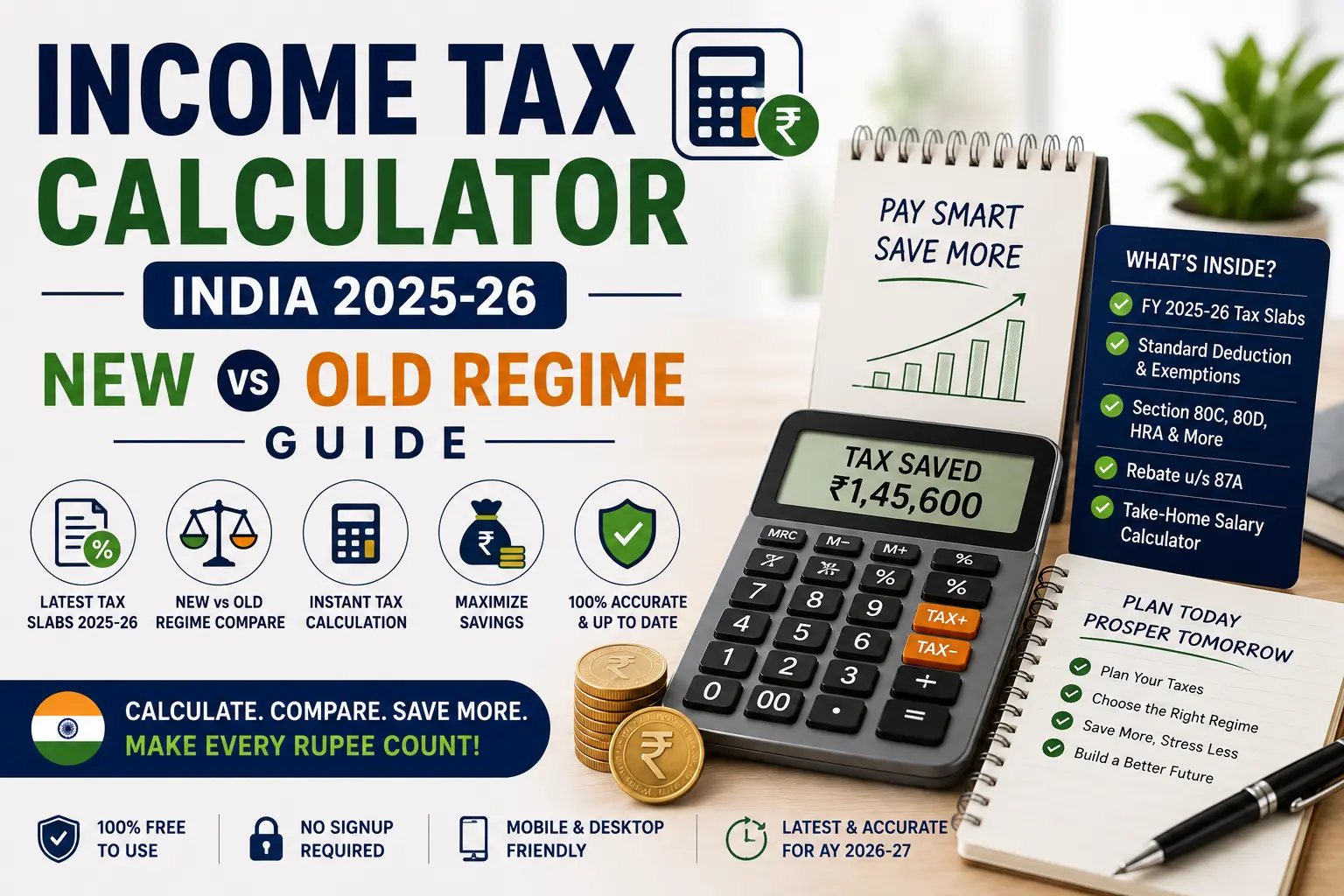
Introduction
Indian income tax gives individual taxpayers a real choice every year: opt for the New regime (Section 115BAC) with lower slab rates but most exemptions removed, or stay with the Old regime that allows deductions under Section 80C, 80D, HRA and home loan interest. The right answer depends entirely on your income mix and deduction stack — not on which regime is "popular".
This guide walks you through both regimes for FY 2025-26, the latest slabs, what changes for each deduction, and how to use our Income Tax Calculator to compare both side-by-side with your actual numbers.
What Are the Two Regimes?
Old Tax Regime (existing law)
The traditional Indian income-tax structure. Allows a wide set of exemptions and deductions under sections like 80C, 80D, 80CCD(1B), HRA, LTA and home loan interest under Section 24(b). Tax rates are steeper than the New regime, but the deduction stack often brings taxable income down sharply.
New Tax Regime (Section 115BAC)
Introduced in Budget 2020 and revised in Budget 2023 to make it the default. Lower slab rates, but most exemptions and deductions are removed. Standard deduction of ₹50,000 is retained. Best for taxpayers whose deduction stack is small.
Why Choosing the Right Regime Matters
- Annual savings: picking the right regime can save ₹20,000–₹1,50,000 per year depending on income.
- Investment behaviour: the New regime removes the "tax-saving" motive for many investments; the Old regime rewards specific deductions.
- Cash flow: lower tax means higher in-hand salary each month.
- Refund risk: wrong TDS deduction by employer can leave you short at year-end.
How Income Tax Is Calculated in India
New regime slabs (FY 2025-26)
| Income slab (₹) | Rate | Cess 4% |
|---|---|---|
| 0 – 3,00,000 | Nil | Nil |
| 3,00,001 – 6,00,000 | 5% | 5.2% |
| 6,00,001 – 9,00,000 | 10% | 10.4% |
| 9,00,001 – 12,00,000 | 15% | 15.6% |
| 12,00,001 – 15,00,000 | 20% | 20.8% |
| Above 15,00,000 | 30% | 31.2% |
A rebate under Section 87A makes income up to ₹7,00,000 effectively tax-free in the New regime.
Old regime slabs (FY 2025-26)
| Income slab (₹) | Rate | Cess 4% |
|---|---|---|
| 0 – 2,50,000 | Nil | Nil |
| 2,50,001 – 5,00,000 | 5% | 5.2% |
| 5,00,001 – 10,00,000 | 20% | 20.8% |
| Above 10,00,000 | 30% | 31.2% |
Rebate under Section 87A makes income up to ₹5,00,000 effectively tax-free in the Old regime.
Standard deduction
₹50,000 for salaried and pensioners in both regimes. No change in FY 2025-26.
Surcharge (above ₹50 lakh)
| Total income | Surcharge (New) | Surcharge (Old) |
|---|---|---|
| ₹50 lakh – ₹1 crore | 10% | 10% |
| ₹1 crore – ₹2 crore | 15% | 15% |
| ₹2 crore – ₹5 crore | 25% | 25% |
| Above ₹5 crore | 25% | 37% (capped) |
Step-by-Step: Calculate Your Tax
- Compute gross total income — salary, business/profession, house property, capital gains, other sources.
- Apply standard deduction of ₹50,000 (salaried) in either regime.
- Apply regime-specific deductions — Old regime: 80C/80D/HRA/Section 24 etc. New regime: only those retained (employer NPS, transport allowance for disabled, etc.).
- Get taxable income (cannot go below zero).
- Apply slab rates of the chosen regime.
- Add Health & Education Cess @ 4% of the tax amount.
- Add surcharge if income exceeds ₹50 lakh.
- Subtract Section 87A rebate if eligible.
- Net tax payable = steps 5+6+7−8.
- Compare both regimes and pick the lower-tax one.
Worked Example: ₹15 Lakh Salary
Rahul, 35, salaried, lives in a rented house in Pune.
- Gross salary: ₹15,00,000
- Standard deduction: ₹50,000 (both regimes)
- HRA exemption (Old only): ₹1,20,000
- Section 80C investments: ₹1,50,000
- Section 80D health insurance: ₹25,000
Old regime calculation
- Taxable income: 15,00,000 − 50,000 − 1,20,000 − 1,50,000 − 25,000 = ₹11,55,000
- Tax: 12,500 + 1,00,000 + 46,500 = ₹1,59,000
- + 4% cess = ₹1,65,360
New regime calculation
- Taxable income: 15,00,000 − 50,000 = ₹14,50,000
- Tax: 15,000 + 40,000 + 52,500 + 90,000 = ₹1,97,500 (using slabs above)
- + 4% cess = ₹2,05,400
Verdict: Old regime saves Rahul ₹40,040. With this deduction stack, the New regime is more expensive.
Key Factors in Choosing Your Regime
- Total deductions stack — Old regime pays when 80C+80D+HRA+Section 24 exceeds ₹3.5L.
- Income level — New regime rebate makes income up to ₹7L effectively tax-free, regardless of deductions.
- Investment flexibility — New regime removes the forced-investment trap; you can invest where you want.
- Home loan status — Section 24(b) interest deduction up to ₹2L is available only in Old regime.
- Employer NPS contribution — Section 80CCD(2) by employer is allowed in BOTH regimes.
- Capital gains — both regimes follow the same Section 112/111A rules.
Common Mistakes to Avoid
- Choosing New regime by default without comparing deductions — a common ₹30–80k loss per year.
- Forgetting HRA exemption — the metro/non-metro formula can save up to ₹2.4L of taxable income in Old regime.
- Ignoring Section 80CCD(1B) — additional ₹50,000 NPS deduction available in Old regime.
- Claiming 80C without receipts — only investments actually made by 31 March count; keep proof.
- Missing TDS reconciliation — Form 26AS / AIS must match your actual income before ITR.
- Filing after the deadline — late filing attracts interest under Section 234A and a fee under Section 234F.
- Not declaring exempt income — agriculture, dividend, exempt capital gains still need to be reported even if not taxed.
Frequently Asked Questions
Which regime should I choose for FY 2025-26?
Run both numbers with your exact salary and deduction stack. As a rule of thumb: if your total deductions under 80C+80D+HRA+Section 24 are below ₹3.5L, New regime usually wins. Above that, Old regime dominates. Always verify with the Income Tax Calculator.
Can I switch regimes every year?
Yes for salaried individuals. Just declare the choice in ITR-1 or ITR-2 each year. For business income, the choice is one-time — once you opt out of Section 115BAC for that business, you cannot opt back in.
What is the rebate under Section 87A?
A rebate that makes income up to ₹7,00,000 effectively tax-free in the New regime (up to ₹25,000 rebate) and up to ₹5,00,000 effectively tax-free in the Old regime (up to ₹12,500 rebate).
Is standard deduction available in the New regime?
Yes. The ₹50,000 standard deduction for salaried and pensioners is available in both regimes.
Can I claim 80C deductions in the New regime?
No — Section 80C, 80D, 80CCD(1B), HRA, LTA and home loan interest are not allowed in the New regime. Section 80CCD(2) — employer NPS contribution — is the major deduction that survives.
When is the ITR filing due date for FY 2025-26?
31 July 2026 for individuals / HUF not requiring audit, 31 October 2026 for those requiring audit, and 30 November 2026 for transfer-pricing cases. Late filing attracts ₹1,000–₹5,000 fee under Section 234F.
Conclusion
The New regime versus Old regime question is one of the highest-impact tax decisions for Indian earners each year. Use the Income Tax Calculator with your exact salary, HRA, Section 80C and 80D figures — the side-by-side comparison leaves no ambiguity. Remember: you can revisit the choice every year for salaried income, so what worked for FY 2024-25 may not be optimal for FY 2025-26.