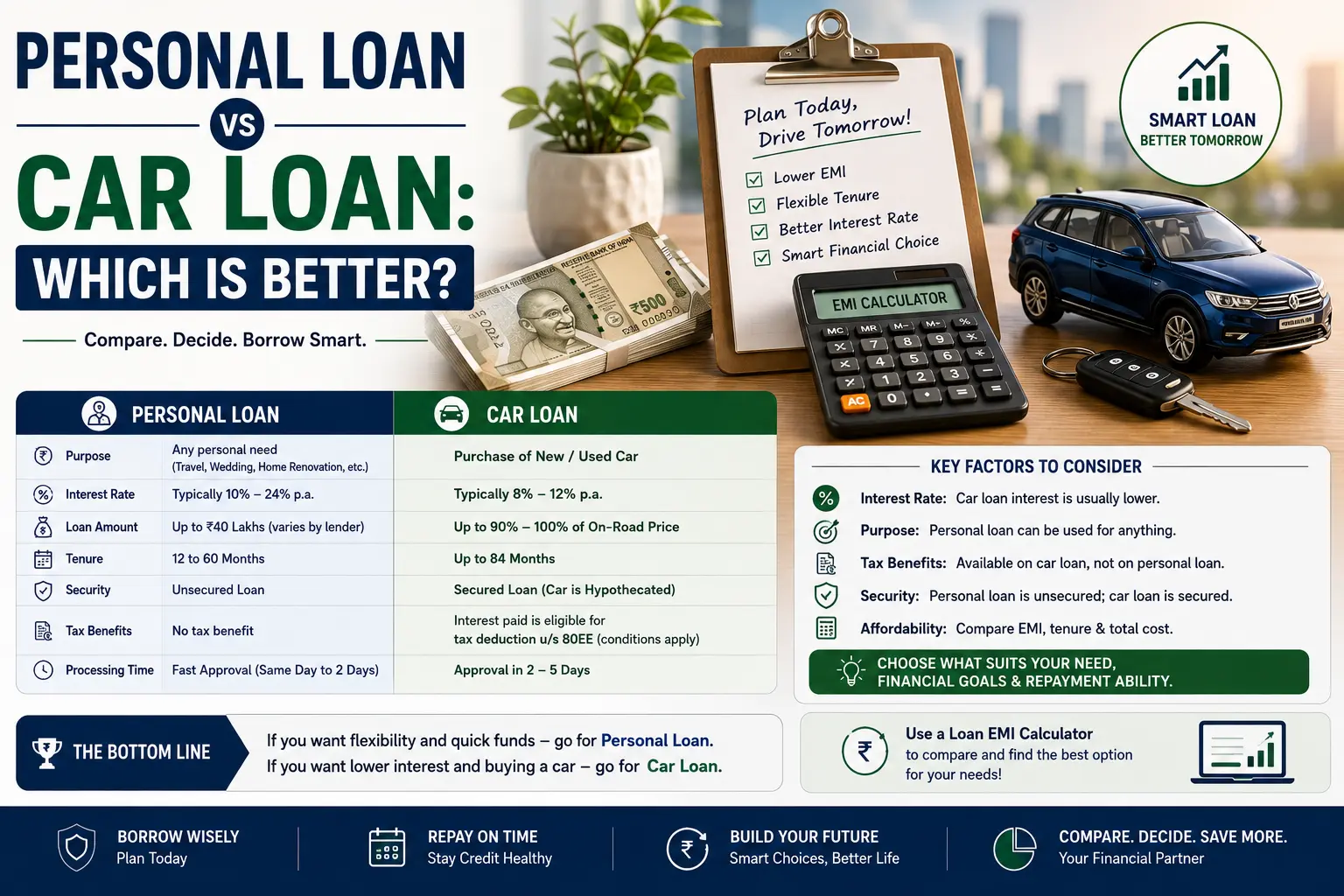
Dealers push car loans; banks push personal loans; buyers just want the lowest total cost. The two products look interchangeable — money today, EMIs tomorrow — but they price risk differently, and the gap compounds into tens of thousands of rupees over a typical tenure. Here is the honest comparison, including the two situations where the "expensive" personal loan wins.
Head-to-head: what each loan offers in 2026
| Feature | Car loan (secured) | Personal loan (unsecured) |
|---|---|---|
| Typical rate | 8.5 – 11.5% p.a. | 10.5 – 24% p.a. |
| Tenure | Up to 7–8 years | 1 – 5 years |
| Loan-to-value | 80–100% of on-road price | Up to ₹40L based on income |
| Collateral | Car hypothecated to bank | None |
| Processing fee | 0.25 – 1% | 1 – 2.5% |
| Prepayment | Often allowed, sometimes with fee | Usually allowed, 2–5% fee |
| Restriction on car choice | Bank’s dealer/Make list may apply | Any car, any seller — including used from individuals |
The ₹8 lakh worked example
Borrowing ₹8,00,000 for 5 years:
- Car loan at 9.5%: EMI ₹16,801, total interest ≈ ₹2.08 lakh, all-in ≈ ₹10.08 lakh.
- Personal loan at 15%: EMI ₹18,985, total interest ≈ ₹3.39 lakh, all-in ≈ ₹11.39 lakh.
The car loan saves about ₹1.3 lakh — the default answer. But adjust for two real-world factors before deciding: many manufacturers offer ₹20,000–60,000 cash discounts for "cash" (non-finance) buyers that vanish the moment you take the dealer’s loan, and personal loans let you buy a used car from a private seller at a price banks’ car-loan desks rarely entertain. A ₹40,000 discount plus a ₹50,000-lower private-purchase price can erase most of the rate gap. Run your exact figures in the Personal Loan Calculator and Car Loan Calculator side by side.
The business-use tax angle
When each one wins
Choose the car loan when
- You are buying a new car from a dealer and qualify for the 8.5–10% tier (CIBIL 750+).
- You want the longest tenure (7–8 years) to keep EMIs low — personal loans cap at ~5.
- You may want structured options: balloon payments, step-up EMIs, manufacturer subvention schemes at 7–8%.
Choose the personal loan when
- The cash-purchase discount exceeds the interest differential (do the maths — it often does on slow-moving models).
- You are buying a used car from an individual seller or a car outside the bank’s age/manufacturer list.
- You want to own the car outright from day one — no hypothecation, no NOC hassle on resale, easier insurance claims.
Either way: the affordability gate first
Whichever loan wins the comparison, total EMIs should stay under 40% of take-home pay, and a car — a depreciating asset — should ideally be financed for no more than 5 years. Stretching a car loan to 8 years to "afford" a dearer model is how a ₹12 lakh car becomes a ₹16 lakh one. Check your headroom in the Debt-to-Income Calculator before you sign, and if you are juggling existing EMIs, the Debt Payoff Planner shows whether clearing them first improves your rate tier.