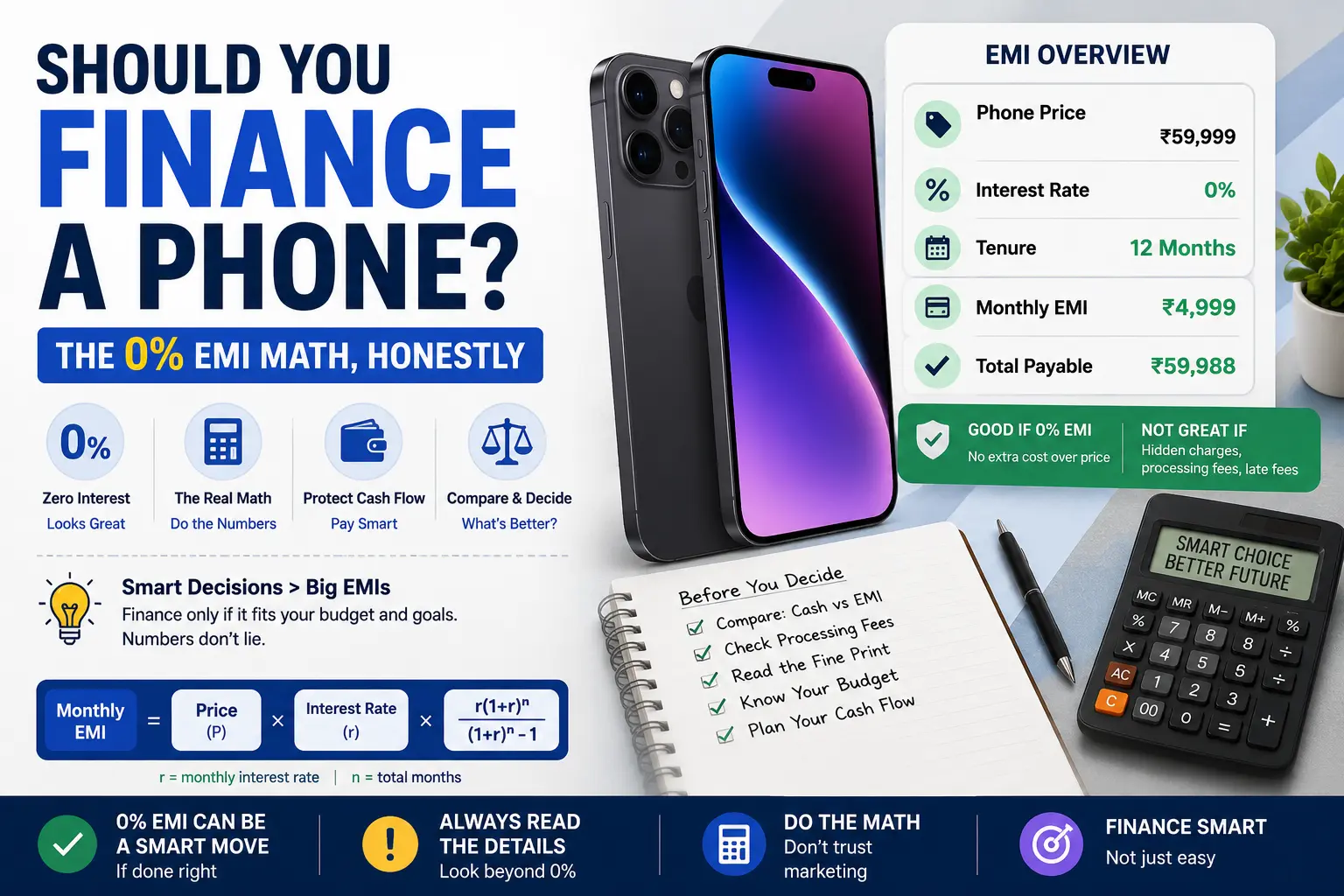
Phones are the most-financed consumer gadget on earth, and the financing is deliberately confusing: "$0 down, $33.34/month" reads like a rental, but it is a loan with an amortization schedule, a credit check, and sometimes a plan lock-in worth more than the phone. The right question is never "can I afford $33 a month?" — it is "what is the total cost of this phone across every dollar I will spend because of this deal?"
The three ways to pay, costed honestly
| Method | Cash price | Financing cost | Total paid |
|---|---|---|---|
| Cash (full price) | $1,000 | $0 | $1,000 |
| True 0% EMI, 24 mo | $1,000 | $0 | $1,000 |
| Card EMI at 15%, 12 mo | $1,000 | +$83 | $1,083 |
| Revolving card ~25% APR, 24 mo | $1,000 | +$270+ | $1,270+ |
| Carrier "free" w/ plan lock | $1,000 | plan premium $15/mo × 36 | up to ~$1,540 |
Score your own offer with the phone EMI calculator — it exposes the total paid, not just the monthly figure.
The bill-credit trap inside "free phone" offers
Carriers rarely discount the device anymore — they discount it conditionally. A typical flagship promo: trade in any recent phone, get $830 off, delivered as 36 monthly bill credits. Three catches compound:
- Credits die if you leave. Switch carriers at month 20 and the remaining ~$370 vanishes while the device balance comes due in full.
- You paid with your old phone. The traded device had a resale value of $250–$450 you could have kept in cash.
- The required plan costs more. If the qualifying unlimited plan is $15/month above your alternative, that is $540 over 36 months — nearly the whole "discount."
None of this makes carrier deals bad — for a customer who would stay anyway, the math can be genuinely strong. It makes them conditional, and conditionality has a price you should put a number on before signing.
When financing a phone is actually the right move
- True 0% with identical cash pricing. If the cash price and the financed price are equal and there is no plan requirement, 0% EMI is a free loan. Take it and keep your cash earning 4–5% elsewhere.
- The phone is a work tool. If the device directly earns income (creator, gig work, sales), spreading cost over its earning life is sensible business practice.
- Emergency replacement. A broken essential phone with no savings cushion is what short 0% financing is for — 12 months maximum.
When to walk away from the EMI screen
- The term is longer than you intend to keep the phone (a 36-month loan on a phone you replace every 2 years means paying for two phones at once).
- The "discount" requires opening a new credit line or upgrading your plan.
- You are adding insurance you did not plan for — at $15–$20/month over 24 months that is $360–$480, more than most out-of-warranty repairs.
- The EMI only fits if nothing else goes wrong this month. Gadgets should never occupy your emergency buffer.
The same framework scales up to bigger devices — the laptop EMI calculator, iPad EMI calculator, TV EMI calculator and appliance EMI calculator all run the identical math. And if a sale price is driving the urge, check it with how to calculate a discount first — a fake "40% off" sticker has launched a thousand unnecessary EMIs.