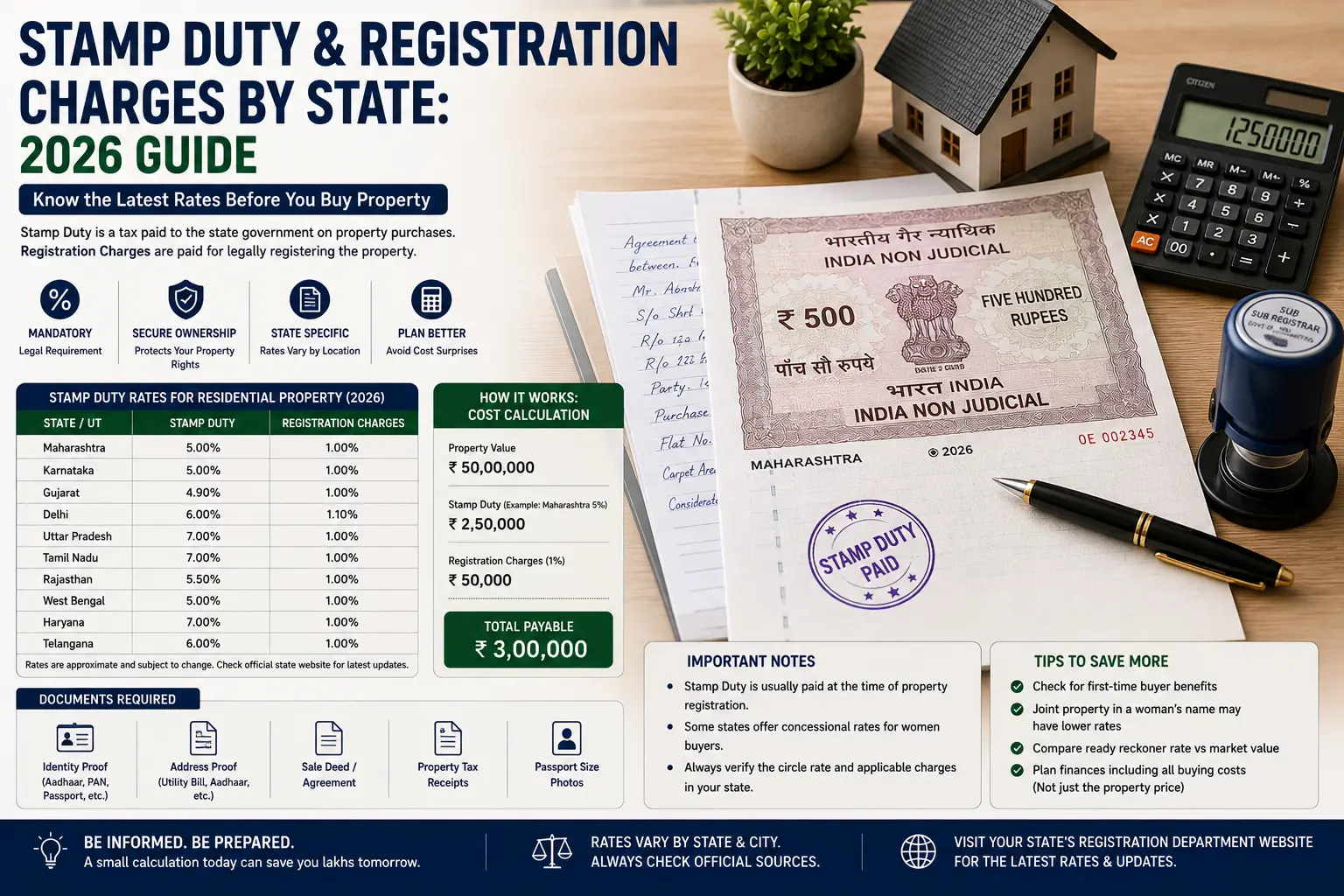
Stamp duty is the tax your state charges for registering a property document, and registration is the fee for putting your ownership on the official record. Together they typically add 6–8% of the property value to your purchase cost — ₹4–6 lakh on a ₹60 lakh flat — paid in cash or from savings, because home loans do not cover them. Rates differ by state, by gender, and sometimes by property value. Here is the complete picture.
State-wise stamp duty and registration rates (2026)
| State | Stamp duty (men) | Registration | Women’s concession |
|---|---|---|---|
| Maharashtra (Mumbai) | 6% | 1% (cap ₹30k on old) | 1% concession if no previous concession used |
| Delhi | 6% | 1% | 4% for women |
| Karnataka (Bengaluru) | 5% | 1% | — |
| Tamil Nadu (Chennai) | 7% | 4% | 1% reduction in many cases |
| Telangana (Hyderabad) | 4% | 0.5% | 1% if value ≤ ₹10L (older scheme; verify) |
| Uttar Pradesh (Noida, Lucknow) | 7% | 1% | ₹10k rebate (≤ ₹10L value) |
| Gujarat (Ahmedabad) | 4.9% | 1% | — |
| West Bengal (Kolkata) | 6% | 1.1% | — |
| Rajasthan (Jaipur) | 5–6.5% | 1% | 1% concession in some brackets |
| Haryana (Gurgaon) | 5–7% (urban women: lower) | up to 2% | Often 5% for urban women |
Rates change with state budgets and are sometimes temporarily cut (Maharashtra’s famous 2020–21 concession window). Treat the table as indicative for 2026 and confirm on the state registration portal (IGRS/Shivalik/Bhulekh etc.) before closing — the Stamp Duty Calculator keeps current-state presets.
Worked example: the true cost of a ₹50 lakh flat in Bengaluru
- Stamp duty 5% = ₹2,50,000
- Registration 1% = ₹50,000
- GST on under-construction (5%): applies on the agreement value — on ₹50L that is ₹2.5L (already embedded in pricing, but budget-aware)
- Legal/brokerage/misc: ₹50,000–1,00,000
Registration-ready cash: about ₹3–3.5 lakh on top of the down payment — which is why buyers should budget 8–10% of property value as "closing costs", never covered by the loan. A bank finances up to 90% of the agreement value; duty and fees come from your pocket.
Six rules that change what you pay
- Gender concessions are real money — registering in a woman’s name (sole or joint) saves 1–2% in several states: ₹50,000–1,00,000 on ₹50 lakh.
- Circle rate vs agreement value — duty is paid on the higher of the two. Buying below circle rate? You still pay duty on the circle rate, and the gap can attract income-tax attention (Section 50C for sellers).
- Under-construction vs ready — GST (5% non-affordable / 1% affordable) applies to under-construction; ready resale has no GST but its own duty arithmetic.
- First-time women buyers in some states get additional rebates — ask the sub-registrar’s office; these schemes change.
- Joint registration splits concessions: many states apply the women’s rate only to the woman’s share of ownership.
- TDS on property ≥ ₹50 lakh — the buyer deducts 1% TDS (Section 194-IA) and deposits it against the seller’s PAN — a compliance step, not an extra cost, but penalties for missing it are real.
Can you save legally? Yes — three ways
- Register in the woman’s name where the concession exists (Delhi’s 4% vs 6% saves ₹1 lakh per ₹50L).
- Time the purchase: states periodically announce duty cuts (Maharashtra 2020, UP windows); a 1–2 month wait can be worth ₹50k+.
- Declare the true agreement value — undervaluation to save duty is the classic trap: if caught, you pay the deficit, penalty (up to 10× duty in egregious cases), and lose the property’s clean title standing.
How this fits your home-buying budget
Sequence every cash outflow before booking: down payment (10–20%) + stamp duty + registration + GST (if under-construction) + brokerage + interiors. That is 25–30% of property value in cash for a typical buy. Check what loan your salary actually supports in the home-loan-on-salary guide, and read Rent or Buy 2026 if the all-in cost is making you reconsider.