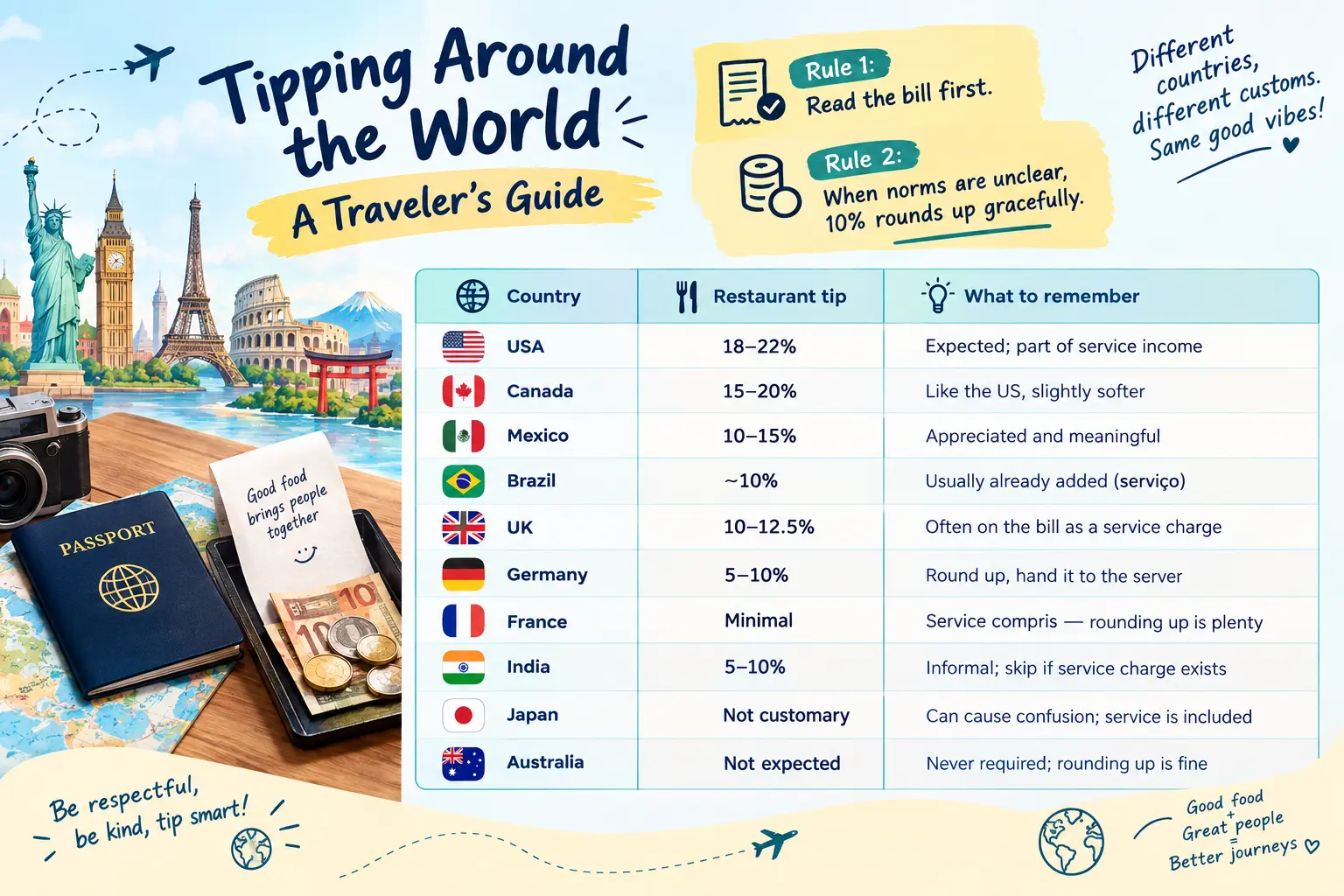
Tipping norms at a glance (2026)
Travelers lose more money to guesswork than to generosity - tipping too little where it matters, double-tipping where service was already included, and over-tipping where it reads as strange. The table below is the whole guide in one view: every country, its restaurant norm, and the one thing to remember when the bill lands. Rule 1: read the bill first - a printed service charge means you're already done. Rule 2: when the norms are unclear, 10% rounds up gracefully, everywhere. Save this table, or skip it entirely and let the travel tip calculator apply your country's norm automatically.
| Country | Restaurant tip | What to remember |
|---|---|---|
| USA | 18-22% | Expected; part of service income |
| Canada | 15-20% | Like the US, slightly softer |
| Mexico | 10-15% | Appreciated and meaningful |
| Brazil | ~10% | Usually already added (servico) |
| UK | 10-12.5% | Often on the bill as a service charge |
| Germany | 5-10% | Round up, hand it to the server |
| France | Minimal | Service compris - rounding up is plenty |
| India | 5-10% | Informal; skip if service charge exists |
| Japan | Not customary | Can cause confusion; service is included |
| Australia | Not expected | Never required; rounding up is fine |
There's a specific kind of panic that hits about four seconds after the bill arrives in a foreign country. The food was great, the company was better, and now everyone at the table is quietly doing currency conversion in their heads and looking at each other for a verdict: do we tip here? How much? Is it an insult?
I've watched this scene play out in a Mumbai cafe (no tip needed - service charge was on the bill), a Tokyo izakaya (tipping genuinely confused the staff), and an Austin taco place (20% or you're the problem). The rules aren't written down anywhere official. They're just absorbed by people who live there. This guide writes them down for you, country by country, so you never have to guess at the table again.
The two rules that cover 90% of situations
Before the country-by-country breakdown, memorize these:
- Rule 1: Read the bill first. In much of the world - the UK, Brazil, much of India and Europe - restaurants add a 5-12.5% "service charge" automatically. Tipping on top of that is optional at best and double-paying at worst. The bill literally tells you what to do; most travelers never look.
- Rule 2: When norms are unclear, 10% rounds up gracefully. In the gray-zone countries, 10% is never an insult. It might be more than expected (Germany, Australia) or slightly light (USA), but it always lands as polite.
Everything else in this article is detail. If you want the full worked examples - the 10% mental-math trick, the pre-tax vs post-tax debate, how to split when three friends have only exact change - our earlier guide on how to calculate a tip covers the arithmetic, and the free tip calculator handles the awkward bills for you.
The Americas: tipping is part of the price
United States - 18-22%, and it's not really optional
The US is the country where tipping is least optional. Servers in many states earn a base wage well below minimum wage on the understanding that tips make up the difference - so a "18-22% restaurant tip" isn't generosity, it's the actual price of the meal with a flexible second digit. Delivery apps like DoorDash and Uber Eats now suggest 15-20% with $3-5 minimums; tattoo artists, hairdressers and nail salons all sit in the same 15-20% band. If the service was genuinely terrible, the move is to speak to the manager - not to silently leave 8%.
Canada - 15-20%, the US with slightly softer edges
Canada works almost identically to the US, with card machines that suggest 15-20% instead of 18-25%. The same service-worker economics apply in most provinces. Rounding up a taxi fare is common; hotel housekeeping gets $2-5 per night.
Mexico - 10-15%, meaningful and appreciated
In tourist areas and sit-down restaurants, 10-15% is the norm and it genuinely matters to the people receiving it. Many mid-range restaurants add a propina for large groups - check the bill. Supermarket valets, gas station attendants and baggers at grocery stores often work purely for tips, so small amounts go a long way here.
Brazil - ~10%, usually already on the bill
Brazilian restaurants typically add a 10% servico charge automatically. If it's there, you're done. If it isn't, 10% in cash is the graceful move. Bars sometimes run on rounding up instead.
Europe: included, rounded, or quietly optional
United Kingdom - 10-12.5%, often already added
UK restaurants frequently add a 12.5% service charge for table service - and it's exactly what it sounds like, a service charge, not a suggestion. If it's on the bill you owe nothing more; if service wasn't added, 10-12.5% is the standard for good service. Pub rounds and counter service get no tip at all.
Germany - 5-10%, rounded up, handed to the person
German tipping is a rounding culture. When the bill is €47.80, you say "auf 52" (make it 52) and the extra €4.20 is the tip. 5-10% at restaurants, rounding up taxis, small amounts for hotel porters. The money is traditionally handed directly to the server rather than left on the table.
France - minimal, and nobody will chase you
French service is priced in. The service compris on the menu means the staff are paid properly and your bill already includes service. Rounding up a pleasant meal by a euro or two is a kind gesture, never an obligation. Cafe terraces run on this system entirely.
Asia: the continent where the rules flip
India - 5-10%, informal and flexible
Tipping in India is genuinely situational. Sit-down restaurants: 5-10% where no service charge appears. Round up taxi and auto fares. Hotel porters get ₹50-100 per bag. Delivery apps now have in-app tipping and it's genuinely appreciated. But check every bill - a 5-10% service charge is extremely common, and stacking a tip on a service charge helps nobody except the restaurant's accounting.
Japan - not customary, and that's not modesty, it's the culture
Tipping in Japan can genuinely confuse people. Staff have been known to chase customers down the street to return "forgotten" cash. Service excellence is the baseline, not an extra to be purchased. If you want to acknowledge something exceptional, a small gift or a sincere verbal thanks lands better than yen. Tipping a taxi driver will get your door opened for you - and your money handed back.
Rest of Asia in one breath
South Korea and China: not expected, rounding up in taxis is fine. Thailand: rounding up the bill or leaving change is the local style. Singapore: a 10% service charge is standard and included. Indonesia: 5-10% where no service charge appears. The pattern holds - look for the service charge first.
Oceania and the Middle East
Australia and New Zealand: tipping is never required. Wages are high, service is professional, and nobody is depending on your 15%. Rounding up or leaving a small amount for genuinely outstanding service is appreciated, entirely optional, and genuinely rare.
UAE and the Gulf: 10-15% at restaurants, usually already on the bill in hotels. South Africa: 10-15% at restaurants is customary and meaningful. Egypt: "baksheesh" culture means small tips for almost any assistance - keep small notes handy.
Hotels, taxis, and tours - the in-between cases
- Hotel housekeeping: $2-5 per night in cash, left daily (staff rotate, so a lump sum on the last day may reach the wrong person).
- Taxis: round up in most of the world; 10-15% in the US and Canada.
- Tour guides: this one surprises people - for a full-day group tour, $10-20 per person per day is normal in the US, and half that in most of the rest of the world. Free walking tours are explicitly tip-based; the guide is working for it.
- Cruises: nearly automatic now. Disney Cruise Line, for example, adds a recommended daily gratuity per guest - roughly $16 per guest per night in standard staterooms and about $27.25 for concierge-level - charged to your onboard account and adjustable at guest services. A quick nights × guests × daily rate calculation tells you what to budget before you sail; the tip calculator has a built-in cruise gratuity estimator for exactly this.
Delivery apps changed the math everywhere
Uber, DoorDash, Zomato, Swiggy, Bolt - every market now has an app asking for a tip before the order arrives. The norms track the country you're in: 15-20% with $3-5 minimums in North America, in-app round-ups in India, and simply nothing in Japan. The screen guilt is universal though. Remember that on delivery apps the tip often IS the driver's actual margin on the trip - a zero tip on a long delivery in the rain is a statement, whether you meant it as one or not.
The 30-second pre-dinner routine
Here's the whole article compressed into something you can do while the menus are being handed out:
- Open the tip calculator and pick your country - the local norm loads automatically with an etiquette note.
- Enter the bill when it arrives; the tip, total, and per-person split update live.
- Glance at the bill for a service charge. If it's there, drop the tip to 0 and you're done.
- Paying cash? Hit the round-up toggle so nobody's fighting over coins.
Thirty seconds, once, and tipping stops being a traveling anxiety forever.
One last thing worth saying plainly: every number in this guide is a norm, not a law. Service charges, tourist districts, and simple human judgment all move the figures. The point of knowing the norms isn't to tip correctly for a grade - it's so the math never gets between you and saying thank you properly.