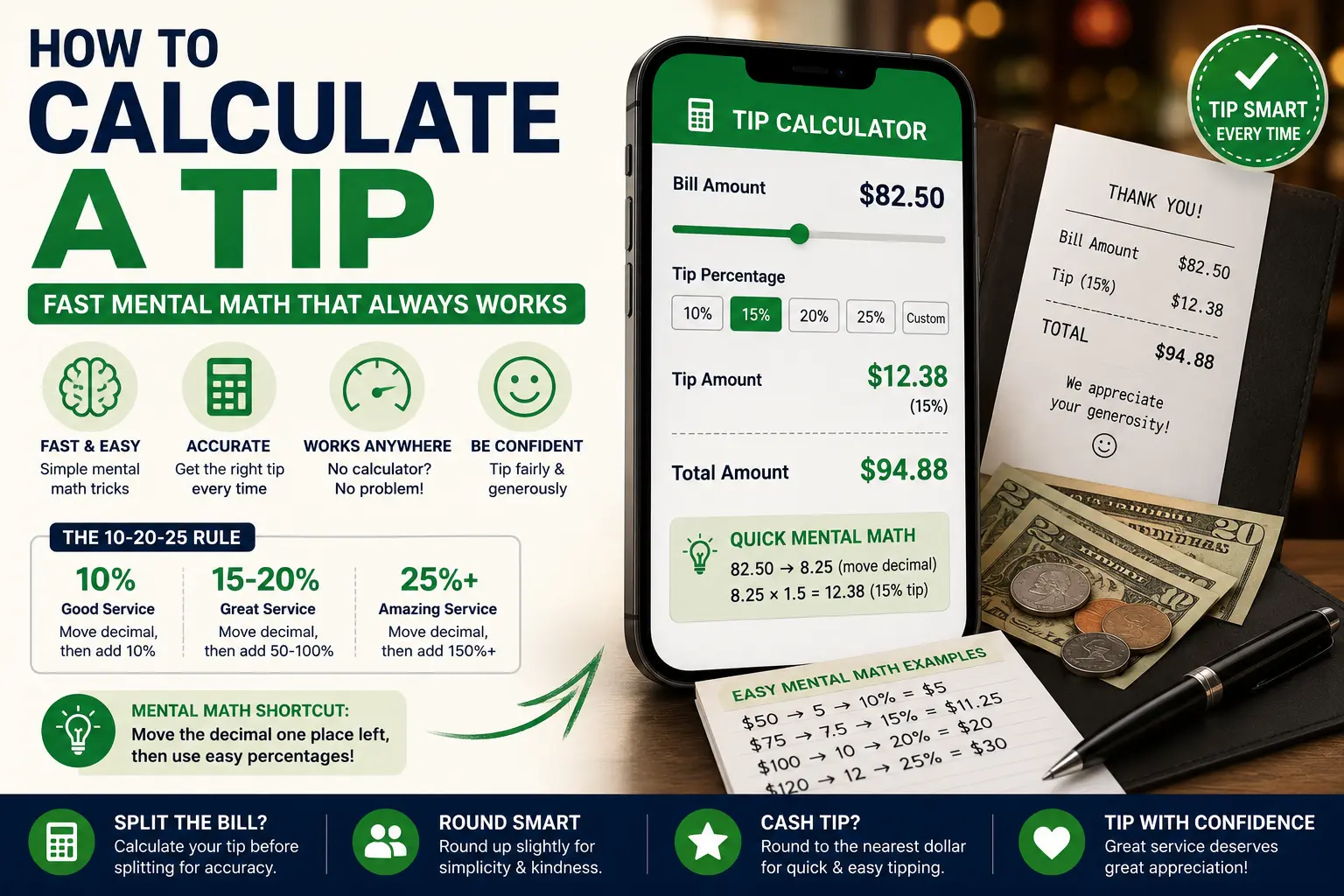
Tipping sits at the intersection of arithmetic and social pressure — which is why payment screens now start at 18% and why people regularly over-tip on bad service or under-tip brilliant servers simply because the math felt awkward in the moment. Fix the math side permanently and the social side gets much easier.
The 10% anchor: the only trick you need
- 15% = 10% + half of 10% → $8.64 + $4.32 = $12.96 (round to $13)
- 18% = 20% − a little: 20% is $17.28, subtract ~$1.70 → $15.55 (round to $15.50 or $16)
- 20% = double the anchor → $8.64 × 2 = $17.28
- 25% = 20% + half of 10% → $17.28 + $4.32 = $21.60 (round to $22)
Two seconds, no phone, works on any bill. When the amount is ugly, do the math on a rounded bill ($86 instead of $86.40) — the 4-cent difference will never matter.
Pre-tax or post-tax? Why restaurants don't clarify
The service industry convention is tip on the pre-tax subtotal — tax is not a service the staff provided. On an $80 meal with 8.5% sales tax, the difference between the two bases is only $1.36 at a 20% rate, so nobody argues. But on a $400 celebratory dinner with wine, that gap grows to $7+ and the printed "suggested tips" at the bottom of the receipt are almost always calculated on the post-tax total. Knowing the convention lets you choose deliberately instead of by default.
Splitting without the awkwardness
The clean sequence for group bills:
- Tip first, split second. Compute the tip on the entire bill, add it to get the grand total, then divide. 20% on $210 = $42; total $252; five ways = $50.40 each.
- Unequal ordering? Each diner adds up their own items, applies the tip rate to that subtotal, then adds their share of tax and shared plates. It takes one extra minute and ends every quiet resentment at the table.
- Cash-and-card mixes. Whoever pays by card adds the full tip on the card slip; cash contributors hand over their share of food + tip. Never let the card-holder eat the whole tip because "we'll figure it out later."
The modern tip-screen problem
Counter tablets now prompt 18/20/25% for coffee and takeout, and some calculate those percentages on the post-tax, post-fee total. Three defenses: know your number before the screen flips around, remember that custom-tip buttons exist on every terminal, and separate "service was performed" (food to your table, delivery to your door) from "service was transacted" (handing you a bag). Tip the first; the second is optional by every traditional standard.
A quick world tour
| Region | Sit-down restaurants | Notes |
|---|---|---|
| USA / Canada | 15–20% | Servers often earn a tipped minimum wage; tips are core income |
| India | 5–10% | Check for an auto-added service charge before tipping on top |
| UK / Europe | 0–10% | Service charge often included; rounding up is the norm |
| Japan / Korea | None | Tipping can read as an insult; excellent service is baseline |
Traveling? Five minutes of local norms research beats any percentage rule. And when the bill includes a discount, tip on the pre-discount amount — the kitchen and server did the full-price work. Related: how to calculate a discount and how sales tax works.