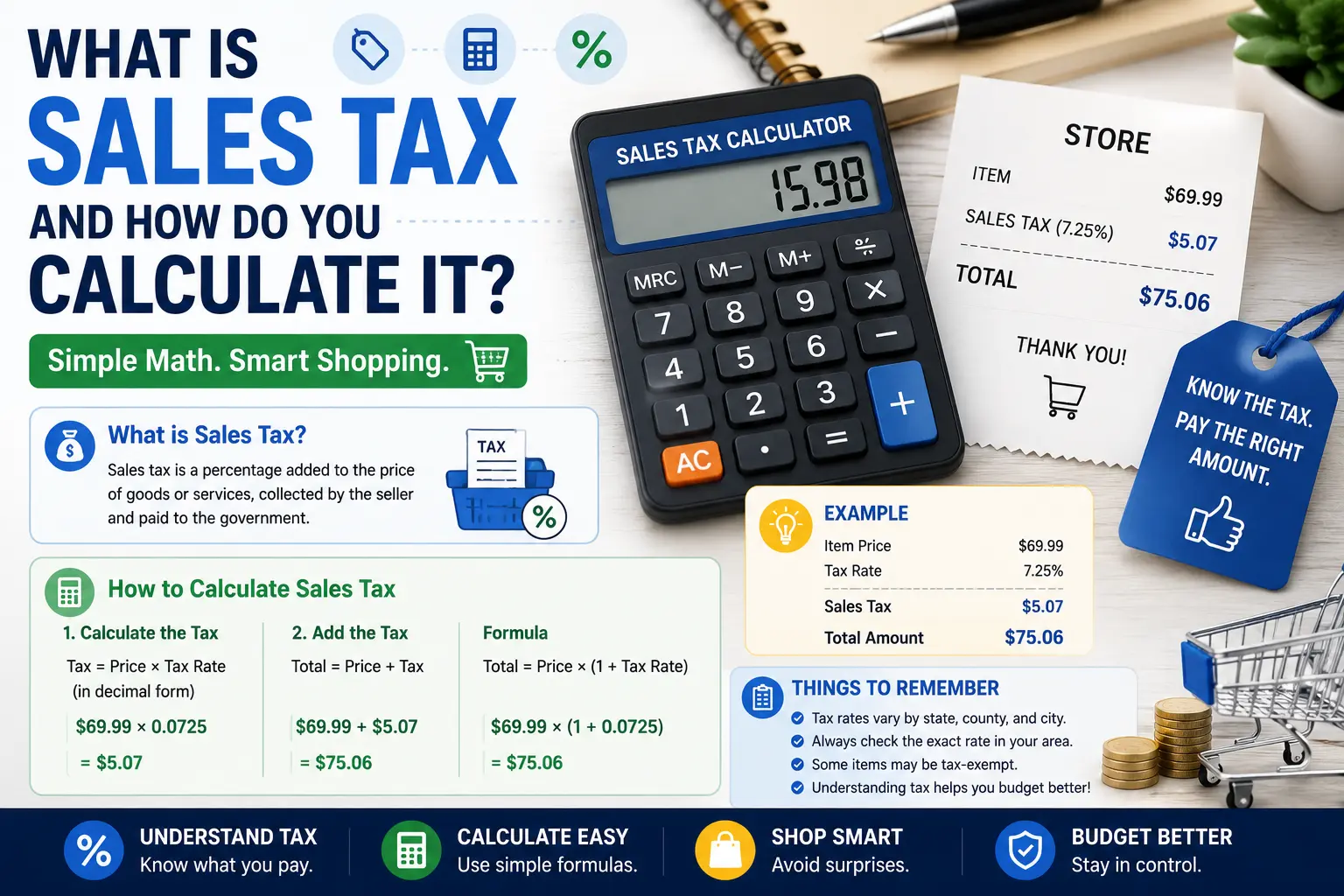
Sales tax is the only major tax most people pay weekly without ever calculating it — it just appears at the register. That is exactly why the math matters: budgeting from shelf prices in an 9% state means every $500 shopping plan is silently a $545 plan, and expense reports, side-hustle pricing and marketplace selling all demand you can move between pre-tax and post-tax numbers fluently.
Formula 1: adding sales tax to a price
Combined rate = state + county + city + district rates, added together.
Example: a $1,299 laptop in a jurisdiction with 6% state, 1.5% county and 0.75% city tax. Combined rate = 8.25%. Tax = 1,299 × 0.0825 = $107.17; checkout total = $1,406.17.
Formula 2: reversing tax out of a receipt total
A $53.94 receipt in a 8% combined zone: 53.94 ÷ 1.08 = $49.94 pre-tax; tax = $4.00. The common mistake — subtracting 8% of $53.94 — gives $4.32, which is wrong by 8%. Divide, don't subtract.
Tax meets discounts: the order matters
Sales tax is charged on what you actually pay, so apply discounts first:
- $240 headphones, 30% off → $180 taxable base
- 8% tax on $180 = $14.40 → pay $194.40
- (Taxing the original $240 would have added $4.80 more — retailers who do this are over-collecting.)
Seller-funded coupons and instant discounts reduce the taxable amount almost everywhere in the US. Manufacturer mail-in rebates usually do not — you pay tax on the full price and recover the rebate later. Check the discount formula guide when stacking multiple percent-offs, because percentages never add linearly.
Why your friend's rate is different across the river
US sales tax is layer cake: statewide base + county + city + special district (transit, stadium, school) rates. Forty-five states plus DC levy at least a state rate; roughly 38 states permit local additions. That produces real shopping behavior — Portland, Oregon (0%) sits minutes from Vancouver, Washington (~8.6%), and big-ticket purchases genuinely follow the border.
US sales tax vs VAT vs GST — one table
| US sales tax | VAT (EU/UK) | GST (India/Canada/Australia) | |
|---|---|---|---|
| Who charges | State + local | National | National + state (India: CGST+SGST) |
| When applied | Final retail sale only | Each supply-chain stage, credited | Each stage, credited |
| Shelf price includes it? | No — added at checkout | Yes — included | Usually included |
| Typical consumer rate | 4–10.25% | 17–27% | 5–28% (India slabs) |
The practical consequence: in VAT/GST countries the displayed price is what you pay; in the US, never trust the shelf tag for an exact budget. If you are price-comparing internationally on marketplaces, convert both items to their post-tax totals first.
When sales tax math actually changes a decision
- Big electronics, cross-border: a $2,000 camera saves $170+ by buying in a 0% state instead of an 8.6% state — worth a road trip, rarely worth a relocation.
- Vehicle purchases: most states tax the full price minus trade-in and register the car where you live, not where you buy — no savings from crossing lines, but trade-in credits are real money.
- Side hustles: marketplace and craft sellers often must collect destination-based tax; pricing pre-tax then charging the buyer's rate keeps margins identical everywhere.
For the income side of taxes — what actually leaves your paycheck before you spend a dollar — see how to calculate take-home pay.