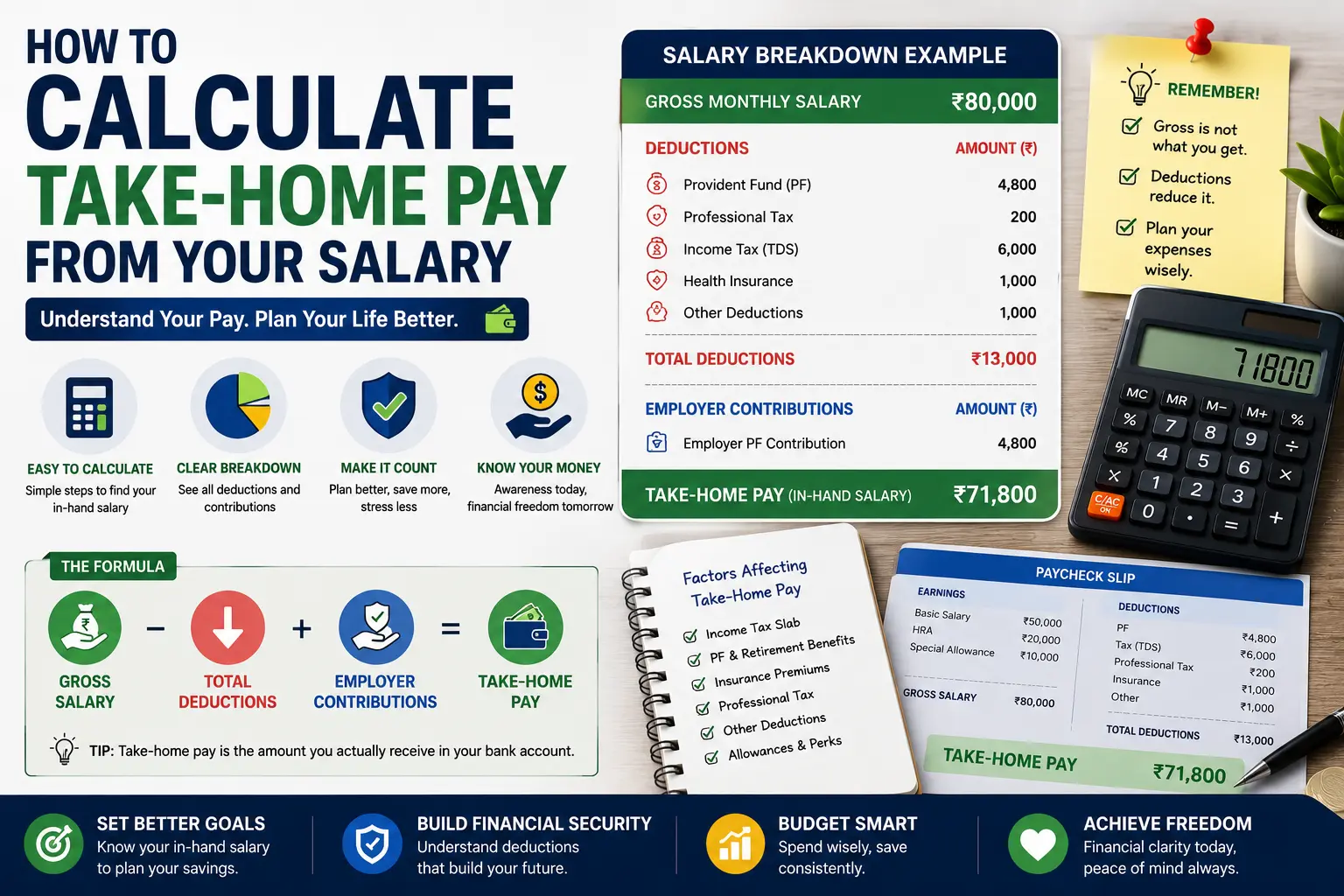
"I make $75,000" is a gross statement. "I spend $4,700 a month" should be a net statement. The distance between those two numbers — and knowing your exact figure before the offer letter, not after the first stub — is the entire foundation of a working budget. Here is the sequence exactly as payroll software applies it.
The subtraction order on a real pay stub
- Gross pay — salary ÷ pay periods, or hourly × hours.
- Pre-tax deductions — traditional 401(k)/403(b), health/dental/vision premiums, HSA contributions. These shrink taxable income before the IRS touches it.
- Federal income tax — brackets applied to taxable income after the standard deduction ($15,000 for single filers in 2026, often adjusted annually).
- FICA — 6.2% Social Security (up to the wage cap, ~$176,100 in 2026) + 1.45% Medicare on all earnings, = 7.65% for most workers. This hits gross, not post-401(k) income.
- State income tax — 0% in nine states; graduated up to 13.3% in California.
- Post-tax deductions — Roth 401(k), union dues, garnishments.
Worked example: $75,000 salary, single, Texas (no state tax)
| Step | Annual | Monthly |
|---|---|---|
| Gross salary | $75,000 | $6,250 |
| 6% 401(k) pre-tax | −$4,500 | −$375 |
| Health insurance | −$2,400 | −$200 |
| Federal income tax (est.) | −$7,860 | −$655 |
| FICA (7.65% of gross) | −$5,738 | −$478 |
| Take-home | ≈ $54,500 | ≈ $4,542 |
That is 27% gone before you see a dollar — and Texas has no income tax. Run your own salary, state and deduction mix in the take-home pay calculator, or for per-paycheck detail the paycheck calculator.
The 401(k) tax discount nobody prices in
Traditional 401(k) contributions dodge federal income tax today, so contributing costs you less take-home than the contribution amount. At a 22% marginal federal bracket, every $1,000 into a pre-tax 401(k) shrinks your paycheck by only about $780. The same logic applies to FSA/HSA dollars and commuter benefits — pre-tax lines are the only discounts the IRS offers automatically.
FICA: the flat toll on every dollar
Federal income tax is progressive — brackets stack — but FICA is a flat 7.65% from the first dollar of wages, with no standard deduction to soften it. That is why effective tax rates are higher than bracket rates for modest incomes: a $40,000 earner may sit "in the 12% bracket" yet lose nearly 20% overall once FICA enters. Above the Social Security wage cap, the 6.2% portion stops — a quiet raise high earners receive mid-year that confuses many pay stubs.
State taxes move the needle more than you think
The exact same $75,000 salary produces roughly $4,540/month take-home in Texas or Florida, about $4,360 in a 4% state like Colorado, and near $4,180 in California (~6% effective here plus SDI). Before relocating "for the salary bump," convert both offers to monthly take-home — a $10,000 raise from Austin to San Jose can be fully consumed by state tax and rent.
Our full stub anatomy — every code from FITW to SDI — is in gross pay vs net pay, and the paycheck-from-salary conversions (hourly, bi-weekly, semi-monthly) are covered in how to calculate paycheck from salary.
Budget on the number that arrives
Every financial rule you use — 50/30/20, rent under 30%, the 20/4/10 car rule — should divide your net income, not your salary. The two minutes it takes to compute take-home pay turn every one of those rules from an aspiration into an arithmetic check you can actually pass.