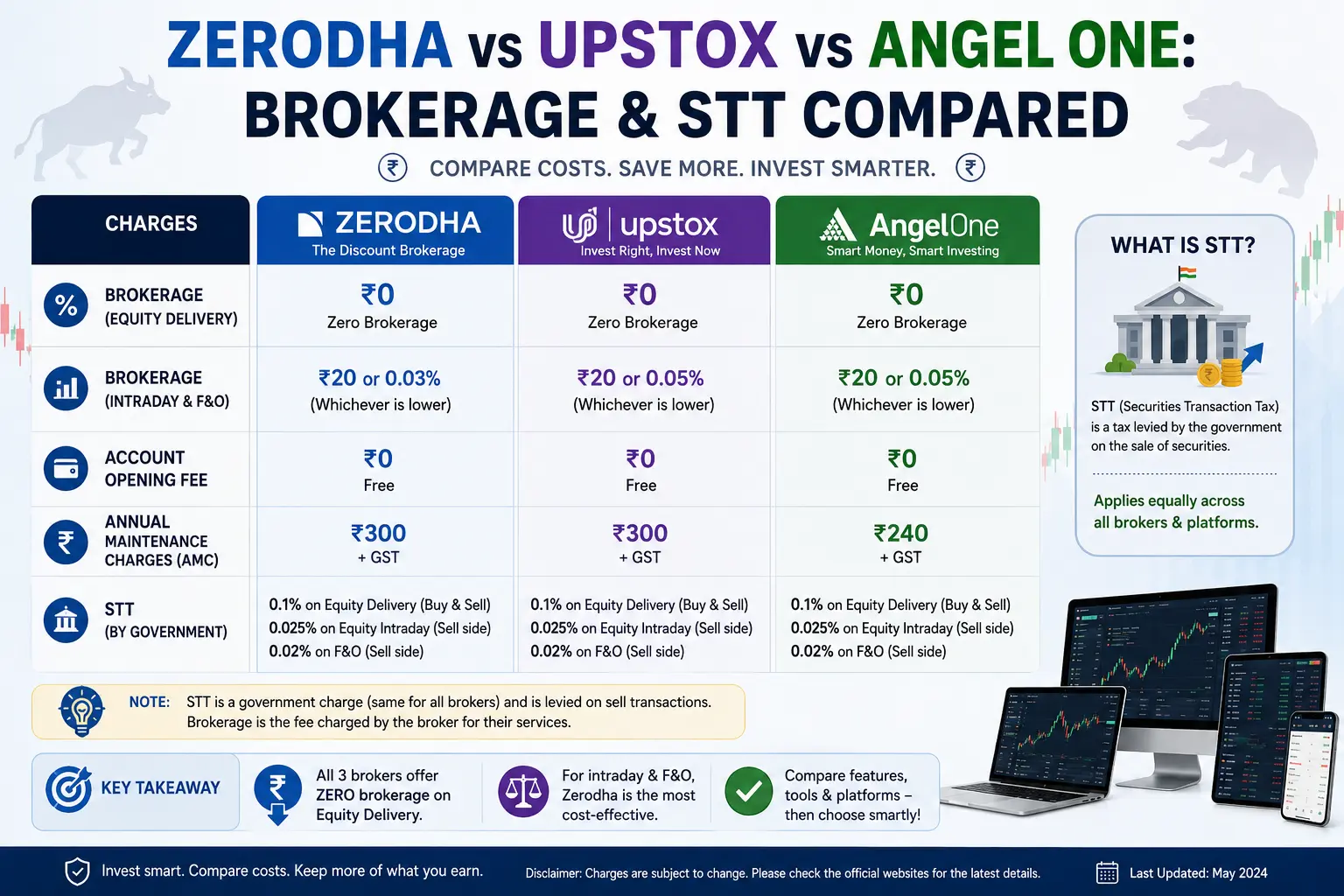
Zerodha, Upstox and Angel One dominate Indian retail discount broking — and their pricing pages look nearly identical: ₹0 delivery, ₹20-capped intraday and F&O. The real differences hide in the fine print: what exactly that ₹20 caps, the platforms you trade on, margin facilities, and the statutory stack (STT, exchange charges, DP fees) that no broker controls but every broker bills. Here is the honest comparison, with a ₹1 lakh trade costed on each.
Headline brokerage rates (2026)
| Trade type | Zerodha | Upstox | Angel One |
|---|---|---|---|
| Equity delivery | ₹0 | ₹0 | ₹0 |
| Intraday equity | ₹20 or 0.03% (lower) | ₹20 or 0.05% (lower) | ₹20 flat (or 0.25%) |
| F&O futures | ₹20 or 0.03% | ₹20 or 0.05% | ₹20 |
| Options | ₹20 per order | ₹20 per order | ₹20 per order |
| Account opening (equity) | ₹200 + ₹100 MCX opt. | ₹0 (equity); ₹150+ F&O opt. | ₹0 |
| AMC (annual) | ₹0 (₹75 opt. consol. ledger) | ₹0 (₹150+ for pro platforms opt.) | ₹0 (₹240 demat opt. tiers) |
Plans are revised periodically — treat this as the 2026 baseline and check the broker’s current schedule. The deeper question is total cost of a trade, which the table below answers.
₹1 lakh intraday round trip: the all-in cost
| Charge | Amount (same at all three) |
|---|---|
| Brokerage (0.03% × 2 legs, under ₹20 cap) | ₹60 |
| STT (0.025% sell side) | ₹25 |
| Exchange txn (NSE ~0.00345% × 2) | ₹7 |
| SEBI turnover fee | ₹0.10 |
| Stamp duty (buy side 0.003%) | ₹3 |
| GST 18% (brokerage + txn + SEBI) | ₹12 |
| Total round trip | ≈ ₹107 |
The shock for most traders: on typical trades, 60–90% of all-in cost is statutory — identical across brokers. Broker choice changes ₹10–30 per trade, not hundreds. Run your exact trade size and segment in the Brokerage Calculator (it models Zerodha-style pricing plus the full statutory stack).
Where the brokers genuinely differ
- Platforms: Zerodha’s Kite is the industry benchmark (and Coin for direct funds); Upstox Pro is fast and lightweight; Angel One’s app bundles research and ArQ recommendations. Your 100th trade’s cost is habit — pick the platform you will actually enjoy.
- Margin and leverage: all follow SEBI peak-margin rules, but intraday leverage product terms (MTF interest on delivery, roughly 0.03–0.05%/day) differ — relevant only if you carry leveraged positions.
- Direct mutual funds: Zerodha Coin (₹0 commission direct plans), Upstox and Angel One also offer direct MFs — compare expense-ratio impact with the expense ratio guide.
- Options trading: all three at ₹20/order — for high-frequency option sellers, ₹20 vs ₹20 is a wash; platform speed and option-chain tools decide.
- Support and uptime: discount broking’s weak spot at peak-market hours for all three; check recent user reports before deciding.
Who should pick which
- Zerodha — the default for most: biggest user base, mature ecosystem (Kite, Coin, Sentinel, Console), ₹0 AMC. The 0.03% intraday rate is the cheapest of the three on large trades under the cap.
- Upstox — strong mobile-first experience and quick onboarding; effectively matched pricing; good if the app is your primary screen.
- Angel One — best if you want a full-service flavour (research calls, ArQ advisory) at discount-broker prices; watch the add-on subscription tiers.
The charges you pay regardless of broker
STT (0.1% each side delivery, 0.025% intraday sell, 0.0625% options sell premium), exchange transaction charges, SEBI fees, stamp duty and 18% GST on brokerage — plus DP charges of about ₹15.93 per scrip per day on delivery sells and annual demat AMC where applicable. These are the floor; no promo code removes them. Model the complete stack before comparing any "₹0 brokerage" advertisement.