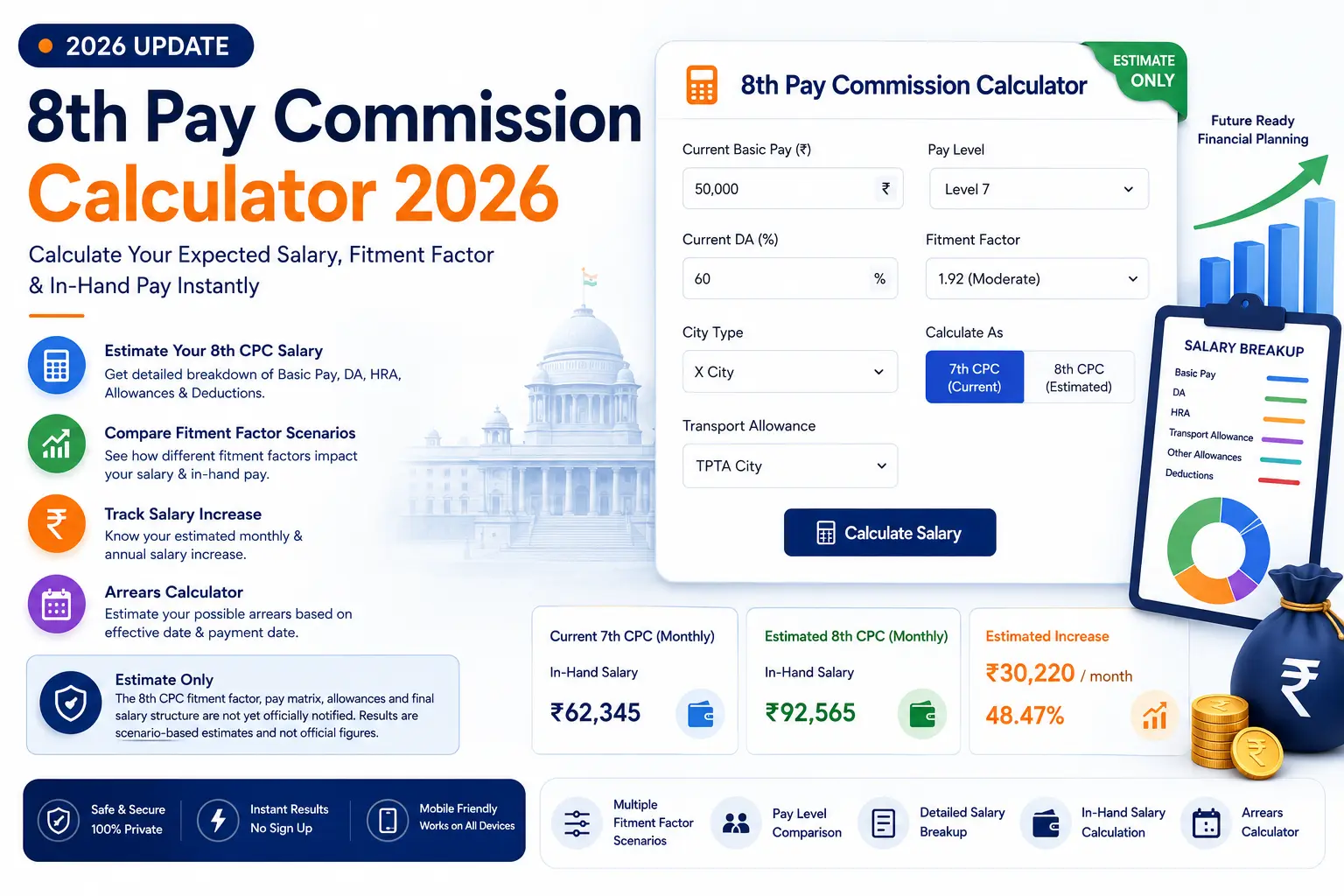
Bottom line first: the 8th Central Pay Commission has not been formed yet. Any salary figures you see online are estimates based on projected fitment factors. The 7th CPC (effective January 2016) used a fitment factor of 2.57. Analysts project the 8th CPC factor between 1.82 and 2.86. Your actual salary increase will depend on the final government notification.
What is the 8th Pay Commission?
Central Pay Commissions are constituted by the Government of India approximately every 10 years to review and recommend pay structures, allowances, and benefits for central government employees, armed forces personnel, and pensioners.
Here's a quick timeline:
- 6th CPC (Pay Commission): Effective January 1, 1997
- 7th CPC: Effective January 1, 2016 — currently in force
- 8th CPC: Not yet formed — expected around 2026
The 7th CPC introduced 18 pay levels (replacing the old grade pay system), a fitment factor of 2.57, and revised HRA and transport allowance structures. The 8th CPC is expected to follow a similar framework with updated fitment factors and allowance rates.
Current Status as of 2026
As of this writing, the Government of India has not announced the formation of the 8th Pay Commission. However, given that the 7th CPC has been in effect for over a decade, discussions and preparations are expected to intensify.
Key points to understand:
- The 8th CPC, if formed, may be retrospective — meaning it could be effective from an earlier date (potentially January 2026 or July 2026) even if implemented later.
- Retrospective implementation means employees would receive arrears — the accumulated salary difference between the old and new pay structures for all months between the effective date and the implementation date.
- State governments may follow the central recommendation independently or form their own state pay commissions.
The Fitment Factor Explained
The fitment factor is the single most important number in any Pay Commission. It is the multiplier applied to your current basic pay (plus dearness allowance) to arrive at your revised basic pay under the new structure.
Under the 7th CPC, the fitment factor was 2.57. This means if your 6th CPC basic + DA was ₹10,000, your 7th CPC basic became ₹25,700.
Projected 8th CPC Fitment Factor Scenarios
Since no official factor exists, here are the most commonly discussed scenarios among analysts and employee unions:
| Fitment Factor | Scenario | Description |
|---|---|---|
| 1.82× | Conservative | Minimum projected increase — accounts for DA already absorbed in current pay |
| 1.92× | Moderate | Moderate increase balancing fiscal constraints |
| 2.08× | Higher | More aggressive projection used by several analyst groups |
| 2.28× | Staff-side | Aligned with central trade union demands |
| 2.57× | 7th CPC Reference | Same multiplier as the 7th CPC — a benchmark for comparison |
| 2.86× | High | Maximum projected — unlikely but possible |
Why is the projected 8th CPC factor lower than 2.57? Because the Dearness Allowance (DA) has already increased your effective pay significantly since 2016. The 7th CPC started with a DA of 0%, and DA has been rising since then. The 8th CPC factor is applied on top of the current basic + DA, so a lower factor still results in a meaningful increase.
Salary Calculation Formula
Here's the complete estimation framework:
Step 2: Revised Basic = (Basic + DA) × Fitment Factor
Step 3: Revised HRA = Revised Basic × HRA Rate (City X: 20%, Y: 12%, Z: 8%)
Step 4: Revised Gross = Revised Basic + Revised HRA + TA + Other Allowances
Step 5: Revised In-Hand = Revised Gross − Deductions (NPS, CGHS, Tax, etc.)
Worked Example: Pay Level 7 (₹44,900 Basic)
Let's walk through a concrete example for a central government employee at Pay Level 7:
- Current Basic Pay: ₹44,900
- Current DA: 50% = ₹22,450
- Basic + DA: ₹67,350
- City Type: Y (12% HRA)
Current 7th CPC Salary (Monthly)
| Component | Amount |
|---|---|
| Basic Pay | ₹44,900 |
| Dearness Allowance (50%) | ₹22,450 |
| HRA (12% of Basic) | ₹5,388 |
| Transport Allowance | ₹3,600 |
| Gross Salary | ₹76,338 |
Estimated 8th CPC Salary — 2.08× Fitment Factor (Monthly)
| Component | Amount |
|---|---|
| Revised Basic (₹67,350 × 2.08) | ₹1,39,988 |
| Revised HRA (12% of Revised Basic) | ₹16,799 |
| Transport Allowance | ₹3,600 |
| Estimated Gross | ₹1,60,387 |
| Increase: ₹84,049/month (110.1%) | |
Salary Increase Across Fitment Factor Scenarios
For the same Pay Level 7 employee (₹44,900 basic, 50% DA, City Y), here's how the estimated gross salary changes across all scenarios:
| Fitment Factor | Scenario | Est. Revised Basic | Est. Gross | Increase |
|---|---|---|---|---|
| 1.82× | Conservative | ₹1,22,577 | ₹1,46,054 | +91.2% |
| 1.92× | Moderate | ₹1,29,312 | ₹1,52,689 | +100.0% |
| 2.08× | Higher | ₹1,39,988 | ₹1,60,387 | +110.1% |
| 2.28× | Staff-side | ₹1,53,558 | ₹1,71,020 | +124.0% |
| 2.57× | 7th CPC Ref. | ₹1,73,090 | ₹1,85,800 | +143.7% |
| 2.86× | High | ₹1,92,621 | ₹2,00,605 | +162.8% |
HRA Under the 8th CPC
House Rent Allowance is calculated as a percentage of basic pay based on the city type. Current rates are:
- City X (20%): Delhi, Mumbai, Kolkata, Chennai and metropolitan areas
- City Y (12%): Other cities and major towns
- City Z (8%): Smaller towns and rural areas
The 8th CPC may revise these percentages or introduce new city categories. Until an official notification is released, current rates are used for estimation.
For a detailed HRA calculation, use the HRA Exemption Calculator.
Estimated In-Hand Salary
Your actual take-home (in-hand) salary is the gross salary minus all deductions. Common deductions for central government employees include:
- NPS (National Pension System): 10% of basic + DA (employee contribution)
- CGHS: Central Government Health Scheme — fixed monthly contribution (₹150/₹500/₹1,250 depending on family size)
- CGEGIS: Central Government Employees Group Insurance Scheme
- Professional Tax: State-specific (applicable in some states)
- Income Tax: Based on applicable tax regime and slabs
To estimate your exact in-hand salary with deductions, use the 8th Pay Commission Calculator which lets you configure all deduction amounts.
Arrears Calculation
If the 8th CPC is implemented retrospectively, you'll receive arrears for the period between the effective date and the actual implementation date.
Example: If the 8th CPC is effective from July 2026 but implemented in April 2027 (9 months), and your monthly salary increases by ₹84,049:
Arrears = ₹84,049 × 9 = ₹7,56,441
This is a significant lump sum. Keep in mind:
- Arrears are typically taxable in the year of receipt
- Pensioner arrears may be calculated differently
- The actual effective date will be decided by the government
7th CPC vs 8th CPC: Key Differences to Watch
| Aspect | 7th CPC (Current) | 8th CPC (Expected) |
|---|---|---|
| Effective Date | January 1, 2016 | Not announced |
| Fitment Factor | 2.57× | Projected: 1.82× to 2.86× |
| Pay Levels | 18 levels | May be restructured |
| HRA | X: 20%, Y: 12%, Z: 8% | To be determined |
| DA Base | Started at 0% | May be reset or merged |
| Pension | Unrevised for most | Expected revision |
Pay Level Structure (7th CPC)
The 7th CPC introduced 18 pay levels. Here are the starting basic pay values:
| Pay Level | Starting Basic Pay | Typical Designation |
|---|---|---|
| Level 1 | ₹18,000 | Multi-tasking Staff |
| Level 2 | ₹19,900 | LDC/NA |
| Level 3 | ₹20,900 | SE/SA |
| Level 4 | ₹25,500 | Senior SE |
| Level 5 | ₹29,200 | Junior Scale Officer |
| Level 6 | ₹33,800 | Junior Scale (Higher) |
| Level 7 | ₹44,900 | Under Secretary / Section Officer |
| Level 8 | ₹47,600 | Deputy Secretary |
| Level 9 | ₹53,200 | Deputy Secretary (Higher) |
| Level 10 | ₹56,100 | Joint Secretary (Lower) |
| Level 11 | ₹67,000 | Joint Secretary |
| Level 12 | ₹78,500 | Additional Secretary |
| Level 13 | ₹1,07,600 | Secretary |
| Level 14 | ₹1,20,000 | Special Secretary |
| Level 15 | ₹1,43,500 | Additional Chief Secretary |
| Level 16 | ₹1,82,200 | Chief Secretary |
| Level 17 | ₹2,05,400 | Cabinet Secretary (Lower) |
| Level 18 | ₹2,50,000 | Cabinet Secretary |
Related Calculators
Use these calculators to plan your finances alongside the 8th CPC estimation:
- 8th Pay Commission Calculator — Interactive salary estimation with all fitment factor scenarios
- Income Tax Calculator — Compare old vs new tax regime
- Take-Home Pay Calculator — Net salary after deductions
- NPS Calculator — Project your NPS retirement corpus
- HRA Calculator — Section 10(13A) exemption
- EPF Calculator — Provident Fund retirement corpus
- EMI Calculator — Loan installment planning
- Home Loan Eligibility — Estimate your loan eligibility
Sources & Further Reading
- 8th Pay Commission Official Portal (8cpc.gov.in) — for official notifications when available
- Department of Personnel & Training (DoPT) — government policy on pay and allowances
- PFRDA — Pension Fund Regulatory and Development Authority for NPS updates
Frequently Asked Questions
When will the 8th Pay Commission be implemented?
Pay Commissions are typically appointed every 10 years. The 7th CPC started in January 2016, so the 8th CPC could be effective from January 2026 or later. The exact effective date and implementation timeline will be announced by the Government of India. Some retroactive implementation (arrears) is common.
What is the fitment factor for the 8th CPC?
No official fitment factor has been announced. Analysts project a range between 1.82 and 2.86. The 7th CPC used 2.57. The actual factor will be decided by the government and the Pay Commission.
Will my pension increase under the 8th CPC?
Most central government pensioners' pensions were not revised under the 7th CPC (except those who retired before the 6th CPC). The 8th CPC is widely expected to address pension revision, but no official decision has been made. Pensioner arrears may also be calculated differently from serving employees.
Does the 8th CPC apply to state government employees?
The 8th Pay Commission applies to central government employees. State governments may form their own pay commissions or adopt central recommendations independently. Each state follows its own timeline and may have different fitment factors.
Will DA be merged with basic pay?
There are ongoing discussions about merging DA with basic pay under the 8th CPC. If DA is merged, the fitment factor calculation may change. This remains to be confirmed by the government.
How will income tax change with higher salary?
A higher salary may push you into a higher tax bracket. Use the Income Tax Calculator to estimate your tax liability under both old and new regimes with your projected 8th CPC salary.
Is this calculator official?
No. This is an independent estimation tool. The 8th Pay Commission has not been constituted and no official fitment factor, pay structure or allowance rates have been announced. Use this for scenario planning only and verify with official government sources when available.