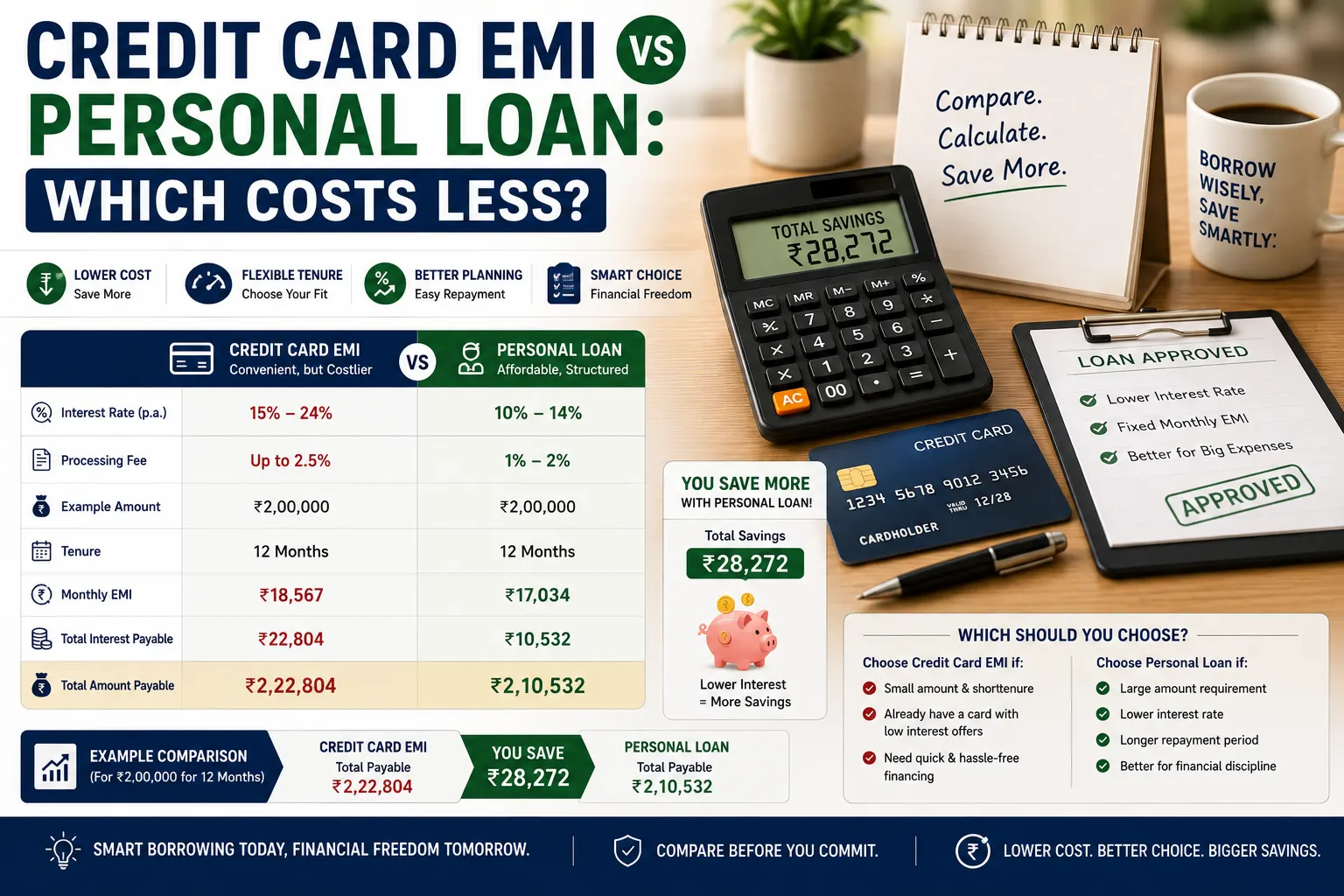
Big bill, empty wallet, two buttons: "Convert to EMI" on your credit card app, or a personal loan application. Card EMIs are instantly approved against your existing limit; personal loans take longer but price far lower for anyone with a decent credit score. This guide puts exact rupee numbers on the choice — including the GST trap nobody advertises.
What each option really costs in 2026
| Feature | Credit card EMI | Personal loan |
|---|---|---|
| Typical rate (flat/reducing) | 12–24% p.a. (often quoted flat) | 10.5–18% p.a. reducing |
| Processing fee | 0–3% + GST | 1–2.5% + GST |
| Tenure | 3 – 24 months | 12 – 60 months |
| Approval | Instant (within limit) | Hours–2 days (CIBIL + income) |
| Foreclosure | Penalty 3–5% of balance; GST applies | 2–5% or nil (some lenders) |
| Credit limit impact | Blocks/blocks part of card limit | None on card |
| GST on interest | 18% on interest + fee | 18% on processing fee only (no GST on interest) |
That last row matters more than the headline rate: GST at 18% applies to credit-card EMI interest every month (card EMIs are a "service"), while personal-loan interest carries no GST. On a long EMI this quietly adds 2–3 percentage points to the card’s effective cost.
₹1 lakh, 12 months: the exact comparison
- Credit card EMI at 16% flat: flat-rate EMIs of ₹9,000/month; total interest ₹16,000 + GST ₹2,880 + processing (₹1,000 + GST) ≈ ₹20,060 all-in cost. (16% flat ≈ 29% reducing-balance equivalent!)
- Personal loan at 12% reducing: EMI ₹8,885; total interest ₹6,619 + processing (₹1,000 + GST ₹180) ≈ ₹7,799 all-in.
The personal loan is cheaper by roughly ₹12,000 on a single ₹1 lakh, 12-month borrow — the flat-vs-reducing quoting convention does most of the damage. Always convert a card EMI’s flat rate to reducing (roughly ×1.8) before comparing. Our Credit Card Payoff Calculator and Personal Loan Calculator both show reducing-balance maths.
When the card EMI still wins
- Small ticket, short tenure — ₹15,000–50,000 over 3–6 months: fee+GST overhead on a personal loan erases its rate advantage.
- 0% no-cost EMI on retail (mobiles, appliances): genuinely cheap — but check the "processing" fee and the interest component the merchant folds into MRP, and never let the purchase sit on revolving credit afterwards.
- Speed — money needed today; a card EMI cannot be beaten by any underwriting process.
- Credit file friction — a new loan account adds a hard enquiry; a card EMI does not open a new account.
When the personal loan clearly wins
- ₹1 lakh+ or 12 months+ — the rate gap compounds; differences reach ₹20,000–50,000 on multi-lakh, multi-year borrows.
- You plan to prepay — personal-loan foreclosure is often cheaper than card-EMI foreclosure penalties.
- Your card limit is thin — a big EMI maxes the card, kills your utilisation ratio and drags your CIBIL score precisely when you need it.
The option to refuse: revolving credit
The real comparison is never card-EMI vs loan — it is either vs letting the balance revolve at 36–42% with the grace period gone. If the choice is EMI-or-revolve, take the EMI without hesitation; then read why the minimum payment trap costs lakhs and build the exit with the Debt Payoff Planner.