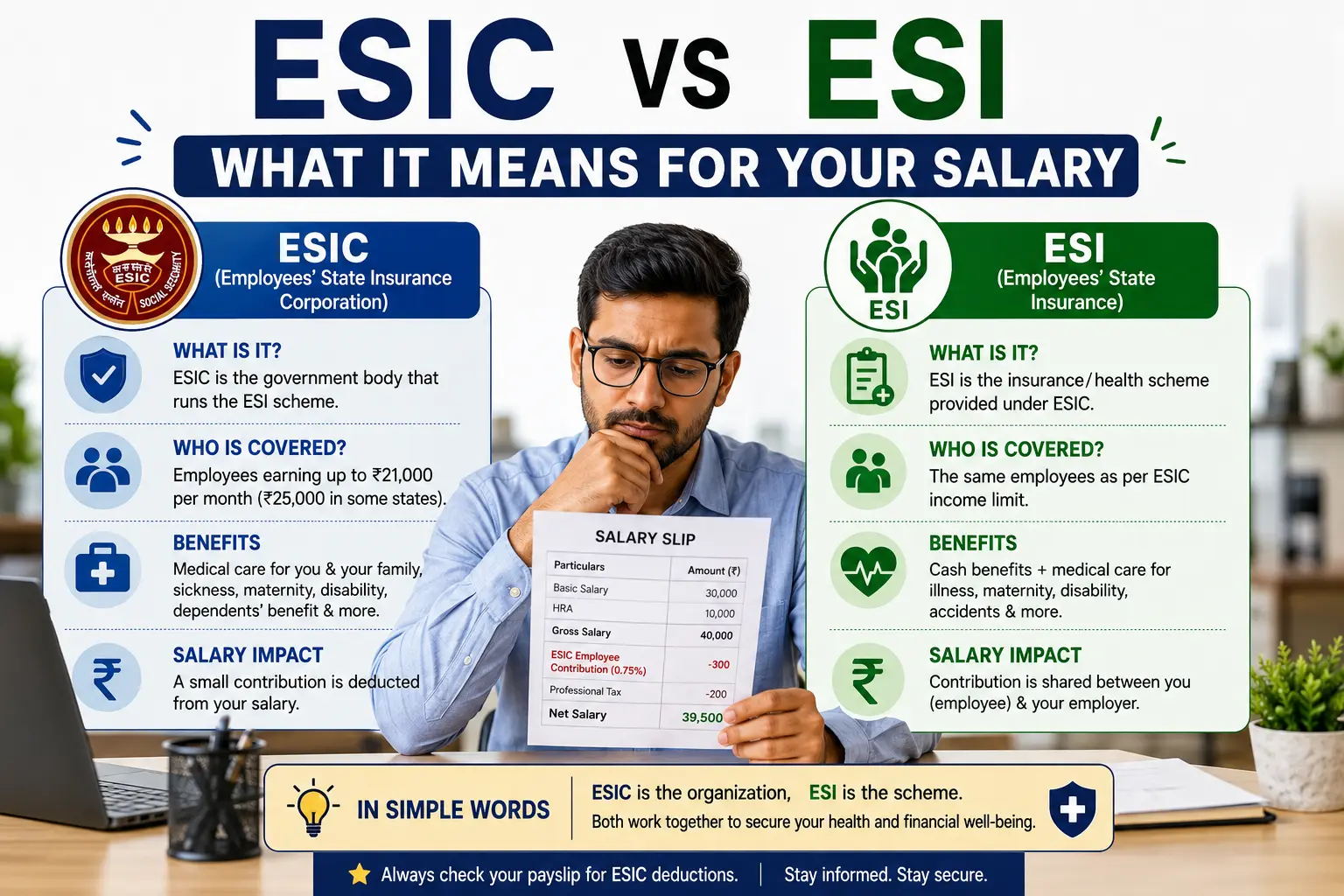
Your payslip shows "ESI ₹135" and the offer letter never explained it. Quick answer: ESI (Employees’ State Insurance) is the social-security scheme; ESIC (ESI Corporation) is the government body that administers it. If your gross wage is ₹21,000/month or less, 0.75% of your wage is deducted, your employer adds 3.25%, and you gain medical cover for your whole family plus cash benefits when you cannot work. Here is the complete picture.
The numbers: who pays what
| Component | Rate | Who pays |
|---|---|---|
| ESI employee share | 0.75% of gross wages | You (deducted from salary) |
| ESI employer share | 3.25% of gross wages | Employer |
| Total contribution | 4.00% | — |
Coverage threshold: gross wages up to ₹21,000/month (₹25,000 for persons with disability). Not a cap on contribution — once covered, the 4% applies to your actual wages for the whole contribution period. Compute your exact deduction in the ESI Contribution Calculator.
What the 4% actually buys
- Full medical care for you, your spouse and children — at ESIC hospitals, dispensaries and empanelled private hospitals: consultations, medicines, diagnostics, hospitalisation. No co-pay, no sum-insured ceiling for enrolled beneficiaries.
- Sickness benefit: ~70% of wages for up to 91 days a year when medically certified unfit.
- Maternity benefit: 100% of wages for 26 weeks — often better than what private maternity cover pays.
- Disablement benefit: ~90% of wages if injured at work, for as long as the disablement lasts.
- Dependants’ benefit: ~60% of wages to family if death occurs due to employment injury.
For a ₹18,000 wage, the employee’s ₹135/month buys family medical cover that would cost ₹1,500–3,000/month on the open market — which is why ESI is genuinely good value, not just a deduction.
Contribution periods and the "why am I still paying?" question
ESI runs in two six-month contribution periods: April–September and October–March, with benefits flowing in the following benefit periods. The practical consequence: if your wage crosses ₹21,000 during a contribution period, you remain covered (and contribute) until that period ends. If you join above ₹21,000, you are simply not covered — no deduction, no benefits.
ESI vs EPF — the payroll pair everyone confuses
| ESI | EPF | |
|---|---|---|
| Purpose | Health + income security | Retirement savings |
| Your contribution | 0.75% of gross | 12% of basic + DA |
| Employer adds | 3.25% | 12% (of which 8.33% to pension) |
| Wage ceiling | ₹21,000 gross/month | ₹15,000 for mandatory (statutory wage ceiling) — most employers enrol above |
| You get money back? | No — it funds benefits | Yes — accumulates in your account with interest |
Both can apply to the same employee; they solve different problems. Estimate your PF accumulation with the EPF Calculator, and pair ESI context with the gratuity formula to understand the full payroll stack.
Using your ESI benefits in practice
- Your employer registers you; you receive an ESIC e-Pehchan card (IP card) after biometric enrolment.
- Locate your nearest ESIC dispensary/hospital at esic.gov.in — that becomes your family’s primary care point while covered.
- Cash benefits (sickness/maternity/disablement) are credited to your registered bank account.
- On leaving the job, medical cover continues for a limited period per ESIC rules; accumulated benefits end — one more reason to keep personal health insurance beyond employer schemes.