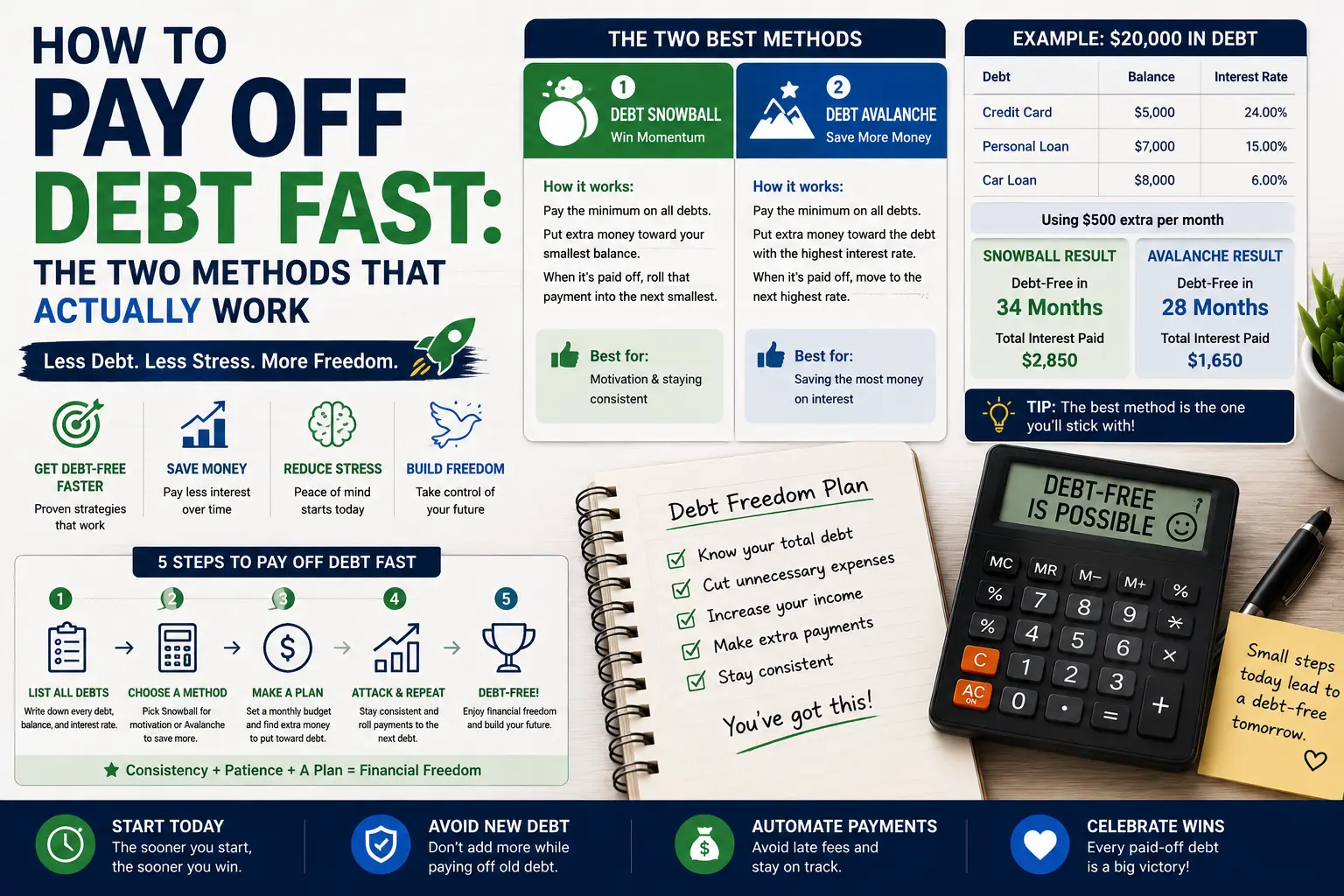
Debt freedom is not about finding more money — it is about aiming the money you already have. Minimum payments are designed to maximize the lender's interest, not your progress. Flip the objective: pick one target balance, throw every spare dollar at it, and let the structure do what minimums never will.
Why minimum payments barely work
An $8,000 credit card at 24% APR with a 2.5%-of-balance minimum starts at $200/month. Pay only that sliding minimum and the schedule looks like this:
- Time to pay off: 25+ years
- Total interest: ~$11,400 — more than the original balance
- Month 1 split: $200 in, $160 to interest, $40 to principal
Now fix the payment at $200 forever — never letting it slide down with the balance — and the same debt clears in ~5.5 years with ~$4,900 of interest. Same money as month one. That one decision is worth more than $6,500. Check your own balances in the debt payoff calculator.
Avalanche: the mathematically optimal order
List every debt by interest rate, highest first. Pay minimums on all, and aim every extra dollar at the top rate until it dies — then roll its full payment into the next one. This minimizes total interest because the most expensive balance shrinks first.
Snowball: the psychologically sustainable order
Same structure, different sort: smallest balance first, regardless of rate. The point is early closure. Behavioral research consistently finds that the win of deleting an account — watching one minimum disappear from your life — keeps more people on the plan long enough to finish.
Both methods on one real stack
| Debt | Balance | APR | Minimum |
|---|---|---|---|
| Store card | $900 | 29% | $27 |
| Credit card | $5,000 | 22% | $150 |
| Personal loan | $18,000 | 11% | $391 |
With $750/month available ($568 minimums + $182 extra):
- Avalanche order: store card → credit card → personal loan. Debt-free in ~40 months, total interest ≈ $5,900.
- Snowball order: with this particular stack, identical order — the smallest balance is also the highest APR (common in real life, where store cards are both).
- Minimums only: the personal loan alone takes ~60 months, and the credit card outlives a decade — total interest easily doubles.
When the orders differ — say a $400 medical bill at 0% versus a $5,000 card at 22% — snowball spends a little more interest to buy an early, motivating zero. On large stacks the premium is usually a few hundred dollars; consider it the fee for finishing.
Accelerators ranked by real impact
- A fixed extra amount every month. Even $50–$100 pointed at the target balance routinely cuts years off card debt. Automate it so the decision is made once.
- Rate reduction. A 0% balance transfer, a lower-APR consolidation loan, or simply calling the issuer to request an APR cut — each dollar of rate saved is a dollar that no longer compounds against you.
- Windfalls to principal. Tax refunds, bonuses, and selling unused items: one-time principal kills future interest permanently. $1,500 onto a 22% card is roughly $330/year of interest that never happens again.
- Biweekly half-payments on installment loans. 26 half-payments = 13 full payments a year. On a 60-month personal loan this quietly sheds months.
Guardrails while you attack
- Keep a $1,000 starter emergency fund even before aggressive payoff, or the next car repair goes back on the card you just cleared.
- Freeze, don't close, cleared credit cards — closing shrinks available credit and can dent your score right when the payoff should be lifting it.
- Track one number: months to zero. Balances wobble with interest; the payoff date is the metric that shows the plan working.
Need the interest math behind any single loan? How to calculate loan interest covers the amortization formula, and the interest calculator does the arithmetic. For an India-specific framing with credit cards and personal loans, see snowball vs avalanche in India.