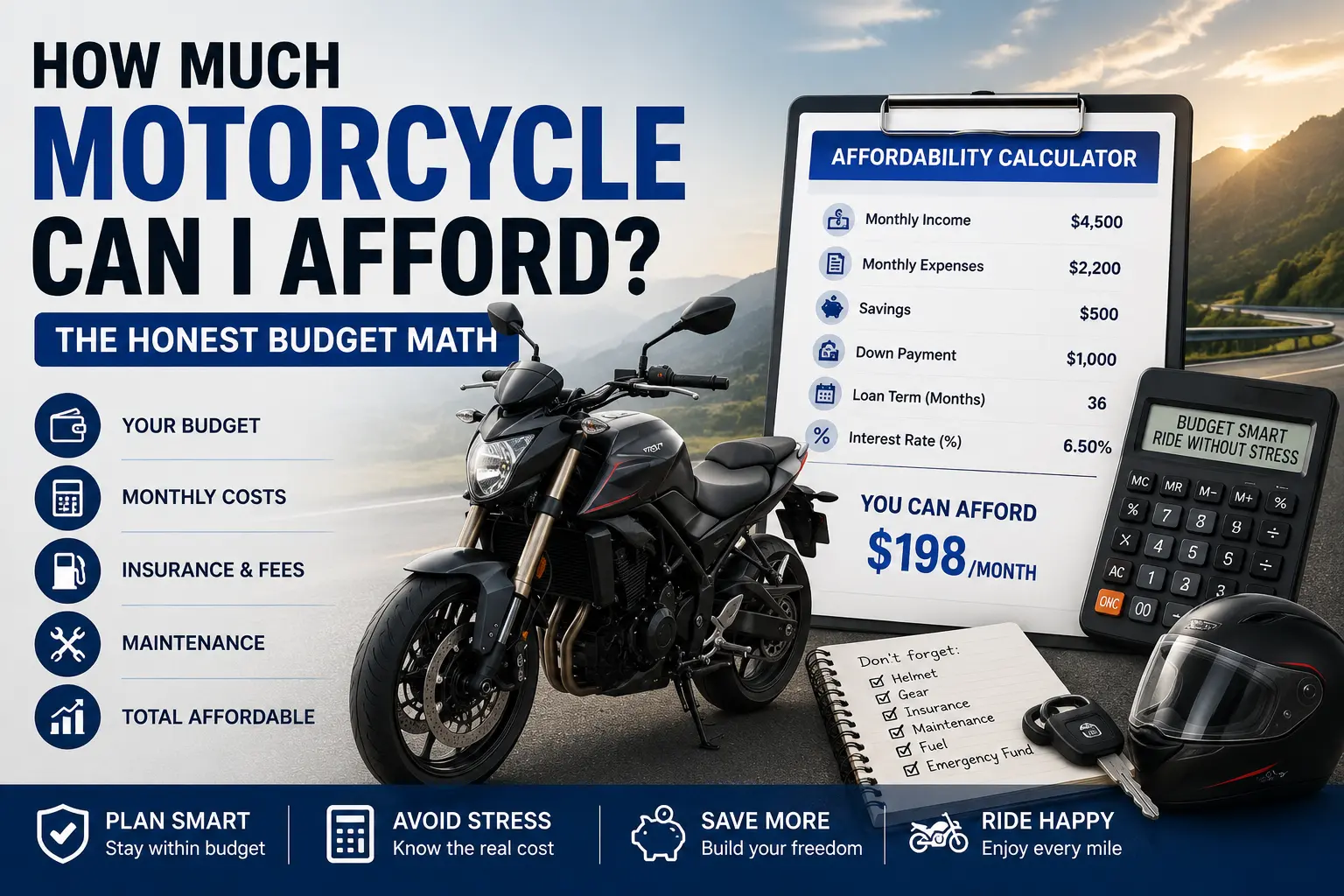
Motorcycles break the normal vehicle-budget rules. The price tag looks friendly — a new middleweight runs $8,000–$14,000 — but the ownership stack is front-loaded: gear, insurance groups that punish displacement, and maintenance intervals measured in thousands of miles, not tens of thousands. Affordability has to be measured all-in, not by the loan payment alone.
The 10/20 rule for bikes
Two numbers keep a motorcycle from eating your budget:
- Payment ≤ 5% of gross monthly income, and all-in riding cost ≤ 10%. All-in means payment + insurance + a monthly set-aside for tires, chain kits and gear replacement.
- 20% down minimum. Bikes depreciate 20–30% in year one; a small down payment guarantees you owe more than the bike is worth within months.
Earning $5,000/month? Your ceiling is roughly a $250 payment and $500 all-in. That comfortably covers a $10,000 bike with $2,000 down — and anything bigger should wait until income catches up.
Worked example: a $12,000 motorcycle
- Price $12,000 + $250 registration/doc − $2,400 down (20%) = $9,850 financed
- APR 9.5% (typical used/new bike blend), 48 months → payment ≈ $247/month
- Total interest over the loan: ≈ $2,020
- Insurance (middleweight, age 30, full coverage): ≈ $110/month
- Gear + maintenance set-aside: ≈ $90/month
All-in: ≈ $447/month — nearly double the headline payment. Run it yourself with the motorcycle loan calculator before test-riding anything.
The insurance multiplier nobody quotes at the dealership
| Class | Typical monthly full-coverage premium* | Why |
|---|---|---|
| Scooter / 125–300cc commuter | $25–$70 | Low speeds, cheap parts, low theft |
| 300–650cc standard | $60–$140 | Moderate claim severity |
| Cruiser 800–1200cc | $90–$180 | Theft-target models, chrome parts |
| Supersport 600–1000cc | $220–$450 | Highest crash frequency + theft |
*Illustrative US ranges for a rider aged 25–35 with a clean record; your VIN, ZIP and age dominate the quote. Always price insurance before you fall in love with a model.
A supersport at $300/month insurance plus a $280 payment is a $580/month hobby — more than many car payments. The scooter loan calculator shows the flip side: smaller-displacement machines keep both numbers tiny.
New vs used: where bikes depreciate fastest
Motorcycles shed value faster than cars early on — commonly 20–30% in the first year and roughly 40% by year three for popular models. A one-year-old bike with 3,000 miles regularly sells 15–25% below MSRP, which both lowers the loan you need and lets you pay cash sooner. The exception: scarce or collectible models, which hold value but carry higher insurance anyway.
Financing traps specific to powersports
- Long promotional terms. 60–72 month bike loans are marketed hard because they shrink the payment; they also multiply interest on a toy that depreciates quickly.
- Add-on financing. Extended warranties, tire-and-wheel protection and "theft recovery" programs rolled into the loan can add $1,500+ at loan APR. Buy gear and coverage separately, in cash.
- Credit cards for gear. A $1,200 helmet-and-jacket purchase at 24% card APR doubles in three years of minimum payments. If the gear needs financing, the bike is too expensive.
Financing smaller gadgets raises similar trade-offs on a smaller scale — see should you finance a phone? for the 0% vs credit-card math. And for the underlying amortization mechanics behind any of these loans, read how loan interest is calculated.
A sane first-bike budget
Overwhelmingly, the pattern among riders who stay in the sport: first bike used, $3,000–$6,000, cash or a ≤36-month loan, gear bought separately, insurance quoted by VIN before purchase. Upgrade once skills — and income — have grown. The bike you can afford is the one whose total monthly footprint you never think about twice.